My google alert screamed this afternoon with a new hit for Immaculate Inning: this article by Gregg Found at ESPN, which mentions the 44th Immaculate Inning in Major League History. Congratulations to Rafael Soriano, the Tampa Bay Rays closer who effortlessly dispatched the Los Angeles Angels of Anaheim, California, USA, Earth by striking out the side on nine pitches last night. His victims were Erik Aybar, pinch hitter Mike Napoli, and Peter Bourjos.
Soriano was not the first one to throw an Immaculate Inning to end a game, which has happened eight times previously, though two ended complete games with Immaculate Innings (by Ron Guidry and Trevor Wilson). Closers, meanwhile, don't need to play the cat-and-mouse game of wasting pitches, and there is a high priority placed on not walking anyone. Therefore it makes a bit of sense that Soriano joins closers such as Jason Isringhausen by finishing off the game with nine straight strikes.
We honor the Immaculate Inning here because it serves as a type of dominance a pitcher can have over the batters in that inning, and along those lines, Soriano's feat stands out. The Rays' closer got seven swinging strikes (including one foul by Napoli) out of the nine strikes, and all three batters swung through the final pitch. Napoli's at bat was also interesting, as a pinch hitter he seemed predestined to swing-- missing wildly on breaking pitches for strikes one and three. For his part, he just missed a fastball right down the middle on Soriano's second pitch-- a few centimeters over and we're not talking about an Immaculate Inning.
Soriano picked up his league-leading 38th save for the effort, and the victory secured a tie in the AL East with the Yankees, meaning that this Immaculate Inning is one of the most "clutch" in the history of the feat, the first in nearly a year. Honestly, despite two perfect games, how could we call 2010 the Year of the Pitcher without at least one Immaculate Inning?
Finally, we'll have to agree with Found as he notes that an Immaculate Inning is "a feat with a cool-sounding moniker to match its impressiveness."
Showing posts with label Immaculate Inning. Show all posts
Showing posts with label Immaculate Inning. Show all posts
Tuesday, August 24, 2010


Monday, September 07, 2009
Congrats to Ross Ohlendorf(and belatedly to A.J. Burnett)
On Saturday, Ross Ohlendorf pitched an immaculate seventh inning against the Cardinals. You can watch it here. I'd have to defer to mehmattski on this, but I would bet that it's the first time that an Immaculate Inning has been throw where every strikeout was a dropped third strike.
On June 20th, AJ Burnett threw an immaculate inning of his own. You would think that a blog written by a Yankees fan and a Marlins fan who also follows Former Marlins, would've noticed when a Former Marlin throws an Immaculate Inning for the Yankees, against the Marlins. To our 6 readers and AJ Burnett, we wholeheartedly apologize for not posting about it when it happened.
On June 20th, AJ Burnett threw an immaculate inning of his own. You would think that a blog written by a Yankees fan and a Marlins fan who also follows Former Marlins, would've noticed when a Former Marlin throws an Immaculate Inning for the Yankees, against the Marlins. To our 6 readers and AJ Burnett, we wholeheartedly apologize for not posting about it when it happened.
Labels:
baseball,
cookie,
Immaculate Inning

Tuesday, April 28, 2009
Immaculate Inning: Daniel Bard
We at Immaculate Inning take a lot of pride in chronicling the rare feat which gives our blog its name; that is, striking out three batters in an inning using just nine pitches. It has only happened 41 times in major league history, but unfortunately we have no idea how common the feat is at the minor leagues. A few years ago it came to our attention that Chris Mason twirled an Immaculate Inning in a AA game. The immaculate inning fires take a while to get stroked with these minor league games, but we are proud to recount the feat of Red Sox prospect Daniel Bard. Major hat-tip to the Projo Sox Blog for bringing the performance to my attention.
Daniel Bard is a 23-year old righthander pitching for the Pawtucket Sox in AAA. He finished last season at AA, retiring 20 of his final 23 batters; that domination has continued into this season, as he sports a 1.69 ERA and has struck out 18 in 10.3 innings. One of those innings, and three of those strikeouts, came against the Rochester Red Wings on April 22. Some video of the immaculate inning can be found here.
The batters were Jason Pridie, Matt Tolbert, and Luke Hughes, the first three batters in the Rochester order. All of them are career minor leaguers, although the 23 year old Hughes appears to be a legit prospect. Pridie appears to go down swinging on three straight fastballs right down the pipe. Tolbert follows the advice of a nearby heckler ("swing!") and misses at three more fastballs from Bard. Some kind of offspeed pitch (curveball) is taken for a strike by Hughes before he swings way late on two fastballs, the second around his eyes. Bard, meanwhile, looks to be rather bored with AAA pitching, and should expect a call up to the majors sometime this season. Regardless of his future, Bard has solidified a place in history with his immaculate inning, and we offer him the highest congratulations!
Daniel Bard is a 23-year old righthander pitching for the Pawtucket Sox in AAA. He finished last season at AA, retiring 20 of his final 23 batters; that domination has continued into this season, as he sports a 1.69 ERA and has struck out 18 in 10.3 innings. One of those innings, and three of those strikeouts, came against the Rochester Red Wings on April 22. Some video of the immaculate inning can be found here.
The batters were Jason Pridie, Matt Tolbert, and Luke Hughes, the first three batters in the Rochester order. All of them are career minor leaguers, although the 23 year old Hughes appears to be a legit prospect. Pridie appears to go down swinging on three straight fastballs right down the pipe. Tolbert follows the advice of a nearby heckler ("swing!") and misses at three more fastballs from Bard. Some kind of offspeed pitch (curveball) is taken for a strike by Hughes before he swings way late on two fastballs, the second around his eyes. Bard, meanwhile, looks to be rather bored with AAA pitching, and should expect a call up to the majors sometime this season. Regardless of his future, Bard has solidified a place in history with his immaculate inning, and we offer him the highest congratulations!
Labels:
Immaculate Inning
Thursday, August 21, 2008
Immaculate Inning: Pat Ragan
"Ragan, by the way, had made something of a record in the previous inning, by striking out three men in succession on nine pitched balls. Ragan called the crowd's attention to his performance as he went along by taking off his hat and bowing after he pitched each strike. He didn't have much to bow for though, when the ninth inning was finished." -- New York Times, October 6, 1914

Of all the Immaculate Innings that have occurred since 1889, few of them could match the circus-like atmosphere surrounding the performance of Brooklyn's Don Carlos Patrick Ragan. It was the ninth inning of the final game of the season, and the team then alternatively known as the Superbas and Robins capped a mediocre season with a pair of lopsided losses. The first place Boston Braves were in town and dominated Brooklyn in the first game, 15-2 (in a sign of the speed of baseball at the time, the game took just one hour and four minutes). In the second game, Brooklyn pitchers kept the Braves' offense mostly check through the first seven innings, but the home team was still losing 4-1 when Ragan took the mound for the eighth. The antics are certainly legendary, and because I've read Rob Neyer's Big Book of Baseball Legends, normally I would not expect one isolated account to stand as fact. However, the Boston Globe's account of the game goes into hilarious detail (see a scan of the excerpt here):
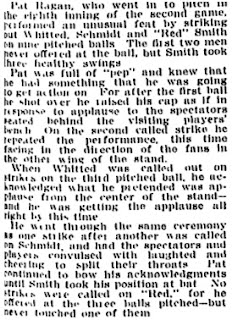
Pat Ragan, who went into pitch the eighth inning of the second game, performed an unusual feat by striking out Whitted, Schmidt, and "Red" Smith, on nine pitched balls. The first two men never offered at the ball, but Smith took three healthy swings.Read the full article here (for $4.95).
Pat was full of "pep" and knew that he had something that he was going to get action on. For after the first ball he shot over he tossed his cap as if response to applause to the spectators seated behind the visting players' bench. On the second called strike he repeated the performance, this time facing in the direction of the fans in the other wing of the stand.
When Whitted was called out on strikes on the third pitched ball, he acknowledged what he pretended was applause from the center of the stand-- and he was getting applause all right by this time.
He went through the same cerempny as one strike after another was called on Schmidt, and had the spectators and players convulsed with laughter and cheering to split their throats. Pat continued to bow his acknowledgements until Smith took his position at bat. No strikes were called on Red, for he offered at the three balls pitched-- but never touched one of them.
Ragan's victims were: Possum Whitted (I bet there's a great story behind that nickname...), Butch Schmidt, and Red Smith. Possibly inspired by Ragan's strikeouts and accompaning theatrics, Brooklyn rallied four runs across in the bottom of the eighth, anchored by a double down the line, called fair despite appearing to be more than a foot foul. However, the Times was right about Ragan not having much to bow for in the ninth; the Braves enacted sweet revenge on the showboating Ragan. The man named Possum delivered the death blow, grand slam that broke a tie game and eventually gave the Braves a 9-5 win.
Surely, if Around the Horn and PTI and Deadspin and other rabble rousers were around in 1914, there would be hell to pay for Ragan. Given the rending of garments about Joba Chamberlain's fist pumps and Manny Ramirez's crowd high-fives, a pitcher who gestures to the crowd after every pitch in a meaningless late-season game would probably make Skip Bayless' head explode (especially since he then blew the game!). Still, I find it a bit sad that Rich Harden and Felix Hernandez didn't do the same during their Immaculate Innings this season.
Ragan's Immaculate Inning came exactly two years after he pitched the final game in Washington Park for Brooklyn, who crossed the street to Ebbet's Field the following year. According to the Times, "Ragon [sp]... wasn't half bad in pinches, for out of a dozen raps the Giants were only able to harvest a single run." Strangely, the Times consistently spelled our hero's name as "Ragon" prior to 1914. They had it right following the 1913 season, when Ragan apparently considered a jump to the newborn Federal League, which was offering major contracts for the first time, in an attempt to challenge the NL-AL relationship. Unlike Ban Johnson a dozen years earlier, John T. Powers wasn't able to establish his league, and no serious challenge to the major leagues has happened since.
Ragan did eventually return to the Superbas, but only for the one season. Perhaps his antics on the mound in Boston on that immaculate day in 1914 was his way of saying a sarcastic goodbye to Brooklyn. Ragan pitched five games (only one start) for the Superbas in 1915 before being sent to the Boston team he'd dominated seven months earlier. I had some trouble tracking down the details of the transaction: on April 20, Ragan faced the Braves, while on May 7 the Times has Ragan pitching for the Braves, against the Giants. Baseball Almanac records that Ragan was sold to the Braves on April 28, 1915. It turns out the New York Times coverage of the transaction is buried in an article about a college baseball game: "Manager George Stallings of the Boston Braves has refused to waive claim on pitcher Pat Ragan of Brooklyn, and the player has been ordered to report to the Boston Club." It was a waiver claim, and the Superbas had tried to send Ragan to Newark because the National League required a roster reduction to 21 players by April 29.
The New York Times, for its part, considered the move a big mistake for the Brooklyn team. Ragan would have his two best full seasons of his career in 1915 and 1916. The following year, a Times article had an amusing headline: "Ragan Jinx Fails to Daunt Giants: McGraw's Men Chase Don Carlos and His Hoodoo to Shower in Fourth." In 1918, shortly before a trade to the Giants, Ragan shut down the Brooklyn team now nicknamed "Robins," and the Time waxed poetic: "It has ever been the history of baseball in Brooklyn that those players who in due course of time have been graduated to another major league club have taken a keen delight in pummeling the team mates of their earlier days on the diamond. The rule was in no wise violated yesterday when there came forth to dominate the Dodger batsmen none other than Pat Ragan of the Braves."
Two weeks after that article, Ragan was sent back to New York, this time to the Giants, in exchange for a man you may have heard of: Jim Thorpe. The man who was later voted the greatest athlete of the first half of the twentieth century was winding down his baseball career, and had played only sporadically for the Giants in 1918. He was quite successful for the Braves following the trade, hitting .327/.360/.429 (OPS+ of 141) in 156 at bats. Ragan, meanwhile, saw his career slipping away as well; he played just seven games for the Giants before being sold to the White Sox, for whom he pitched just one inning. After several years in the minors, Ragan surfaced for three innings on the Phillies in 1923. He stayed on as a coach during the 1924 season and was quoted in the 2004 book The Fix is In regarding a betting scandal on the Giants in 1923. Ragan said that Jimmy O'Connell, the player who was accusing others of fixing games, was simply the butt of some jokes from the veterans. (National League comissioner Kenesaw Landis eventually found O'Connell guilty of throwing games and banned him from baseball for life.)
Unlike the previous two historic names associated with the Immaculate Inning, Ragan is a relative unknown; no books have been written about him, and his grave in Los Angeles bears simply "Professional Baseball Player." But in the Immaculate Inning hall of honor, he will be remembered for much more.
Labels:
Immaculate Inning
Sunday, August 10, 2008
Immaculate Inning: Rube Waddell
Thirteen years passed be tween the first recorded Immaculate Inning and July 1, 1902. Baseball had grown immensely in between, and the formation of the American League would forever change the dynamics of the sport. League president Bancroft Johnson had the audacity to place major league teams in traditionally National League cities such as Cleveland, Chicago, and Baltimore, and the National League powers finally began to recognize the threat to their monopoly. The league that would eventually be known as the "Junior Circuit" challenged the National League even in the rulebooks, including this 1902 season.
Until 1901, a ball hit out of play was considered dead; foul balls were not counted as strikes. Beginning in 1902, the National League took up this rule in earnest, giving the umpires discretion to call strikes on foul balls, except for the third strike. The American League refused to accept the rule, leading to increased offense in the AL in 1901 and 1902, but tried it on an experimental basis in 1903. After just one season, the American League leaders rejected the foul-strike rule on December 17, 1903. Two months later, at the famous "peace settlement" meetings that established the World Series, Ban Johnson relented on the foul-strike as part of the compromise.
Rube Waddell may have been one of the first beneficiaries of the foul-strike rule. His final two years in the NL, he finished second and fifth in strikeouts, respectively. Neither year did he throw more than 175 strikeouts, but surpassed that mark in each of the next six seasons, and led the league in strikeouts each time. His 349 strikeouts in 1904 was the record for a left-handed pitcher until Koufax eclipsed it in 1965. Waddel had earned his strikeout reputation well by the time he joined the American League; some credit Waddell almost singlehandedly for increasing ticket sales and proving that the AL was legitimate. The first game Waddell pitched for the Philadelphia Athletics was July 1, 1902.
That day, the A's were facing the Baltimore Orioles, who were led by player-manager John McGraw. The famous NY Giants manager had become fed up with the American League, particularly the decisions of the umpires-- McGraw liked to lean into the strike zone and get hit intentionally, and the AL umpires would not grant him first base. The conflict would eventually get McGraw suspended, and McGraw defected for the Giants, leaving the American League behind. Several of the Orioles players left soon after, and part of their final frustration may be the sense of pride lost at the left hand of Rube Waddell.
Connie Mack's new ace was brilliant on July 2, he struck out thirteen Orioles and allowed just two hits, both of whom were erased soon later. Yes, Waddell faced the minimum 27 batters, though his game was not techinically perfect. In the sixth inning, though, Waddel was Immaculate. Facing him were Billy Gilbert, Harry Howell, and Jack Cronin, who had all struck out in the third inning against Waddell. This time, they all struck out again, but on nine straight pitches. Three innings later, as Gilbert would lead off the ninth inning, and Waddell is said to have doffed his cap towards the crowd and annouced "You can all go home now, this game is over." So it was; Waddell struck out Gilbert, Howell, and Cronin for the third time that day, and the fans flooded the field and carried Waddell off on their shoulders. A few weeks later, the Philadelphia Inquirer had the following poem in tribute to that immaculate day:
The long and successful career of Rube Waddell came to a close when he contrated tuberculosis in 1913 after standing in a flooding icy river, stacking sandbags. The man who was born on Friday the 13th (October 1876) would die on April 1st, 1914. At his funeral, Connie Mack said "He was the greatest pitcher in the game... he may have failed us at times but to him, I and the other owners of the Athletics ball club, owe much."
Baseball does owe much of its popularity in the early 20th century to Waddell, and once again the history of baseball and the Immaculate Inning are twined together.
Until 1901, a ball hit out of play was considered dead; foul balls were not counted as strikes. Beginning in 1902, the National League took up this rule in earnest, giving the umpires discretion to call strikes on foul balls, except for the third strike. The American League refused to accept the rule, leading to increased offense in the AL in 1901 and 1902, but tried it on an experimental basis in 1903. After just one season, the American League leaders rejected the foul-strike rule on December 17, 1903. Two months later, at the famous "peace settlement" meetings that established the World Series, Ban Johnson relented on the foul-strike as part of the compromise.
Rube Waddell may have been one of the first beneficiaries of the foul-strike rule. His final two years in the NL, he finished second and fifth in strikeouts, respectively. Neither year did he throw more than 175 strikeouts, but surpassed that mark in each of the next six seasons, and led the league in strikeouts each time. His 349 strikeouts in 1904 was the record for a left-handed pitcher until Koufax eclipsed it in 1965. Waddel had earned his strikeout reputation well by the time he joined the American League; some credit Waddell almost singlehandedly for increasing ticket sales and proving that the AL was legitimate. The first game Waddell pitched for the Philadelphia Athletics was July 1, 1902.
That day, the A's were facing the Baltimore Orioles, who were led by player-manager John McGraw. The famous NY Giants manager had become fed up with the American League, particularly the decisions of the umpires-- McGraw liked to lean into the strike zone and get hit intentionally, and the AL umpires would not grant him first base. The conflict would eventually get McGraw suspended, and McGraw defected for the Giants, leaving the American League behind. Several of the Orioles players left soon after, and part of their final frustration may be the sense of pride lost at the left hand of Rube Waddell.
Connie Mack's new ace was brilliant on July 2, he struck out thirteen Orioles and allowed just two hits, both of whom were erased soon later. Yes, Waddell faced the minimum 27 batters, though his game was not techinically perfect. In the sixth inning, though, Waddel was Immaculate. Facing him were Billy Gilbert, Harry Howell, and Jack Cronin, who had all struck out in the third inning against Waddell. This time, they all struck out again, but on nine straight pitches. Three innings later, as Gilbert would lead off the ninth inning, and Waddell is said to have doffed his cap towards the crowd and annouced "You can all go home now, this game is over." So it was; Waddell struck out Gilbert, Howell, and Cronin for the third time that day, and the fans flooded the field and carried Waddell off on their shoulders. A few weeks later, the Philadelphia Inquirer had the following poem in tribute to that immaculate day:
Up to the bat the Orioles rose, his face was filled with gleeWaddell's immaculate inning, and the rest of his superb shutout, were the talk of baseball for many years. This was not new for the man that thousands of baseball fans flocked to see in the early days of the Deadball Era-- the A's led the American League (and all of baseball) with an attendance of 420,000 in 1902. During exhibitions, sometimes Waddell would direct his fielders to leave the playing area while he struck out each hitter with ease. But Waddel had a bit of a temper, once being suspended after attacking a fan who baited him, and later fighting a teammate over a straw hat. The A's eventually sold Waddell to the Browns, where he continued to draw tremendous crowds.
There're various brands of glee you've never seen before.
"Strike one," the umpire cried, "strike two" --
the umpire said "strike three."
But you've seldom seen those kinds of strikes before.
For when Reuben twirls the sphere
The Planets shrink in fear.
And the sinuous sea serpent
Its sorrow tries to drown.
Then the cyclone hides its head,
And the birds go right to bed
For there's doings on the Diamond when Reuben comes to town.
The long and successful career of Rube Waddell came to a close when he contrated tuberculosis in 1913 after standing in a flooding icy river, stacking sandbags. The man who was born on Friday the 13th (October 1876) would die on April 1st, 1914. At his funeral, Connie Mack said "He was the greatest pitcher in the game... he may have failed us at times but to him, I and the other owners of the Athletics ball club, owe much."
Baseball does owe much of its popularity in the early 20th century to Waddell, and once again the history of baseball and the Immaculate Inning are twined together.
Labels:
Immaculate Inning
Sunday, August 03, 2008
Immaculate Inning: John Clarkson
From the very beginning, this blog has been dedicated to the collection of knowledge associated with a very specific baseball feat. I'm speaking of course of the Immaculate Inning, that frame of domination achieved just 41 times in major league history. Since the inception of the blog, there have been three Immaculate Innings in the major leagues (and one chronicled in the minor leagues). It is also important to understand the achievement's history. With that in mind, I am starting a new series here at Immaculate Inning that chronicles the 38 men with this distinctive honor. First up: John Clarkson.
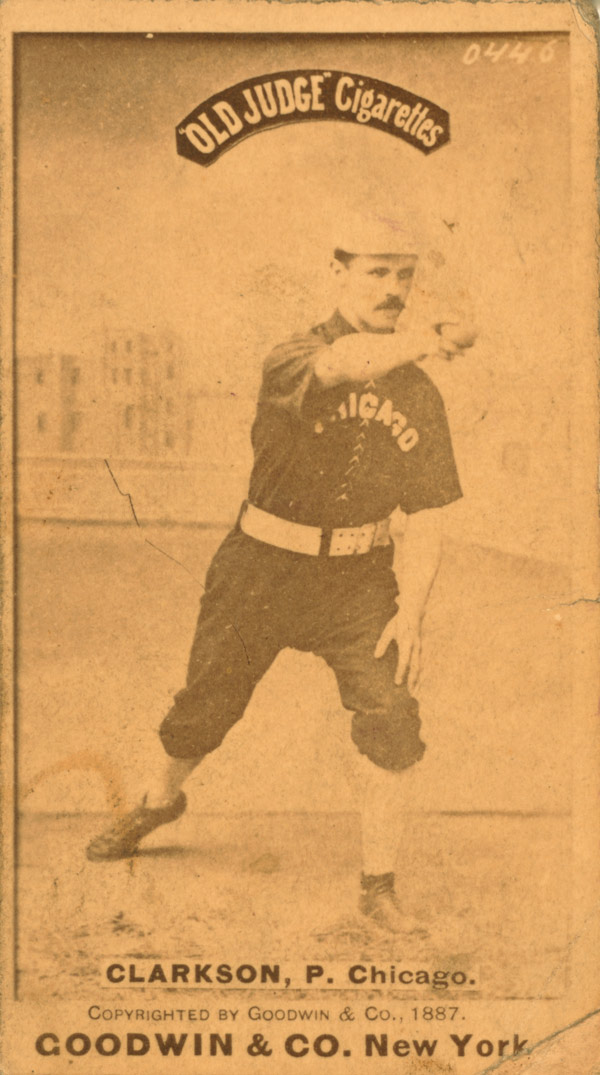
John Clarkson threw what is recorded as the first Immaculate Inning in major league history on June 4, 1889. Given the relative obscurity of nineteenth century baseball, it's amazing that we not only know it happened, but know a great deal about the man who twirled the historic inning for the Boston Beaneaters. On the other hand, it may be that the only reason we know about the immaculate inning is because John Clarkson tossed it. To many baseball historians, Clarkson was the first transcendent pitcher in baseball history, in a time when the position was still in its infancy.
Clarkson's wikipedia page is stocked with a ton of information about the man who retired with a record of 332-178, and was elected to the Hall of Fame in 1963. Clarkson was born in Cambridge, MA into a wealthy, educated, baseball family. Two of Clarkson's brothers, Arthur (who played as "Dad Clarkson") and Walter played in the National League; in addition, two cousins of Clarkson (brothers Mert and Walter Hackett) also spent time in the majors. But none was so accomplished as John.
John Clarkson started his career with the Worcester Ruby Legs in 1882 (at the age of 20), then spent a year in the minors before coming back with the Chicago Cubs. Clarkson pitched in Chicago for four years, tossing over 1700 innings. In the meantime, the rules for pitchers were in constant flux. As this profile of Clarkson notes, the number of balls that issued a walk changed four times during Clarkson's career- from seven in 1882 to six in 1884 to five in 1886 and four in 1889. In 1887, a strikeout took four strikes (the only season this rule was in effect). The pitching mound also evolved during this time, from a 4'x6' box 50 feet from home to a slightly raised 4'x7' box. Pitchers were required to pitch with one foot on the back line of the box from 1887-1893, when the rubber was finally introduced and the distance of 60 feet, 6 inches stayed put.
Most significantly, Clarkson was forbidden from throwing overhand until 1885; pitchers were required to throw underhand. Still, Clarkson adjusted well to the change, throwing 623 innings in 1885. In 1888, Clarkson was sold (for a then-outrageous sum of $10,000) to the Boston Beaneaters, and returned home to play for the next five and a half seasons. It was during Clarkson's most dominant season that his historic inning took place.
In 1889, Clarkson was the main pitcher for Boston, in a time where each team had a primary pitcher and a few backups. He would finish with 49 wins, a 2.73 ERA, and 284 strikeouts, winning the pitching Triple Crown- he also led the league in various other categories (including walks, as it was the first year of the four-balls-walk rule). On June 4, the Beaneaters took on the Philadelphia Quakers. The Baseball Almanac records that the immaculate inning occured in the fourth, but does not note which batters Clarkson faced that inning. One might imagine that Jim Fogarty was involved, as he finished tied for fourth in strikeouts in the National League that year.
UPDATE: A sudden obsession with peeling away the truth about immaculate innings led me to purchase this article from the June 5, 1889 edition of the Boston Globe. I was not disappointed. A few excerpts:
The article has a substantial play-by play of the game, and a detailed box score. The men referenced in the article are Jim Fogarty (mentioned above), Sam Thompson, and Sid Farrar. The obsession with Immaculate Innings began when I found the Baseball Almanac page about it- notice that this site does not have available Clarkson's immaculate victims. Well, we present them to you for the first time!
The immaculate inning that Clarkson threw is perhaps the least-chronicled part of his life. We don't fault history for this, no one could have known in 1889 how rare the feat would be. The rest of the 1889 season was eventful for Clarkson and the Beaneaters, involved in one of the first great pennant races, which was chronicled in a recent book, Tale of Four Cities. The Beaneaters lost the championship by one game. The next season, Clarkson particpated in a player's rebellion that saw the formation of the Players League, but eventually relented and returned to Boston. Clarkson finished his career with the Cleveland Spiders before retiring to Michigan to open a cigar store, and developed mental problems. He died in a psychiatric ward, from pneumonia in 1909.
It is clear that John Clarkson is a worthy man to have acheived the first immaculate inning. One of the National League's first true greats, a pioneer on the mound during a turbulent time for the sport, and a handsome looking chap. A fitting way to begin the journey of the Immaculate Inning.
Photo: 19th Century Baseball
John Clarkson threw what is recorded as the first Immaculate Inning in major league history on June 4, 1889. Given the relative obscurity of nineteenth century baseball, it's amazing that we not only know it happened, but know a great deal about the man who twirled the historic inning for the Boston Beaneaters. On the other hand, it may be that the only reason we know about the immaculate inning is because John Clarkson tossed it. To many baseball historians, Clarkson was the first transcendent pitcher in baseball history, in a time when the position was still in its infancy.
Clarkson's wikipedia page is stocked with a ton of information about the man who retired with a record of 332-178, and was elected to the Hall of Fame in 1963. Clarkson was born in Cambridge, MA into a wealthy, educated, baseball family. Two of Clarkson's brothers, Arthur (who played as "Dad Clarkson") and Walter played in the National League; in addition, two cousins of Clarkson (brothers Mert and Walter Hackett) also spent time in the majors. But none was so accomplished as John.
John Clarkson started his career with the Worcester Ruby Legs in 1882 (at the age of 20), then spent a year in the minors before coming back with the Chicago Cubs. Clarkson pitched in Chicago for four years, tossing over 1700 innings. In the meantime, the rules for pitchers were in constant flux. As this profile of Clarkson notes, the number of balls that issued a walk changed four times during Clarkson's career- from seven in 1882 to six in 1884 to five in 1886 and four in 1889. In 1887, a strikeout took four strikes (the only season this rule was in effect). The pitching mound also evolved during this time, from a 4'x6' box 50 feet from home to a slightly raised 4'x7' box. Pitchers were required to pitch with one foot on the back line of the box from 1887-1893, when the rubber was finally introduced and the distance of 60 feet, 6 inches stayed put.
Most significantly, Clarkson was forbidden from throwing overhand until 1885; pitchers were required to throw underhand. Still, Clarkson adjusted well to the change, throwing 623 innings in 1885. In 1888, Clarkson was sold (for a then-outrageous sum of $10,000) to the Boston Beaneaters, and returned home to play for the next five and a half seasons. It was during Clarkson's most dominant season that his historic inning took place.
In 1889, Clarkson was the main pitcher for Boston, in a time where each team had a primary pitcher and a few backups. He would finish with 49 wins, a 2.73 ERA, and 284 strikeouts, winning the pitching Triple Crown- he also led the league in various other categories (including walks, as it was the first year of the four-balls-walk rule). On June 4, the Beaneaters took on the Philadelphia Quakers. The Baseball Almanac records that the immaculate inning occured in the fourth, but does not note which batters Clarkson faced that inning. One might imagine that Jim Fogarty was involved, as he finished tied for fourth in strikeouts in the National League that year.
UPDATE: A sudden obsession with peeling away the truth about immaculate innings led me to purchase this article from the June 5, 1889 edition of the Boston Globe. I was not disappointed. A few excerpts:
Clarkson and Sanders both did good work, the Boston boy getting most of the glory. He struck out Fogarty, Thompson, Mulvey, Farrarr, and Irwin in succession, and seemed to have little trouble in keeping the visitors from tracking the ball.... Clarkson was on to pitch in this [sixth] inning. Thompson and Fogarty struck out on six pitched balls, and Farrar followed them in fauning the atmosphere... Clarkson had a full head of steam. In the sixth inning he struck out the first two men on six balls. The third man in the same inning was also made to knock three big holes in the air.
The article has a substantial play-by play of the game, and a detailed box score. The men referenced in the article are Jim Fogarty (mentioned above), Sam Thompson, and Sid Farrar. The obsession with Immaculate Innings began when I found the Baseball Almanac page about it- notice that this site does not have available Clarkson's immaculate victims. Well, we present them to you for the first time!
The immaculate inning that Clarkson threw is perhaps the least-chronicled part of his life. We don't fault history for this, no one could have known in 1889 how rare the feat would be. The rest of the 1889 season was eventful for Clarkson and the Beaneaters, involved in one of the first great pennant races, which was chronicled in a recent book, Tale of Four Cities. The Beaneaters lost the championship by one game. The next season, Clarkson particpated in a player's rebellion that saw the formation of the Players League, but eventually relented and returned to Boston. Clarkson finished his career with the Cleveland Spiders before retiring to Michigan to open a cigar store, and developed mental problems. He died in a psychiatric ward, from pneumonia in 1909.
It is clear that John Clarkson is a worthy man to have acheived the first immaculate inning. One of the National League's first true greats, a pioneer on the mound during a turbulent time for the sport, and a handsome looking chap. A fitting way to begin the journey of the Immaculate Inning.
Photo: 19th Century Baseball
Labels:
Immaculate Inning
Wednesday, June 18, 2008
Immaculate, Twice in a Month!
The chisel marks have barely cooled on the Immaculte Inning rock when suddenly, Felix Hernandez etches his name into baseball immortality. Last night, the Seattle Mariners pitcher struck out the side in the fourth inning against the Florida Marlins, becoming the 13th American League pitcher to throw an Immaculate Inning. The feat came in a particular string of dominance for Hernandez, who ended up striking out six straight from the third to the fifth inning. The victims:
Jeremy Hermida
Pitch 1: Fastball (89 mph) down and inside corner, called strike
Pitch 2: Splitter (88 mph) down and inside corner, called strike
Pitch 3: Curveball (85 mph) outside corner, swinging strike
Jorge Cantu
Pitch 4: Fastball (97 mph) belt high over the plate, called strike
Pitch 5: Fastball (97 mph) belt high over the plate, swinging strike
Pitch 6: Fastball (96 mph) chest high and inside, foul tip caught by catcher
Mike Jacobs
Pitch 7: Curveball (84 mph) belt high, outside corner, called strike
Pitch 8: Fastball (96 mph) thigh high, way outside, swinging strike
Pitch 9: Slider (88 mph) thigh high, inside corner, called strike
Hernandez is just the third pitcher to throw an immaculate inning during interleague play, matching the Padres' Brian Lawrence who threw one against the Orioles in 2002 and Rick Helling's effort for the Brewers against the Tigers in 2006. The Florida-Sun Sentinel has the story, including this quote fom Jacobs:
Despite the dominant start to the game, striking out nine and at one point retiring 11 straight hitters, Hernandez struggled to keep the Mariners in the lead. In the sixth inning he gave up three runs (two earned) and left the game in the eighth inning with a respectable pitching line, but nothing like it was shaping up to be in the fateful fourth. So in this one game we have a microcosm of Hernandez's career: at times, absolutely brilliant, and worthy of a "King." At other times, he flounders and winds up with a performance that's simply above average.
After a rookie season that stunned the American league, Hernandez struggled in 2006, putting up an ERA+ of just 98. A simply above average season followed in 2007, an ERA+ of 110 and only 165 strikeouts in 190 innings, a career low for him. This season is off to a great start, however. Amid talks of a long-term contract from the Mariners, he's got an ERA of 2.87 (139 ERA+) in 103 innings, striking out 91. He's got his coaches finally calling him an "ace" again. Whatever his title, today, he is Immaculate.
Jeremy Hermida
Pitch 1: Fastball (89 mph) down and inside corner, called strike
Pitch 2: Splitter (88 mph) down and inside corner, called strike
Pitch 3: Curveball (85 mph) outside corner, swinging strike
Jorge Cantu
Pitch 4: Fastball (97 mph) belt high over the plate, called strike
Pitch 5: Fastball (97 mph) belt high over the plate, swinging strike
Pitch 6: Fastball (96 mph) chest high and inside, foul tip caught by catcher
Mike Jacobs
Pitch 7: Curveball (84 mph) belt high, outside corner, called strike
Pitch 8: Fastball (96 mph) thigh high, way outside, swinging strike
Pitch 9: Slider (88 mph) thigh high, inside corner, called strike
Hernandez is just the third pitcher to throw an immaculate inning during interleague play, matching the Padres' Brian Lawrence who threw one against the Orioles in 2002 and Rick Helling's effort for the Brewers against the Tigers in 2006. The Florida-Sun Sentinel has the story, including this quote fom Jacobs:
"After facing him, it's not surprising he can do that. He did a good job filling the strike zone up with everything he had. He pitched everybody different every at-bat. He's pretty nasty. He's one of the better [ones] I've ever seen."This AP story has more:
Portraying his youth, Hernandez was ambivalent to his accomplishments.
"I was just trying to throw strikes. That's all,'' Hernandez said. "I didn't know it was a nine (pitches), but it felt good.''
Despite the dominant start to the game, striking out nine and at one point retiring 11 straight hitters, Hernandez struggled to keep the Mariners in the lead. In the sixth inning he gave up three runs (two earned) and left the game in the eighth inning with a respectable pitching line, but nothing like it was shaping up to be in the fateful fourth. So in this one game we have a microcosm of Hernandez's career: at times, absolutely brilliant, and worthy of a "King." At other times, he flounders and winds up with a performance that's simply above average.
After a rookie season that stunned the American league, Hernandez struggled in 2006, putting up an ERA+ of just 98. A simply above average season followed in 2007, an ERA+ of 110 and only 165 strikeouts in 190 innings, a career low for him. This season is off to a great start, however. Amid talks of a long-term contract from the Mariners, he's got an ERA of 2.87 (139 ERA+) in 103 innings, striking out 91. He's got his coaches finally calling him an "ace" again. Whatever his title, today, he is Immaculate.
Labels:
Felix hernandez,
Immaculate Inning
Sunday, June 08, 2008
Rich Harden: Immaculate!
The Immacualte Inning Blog rises from its ashes to celebrate Rich Harden's Immaculate Inning, thrown today in a game against the Anaheim Angels. The oft-injured Oakland starter gunned down the first three hitters of the game in the following fashion:
Maicer Izturis
Pitch 1: Fastball away (91 mph)- called strike
Pitch 2: Changeup away (86 mph)- foul
Pitch 3: Fastball away (96 mph)- foul tip caught
Howie Kendrick
Pitch 4: Slider low and away (85 mph)- swinging strike
Pitch 5: Fastball away (93 mph)- foul
Pitch 6: Slider in the dirt (87 mph)- swinging strike
Garret Anderson
Pitch 7: Fastball away (93 mph)- called strike
Pitch 8: Fastball away (95 mph)- called strike
Pitch 9: Slider down and in (88 mph)- swinging strike
Our records indicate that this is the 41st Immaculate Inning in baseball history, and Harden is the 39th pitcher to accomplish the feat, and the first since Buddy Carlyle last year. He joins Sandy Koufax, Pedro Martinez, and Rick Helling as the only pitchers to throw immaculate innings to start the game. Harden would go on to finish with nine strikeouts in six innings, but would have to watch from the clubhouse as his teammates took 12 innings to beat the Angels today. Harden now has an astounding 58 strikeouts, good for 15th in the AL despite missing a month with an injury. He's done it in just 47.1 innings, good for a ratio of 11.02 K/9 IP, which ranks first in the majors among pitchers with at least 40 IP.
Jane Lee of mlb.com describes the situation:
Apparently Harden was more concerned with getting yet another no-decision on the season (his fifth in eight starts). Still, congratulations to Rich Harden, we at Immaculate Inning couldn't help but mark your achievement, even if we're slightly mad at you that you don't go with the nickname "Dick." Your continued health could turn the A's into a juggernaut in the AL West, provided Billy Beane doesn't trade you for ten prospects this July.
Maicer Izturis
Pitch 1: Fastball away (91 mph)- called strike
Pitch 2: Changeup away (86 mph)- foul
Pitch 3: Fastball away (96 mph)- foul tip caught
Howie Kendrick
Pitch 4: Slider low and away (85 mph)- swinging strike
Pitch 5: Fastball away (93 mph)- foul
Pitch 6: Slider in the dirt (87 mph)- swinging strike
Garret Anderson
Pitch 7: Fastball away (93 mph)- called strike
Pitch 8: Fastball away (95 mph)- called strike
Pitch 9: Slider down and in (88 mph)- swinging strike
Our records indicate that this is the 41st Immaculate Inning in baseball history, and Harden is the 39th pitcher to accomplish the feat, and the first since Buddy Carlyle last year. He joins Sandy Koufax, Pedro Martinez, and Rick Helling as the only pitchers to throw immaculate innings to start the game. Harden would go on to finish with nine strikeouts in six innings, but would have to watch from the clubhouse as his teammates took 12 innings to beat the Angels today. Harden now has an astounding 58 strikeouts, good for 15th in the AL despite missing a month with an injury. He's done it in just 47.1 innings, good for a ratio of 11.02 K/9 IP, which ranks first in the majors among pitchers with at least 40 IP.
Jane Lee of mlb.com describes the situation:
Before that frame, Harden had kept things quiet on the mound -- except for a first-inning performance that had everyone in the Coliseum talking.
The 26-year-old pitcher began the game striking out the side on nine pitches, becoming the first A's player to do so since Lefty Grove did it in 1928.
"I don't think I had ever seen that before," Geren said.
But for Harden, it was "just three outs."
Apparently Harden was more concerned with getting yet another no-decision on the season (his fifth in eight starts). Still, congratulations to Rich Harden, we at Immaculate Inning couldn't help but mark your achievement, even if we're slightly mad at you that you don't go with the nickname "Dick." Your continued health could turn the A's into a juggernaut in the AL West, provided Billy Beane doesn't trade you for ten prospects this July.
In closing, we of course have to give you one of these. Savor it, let it melt in your mouth. You deserve it.

Labels:
Immaculate Inning
Wednesday, July 18, 2007
Buddy Carlyle's Moment of History

Edward "Buddy" Carlyle, Jr, has been the very definition of "journeyman" pitcher over the last ten years. Drafted out of Bellvue East HS (Nebraska) in 1996, the Cincinnati Reds assigned Carlyle to their rookie league team in Princeton. Two years later he was traded to the Padres' organization, and continued to put up good (if not overwhelming) peripheral numbers in the minors. His 3-to-1 K:BB ratio was of particular note, and was probably part of the reason the Padres gave Carlyle his "Cup of Coffee" in late August, 1999. A little less than eight years later, Carlyle would become a member of a quite prestigious group- those who have pitched an immaculate inning.
A little over a year after his major league debut, Carlyle was sold to the Hanshin Tigers of the Japan League. Following about a season of work overseas, Carlyle signed a minor league contract with the Royals, and followed that up with other minor league contracts with the Dodgers, Yankees, and Marlins before signing with the Braves this offseason. In nine starts, Carlyle has proven to be a league-average starter and continues his good command, striking out 38 to just 13 walks in 51 innings. None of the strikeouts were as momentous as the ones that came during the fourth inning of his game on July 6, 2007.
Carlyle had calmed down after allowing two runs in the bottom of the first, and in the top of the fourth recorded his first career MLB run batted in, on a line drive single to center. He then took the hill for the bottom of the frame and faced Khalil Greene, whom he set down on three pitches. Russell Branyan followed, fouling off two pitches and missing the third strike. Jose Cruz Jr stepped up and took the first pitch and missed swinging at the final two. Buddy Carlyle had recorded an immaculate inning, just the 37th pitcher to do so since 1958, and only the 40th time such an impressive moment of pitching dominance had occured. Inexplicably, the mlb.com recap of the game failed to call this feat by its correct name, instead going with the verbose "pitchers who have struck out three batters on nine pitches." Immaculate Innng is way more... immaculate, no?
So without further ado, we would like to present Buddy Carlyle with the Immacualte Inning Lifetime Achievement Award, reserved for those who acheive this amazing and rare feat. Congrats Buddy, and get thee to a Publix for your complementary cookies.
Video can be found in the links here.
Sunday, May 20, 2007
Immaculate Near Miss by James Shields
I randomly threw on the Marlins game today on mlb.tv. They were down 3-0 and I wanted to catch a half-inning to see if they could do some damage. Perhaps it was fate that guided my mouse as it loaded up right before the Top of the Third.
As soon as it comes back from commercial Miguel Olivo strikes out on 3 straight pitches. Well, that sucks, I thought, but a crazy possibility entered my head. Some dude named Linden was up next and he was solidly below the Mendoza line. Being the terrible hitter that he is, he too went down on three straight strikes. It was then that I started really getting excited.
Strike 1
Strike 2
......breaking ball misses low and outside.
It didn't help that the announcer said something to the effect that Shields had thrown nothing but strikes that inning. Clearly jinxed him...
As soon as it comes back from commercial Miguel Olivo strikes out on 3 straight pitches. Well, that sucks, I thought, but a crazy possibility entered my head. Some dude named Linden was up next and he was solidly below the Mendoza line. Being the terrible hitter that he is, he too went down on three straight strikes. It was then that I started really getting excited.
Strike 1
Strike 2
......breaking ball misses low and outside.
It didn't help that the announcer said something to the effect that Shields had thrown nothing but strikes that inning. Clearly jinxed him...
Labels:
baseball,
Immaculate Inning,
marlins
Wednesday, April 25, 2007
Publix Cookie Lifetime Achievment Award

Congratulations to Chris Mason of the Montgomery Biscuits, the Devil Rays AA affiliate. On Tuesday he saw three batters, threw three strikes to each, and struck them all out. Chris Mason pitched an immaculate inning. Here at The Immaculate Inning, we honor those who throw immaculate innings at all levels of professional ball. Congratulations Chris Mason, you are hereby awarded the first Publix Cookie Lifetime Achievment Award (still not sponsored by Publix).
More on Chris Mason: Drafted in the second round (56th overall) in 2005 by the Tampa Bay Devil Rays, Mason is a right-hander with a low-90s fastball, a hard slurve, and a decent changeup. In three years at UNC-Greensboro, Mason starred both on the mound (striking out more than 9 per 9 innings) and in the field (hitting around .315/.360/.450 for his career) as a two way player. The Devil Rays had him as a reliever to start his career and then slowly converted him to a starter, which worked well in the beginning of 2006. The wheels then fell off for Mason and he finished the season at A+ Visalia with a 5.02 ERA.
This season, though, has gotten off to a great start. The immaculate inning game raises Mason's record to 2-0, and he has struck out 20 in 23 innings, with only three walks. As we have a soft spot for all immaculate innings, we will be following Mason's career with great interest, especially if he gets promoted to the AAA Durham Bulls, where I may even watch him live. Congrats again, Chris.
~mehmattski
Labels:
cookie,
Immaculate Inning
Subscribe to:
Posts (Atom)

 Posts
Posts