
What a difference two weeks makes. When last the Blue Devils were set to take on the Terrapins, as they will tonight (9 PM, ESPN), both teams were coming off rough stretches. The game, in which Maryland jumped out to a commanding lead and held off a second half Duke run, was a turning point for both teams. Maryland has won four straight ACC games since, including a comeback win over UNC on Sunday. Duke, meanwhile, has also won four straight. The teams come into tonight's contest tied for fifth place in the ACC, and seedings for both the conference and national tournaments may hang in the balance.
Duke's turnaround after their first four-game losing streak in a decade has been, surprisingly, about the defense. Back when I wrote my first game preview, the Blue Devils had just opened ACC play and their offense was ranked 46 th in the nation, adjusted for tempo and opponents. More than a month later, Duke still sits tenth in the ACC in raw efficiency, scoring just 1.03 points per possession. It is not surprising then that many have missed Duke's offensive improvement: in a little over a month, Duke has improved its offense to 37 th in the nation, with an adjusted efficiency of 113.8. Before the GT road game, Nelson, Scheyer, and McRoberts were the only Duke players with OE ratings above 100, and just barely at that. Now, Paulus has joined them, at 103.7, after dropping his turnover rate considerably and improved his scoring rate. In addition, Scheyer is well above average at 116.1, and among the top 175 offensive players in the nation (in terms of tempo-free scoring). Behind this improved offense, the Blue Devils have had efficiencies above their season average in each game of their four-game winning streak.
Things have not been as bright for the Blue Devils on defense, however. It was perhaps inevitable that ACC competition would decrease Duke's defensive efficiency, but seven of Duke's last ten games have feature defensive efficiencies above 100. That should count as poor defense for a Duke team averaging a DE of 86.5 on the season. One reason, that could also explain Duke's apparent inability to sustain a large lead, could be transition defense. Duke's offense in the second half has been less efficient over the last four games- pick your reason, be it stall-ball, poor execution, rushed shots, or the opponent's full court press. Regardless, the defense has been subjected to a lot of fast breaks in the last four second-halves, as well as the first half in the previous matchup with Maryland. I will try to keep track of fast break versus half-court opportunities for both teams in this game and see what the numbers look like.
As for the game itself, it will be interesting to see if Maryland can keep up its extraordinary offense from its last five games, averaging 1.13 points per possession. In addition to improving its transition defense, Duke needs to find a way to stop the dribble-drive work of Greivis Vasquez and DJ Strawberry. In the first matchup, Maryland only attempted seven 3-pt shots (making two) and Vasquez had four of these (making one). Maryland had about as many layups and dunks attempted as they did jumpshots (compared to Duke, who took two jumpers for every layup/dunk). Therefore the Terrapins were able to successfully take Duke's perimeter defense out of play by not attempting many outside shots. Duke must toughen their defense against the drive, and the best way to do this would be to put Demarcus Nelson and Jon Scheyer on Strawberry and Vasquez, respectively. This would leave Greg Paulus to guard Mike Jones or Eric Hayes, but these players aren't much bigger than Maryland's top guards, and are certainly much slower.
On offense, Josh McRoberts must continue the domination he found while guarded by the inferior Ibekwe in the second half of the first matchup. McRoberts mixed up his scoring very well on the way to twenty points, by taking an equal number of jumpers and layups/dunks, including four of five shots from more than 3 feet. This should be complimented by a lot of dribble penetration from Scheyer and Nelson, looking to free up a shooter for an easier three-pointer.
Looking at the stats and thinking more, I don't think this is going to be the blowout I predicted to Agent Swag back on Sunday. However, I do think that Duke's new found offense will combine with a redoubled effort on defense in a rowdy Cameron Indoor Stadium, and that Duke will prevail. Duke, 75-67.
Wednesday, February 28, 2007


PCOW Winner
There were only 2 nominees in this week and it's 1:20 am.
Mike Schmidt - Aside from whoever is currently playing the Hot Corner for the Marlins (and heck, with the dude who is playing there now, I might have an argument some day), I consider Schmidt to be the best third baseman ever. Sure, he only has a lifetime batting average of .267, but he does know a little something about productivity at the plate as evidenced by his 548 homers. The dude knows more about hitting than a roomful of statisticians. I'll talk out of my ass for a bit here, but just because increased strikeouts are correlated to offensive production doesn't mean that batters should be swinging for the fences on a 2-strike count.
This leaves Bellamy and Riise. If a player hit another player in America with a golfclub, the sporting establishment would grind to a hault. ESPN would temporarily add 2 more channels. PTI would have to be an hour long. This would result in endless press-conferences and statements, and who knows, perhaps something similar to this happened in England. A similar thing may have happened in England for all I know, but that particular celebration. I don't even think T.O. would have the balls to mock an incident like that.
Way to hit your teammate with a golf club, and way to get hit by a golf club. Have a cookie Bellamy and Riise(only one though, so you're gonna have to split it).
Mike Schmidt - Aside from whoever is currently playing the Hot Corner for the Marlins (and heck, with the dude who is playing there now, I might have an argument some day), I consider Schmidt to be the best third baseman ever. Sure, he only has a lifetime batting average of .267, but he does know a little something about productivity at the plate as evidenced by his 548 homers. The dude knows more about hitting than a roomful of statisticians. I'll talk out of my ass for a bit here, but just because increased strikeouts are correlated to offensive production doesn't mean that batters should be swinging for the fences on a 2-strike count.
This leaves Bellamy and Riise. If a player hit another player in America with a golfclub, the sporting establishment would grind to a hault. ESPN would temporarily add 2 more channels. PTI would have to be an hour long. This would result in endless press-conferences and statements, and who knows, perhaps something similar to this happened in England. A similar thing may have happened in England for all I know, but that particular celebration. I don't even think T.O. would have the balls to mock an incident like that.
Way to hit your teammate with a golf club, and way to get hit by a golf club. Have a cookie Bellamy and Riise(only one though, so you're gonna have to split it).
Labels:
cookie

Tuesday, February 27, 2007
PCOW nominees
Sorry this post is late, but lets get a discussion going on who this weeks PCOW(NSBP) winner should be.
Labels:
cookie
Monday, February 26, 2007
DYJS: Giant Data Set of Doom
Thank you all for patiently waiting on what has proved to be a monstrous undertaking by the folks at Immaculate Inning: the compilation of Did Your Job Stat for the whole Wild Card Era. We are indebted to retrosheet.org for their publicly available linescore data. The project is facilitated by Xenod (who wrote a program to parse the data and spit out a CSV file) and myself (who arranges the data in various configurations till something interesting leaps out). Agent Swag provides mostly moral support, intelligent questions, and the occasional cookie.
The first set of values is the correlation coefficient, or "r." A value of r that is greater than zero means a positive correlation (as wins go up, DYJS also goes up). Based on my knowledge of similar studies, r-values of greater than 0.35 are considered significant. For comparison, the correlation of Runs Scored to wins in 2006 was r = 0.65. So DYJS continues to have excellent correlation to regular season winning percentage . For a more graphical view of the above, consult the following graphics:
While in the statistical realm such a graph might be referred to as "Shotgun," I believe that the trendline is real and is significant, particularly for pitching. One direction this analysis could take would be to identify some of the extreme outliers and examine these potentially interesting teams. For example, the 1993 Atlanta Braves had an unusually low DYJO% of 55.6%. Yet they won 104 games. Why? Because Greg Maddux, John Smoltz, and Tom Glavine led an extraordinary pitching staff to a DYJD% of 69.1%, second overall in our entire data set.
Anyway, onto the data. To refresh, the core of Did Your Job Stat is measuring consistent performance on a day-to-day basis. What this means for baseball teams is that on a given day, scoring four or more runs means the offense Did Their Job; they put the team in a great position to win. Similarly, if the pitching can limit the team to four or fewer runs, they've Done Their Job. We now have data for every team from 1993-2006, and the results are still encouraging. First, we have four statistics that measure a team's ability to Get the Job Done. "DYJO" and "DYJD" correspond to the percentage of games in which the offense scores 4 runs or the pitching (defense) allows 4 or fewer runs. "DYJB" is the percentage of games in which the team does both Jobs. I also like to look at "DYJ O + D" which is adding the first two metrics together- while highly correlated to DYJB, I think it shows ability throughout the whole season rather than just during a game. Speaking of correlations, this table explains how each stat is correlated to team winning percentage:
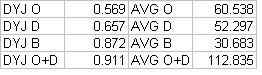 |
| From DYJS Graphics |
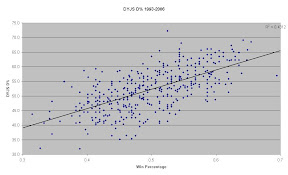
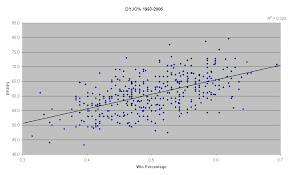
The first set of values is the correlation coefficient, or "r." A value of r that is greater than zero means a positive correlation (as wins go up, DYJS also goes up). Based on my knowledge of similar studies, r-values of greater than 0.35 are considered significant. For comparison, the correlation of Runs Scored to wins in 2006 was r = 0.65. So DYJS continues to have excellent correlation to regular season winning percentage . For a more graphical view of the above, consult the following graphics:
 |
| From DYJS Graphics |
 |
| From DYJS Graphics |
While in the statistical realm such a graph might be referred to as "Shotgun," I believe that the trendline is real and is significant, particularly for pitching. One direction this analysis could take would be to identify some of the extreme outliers and examine these potentially interesting teams. For example, the 1993 Atlanta Braves had an unusually low DYJO% of 55.6%. Yet they won 104 games. Why? Because Greg Maddux, John Smoltz, and Tom Glavine led an extraordinary pitching staff to a DYJD% of 69.1%, second overall in our entire data set.
A primary goal of creating any statistic is to make top 10 lists for your new stat. So here we go, the top 10 teams in all four statistics since 1993:
One thing that kind of jumps out is the high percentage of teams from 1994 that appear on this list. The strike-shortened season did indeed produce two teams with winning percentages greater than .700 (Expos and Yankees), but I cannot be sure whether there was not some effect from not playing games in September (For example, do the "callups" who frequently play in September Get the Job Done less frequently?). I will answer this and other questions in future posts. I would also like to adjust for the year, since the number of runs scored in 1993 is not the same as in 2006; nor is the average DYJS, I'm guessing. I will also try to normalize for home park factors, as suggested by poster Kiffy in the last DYJS post.
Finally, we're working on making the data more flexible, so that we can play with the measure of Doing Your Job. As a poster at WasWatching pointed out:
in reality, the yanks would have to score more than the leage average in runs
per game, and allow less than that. as far as i can tell, the average number of
runs per team per game, last year was 4.857. so when doing this analysis it is
important to remember that when the offense score 5, it is less valuable to the
team than when the pitching/defense allows 4. also it is easy to say the
pitching didn't do their part, because it is easy for the offense to score the
extra ~0.14 runs, as opposed to the offense preventing the extra ~0.84 runs.
This does make sense, and we are hoping to bring more data into the fold that can measure DYJS with a score of 5 or 3, or whatever we wish. Finally, because I'm a Yankees fan, here's a look at how the Yanks have performed in DYJS since 1993 (maybe I'll add more teams later). The teams are arranged by their DYJ O+D score:
Labels:
DYJS
Sunday, February 25, 2007
Duke at St. Johns' Preview
Duke visits Madison Square Garden, their home away from home, this afternoon to take on "home team" St. John's (2 PM, CBS). Here's a quick and dirty preview, as the game is just an hour away.
This game will not do any wonders for Duke's NCAA tourney profile, unless they are upset, which could have ramifications for the entire Atlantic Coast Conference. The ACC currently ranks first in estimated RPI and in Pomeroy's conference rating, thanks in great part to some out of conference wins by Duke, UNC, and Virginia. A loss to St. John's, who sit near the bottom of the Big East, could be part of the case that leaves Clemson and FSU on the wrong side of the NCAA tourney bubble.
The Johnnies are 13-15, 6-9 in the weak Big East. They're coming off a solid 25 point drubbing in Louisville. Their highest profile victory came in a win over Syracuse (#42 Pomeroy) at home back in January, and another home win over DePaul (#49) just after New Years'. The offense is led by 6-10 senior Lamont Hamilton, who takes about 25% of his teams' shots when he's on the court. His 105.8 offensive rating leads the Johnnies, a poor offense that ranks 175th in the nation in adjusted efficiency, at just 100.8 on the season. St John's takes a high percentage of three point shots, (38% of its shots, 81st highest in the country), but hit just 34% of these, with 6-1 junior Eugene Lawrence possessing the best 3pt percentage on the team, at 39.3%.
St. John's defense is better than it's offense, but not by much. With an adjusted efficiency of 94.6, their main strengths come from limiting field goal percentage on 2pt shots, and from
limiting opponents' trips to the free throw line. Curiously, they rank 6th in the nation in Free Throw Percentage against, at just 64.6%. It may be that their defensive efficiency may be affected by a great deal of luck. Individually, the only player of note is Lawrence, who gets steals at a rate of 3.3% of possessions played, leading the team.
Luck may have a lot to do with St. John's record overall- as their expected winning percentage (as measured by Pomeroy) predicts them to have two fewer wins. Matching up with a rejuvenated Duke team, the Johnnies have their work cut out for them. Duke's strengths, defensive rebounding and limiting 3pt percentage, play straight to two of St John's biggest weaknesses. St. John's will either need to have a performance like Duke saw from its opponents at Georgia Tech, or will need a huge game from Hamilton to stay in this game. It won't be enough. Duke, 70-50.
This game will not do any wonders for Duke's NCAA tourney profile, unless they are upset, which could have ramifications for the entire Atlantic Coast Conference. The ACC currently ranks first in estimated RPI and in Pomeroy's conference rating, thanks in great part to some out of conference wins by Duke, UNC, and Virginia. A loss to St. John's, who sit near the bottom of the Big East, could be part of the case that leaves Clemson and FSU on the wrong side of the NCAA tourney bubble.
The Johnnies are 13-15, 6-9 in the weak Big East. They're coming off a solid 25 point drubbing in Louisville. Their highest profile victory came in a win over Syracuse (#42 Pomeroy) at home back in January, and another home win over DePaul (#49) just after New Years'. The offense is led by 6-10 senior Lamont Hamilton, who takes about 25% of his teams' shots when he's on the court. His 105.8 offensive rating leads the Johnnies, a poor offense that ranks 175th in the nation in adjusted efficiency, at just 100.8 on the season. St John's takes a high percentage of three point shots, (38% of its shots, 81st highest in the country), but hit just 34% of these, with 6-1 junior Eugene Lawrence possessing the best 3pt percentage on the team, at 39.3%.
St. John's defense is better than it's offense, but not by much. With an adjusted efficiency of 94.6, their main strengths come from limiting field goal percentage on 2pt shots, and from
limiting opponents' trips to the free throw line. Curiously, they rank 6th in the nation in Free Throw Percentage against, at just 64.6%. It may be that their defensive efficiency may be affected by a great deal of luck. Individually, the only player of note is Lawrence, who gets steals at a rate of 3.3% of possessions played, leading the team.
Luck may have a lot to do with St. John's record overall- as their expected winning percentage (as measured by Pomeroy) predicts them to have two fewer wins. Matching up with a rejuvenated Duke team, the Johnnies have their work cut out for them. Duke's strengths, defensive rebounding and limiting 3pt percentage, play straight to two of St John's biggest weaknesses. St. John's will either need to have a performance like Duke saw from its opponents at Georgia Tech, or will need a huge game from Hamilton to stay in this game. It won't be enough. Duke, 70-50.
Labels:
Duke Game Preview
Friday, February 23, 2007
Something to ponder as you sit in traffic...
Quick and hard-hitting, here's your DLBQ...ladies.
Bonus points if you can name anyone in this game besides Greg Oden and Alando Tucker.
who you got on sunday wisconsin or ohio state?
Bonus points if you can name anyone in this game besides Greg Oden and Alando Tucker.
Thursday, February 22, 2007
Duke at Clemson Liveblog
Tonight at 9 PM the Blue Devils travel to Littlejohn to take on the Clemson Tigers. I'm feeling lazy right now so I'll skimp on the preview and follow up with a liveblog during the game. Duke won the first matchup infamously with a Dave McClure floater as time expired. This followed a much-dissected clock error which was corrected to the fullest extent allowed by NCAA rules (which do not allow for referees to adjust for time that should have come off when a clock is not started). Regardless, Clemson had one of it worst rebounding performances of the season (offensive and defensive) and one of its best free throw shooting performances (10 of 11 for a team that normally shoots 60%). Hamilton should be the focus of the Duke defense in this game, as he was an efficient scorer in the first matchup: 5 for 6 on layups and 4 of 8 on jumpers, for 21 points. Duke had a fairly average game (for Duke) all around, but they handled the Tiger press well almost the entire game, and scored inside in bunches. Of Duke's 51 shots from the field, 23 were either layups or dunks; Demarcus Nelson made six layups, and his ability to drive to the hoop is critical for Duke's offense.
The Blue Devils have won back to back games in convincing fashion following their four game losing streak. Clemson, meanwhile, has been in free-fall since ACC play started. Three one or two point losses (including the Duke game) have been supplemented by absolute blowouts, such as in their last game, at home, to Maryland. If Duke can dominate the boards the way they did the previous matchup while playing the efficient offense they've showed versus GT and BC, this could be a laugher. But, it's a road game in the ACC, which equals uncertainty. Join me (both of you) and follow along for all the action. Alllllll the action.
Pregame. Hopefully that's the last time we'll see the "controversy" of the clock tonight. Maybe if the game is close they'll show it again. I can understand the return to it in the preview, but now it's done, let's play basketball in the present, not the past. No Dickie V, so this game will be watchable.
20:00 Starting for Duke: Nelson, McRoberts, Scheyer, McClure, Paulus. Duke with the first possession, against man-to-man defense.
19:22 Rivers shows no signs of his shooting slump hitting a trey. Could it be one of those games, like GT in the first matchup?
18:34 Clemson fans have apparently caught the "boo every call against us" bug. Support is one thing. Stupidity is another.
18:18 Transition 3-on-1 for Clemson leads to a Hamilton dunk. But at least it came off a missed shot and not a turnover.
16:52 Paulus hits a three after Duke's weave at the top of the key confuses a Mays-less Clemson defense. Mays checks back in immediately.
16:00 Scheyer beats the shot clock, with Patrick declaring "big time players make big time plays." Argument by definition, sir, and a poor effort. The block on McRoberts is a good example of why Shelden Williams was so dominant... nearly every block he made had a purpose, and he wouldn't do it if there were no chance to get it to his teammates. There was no chance there for Clemson, the ball went straight to Duke's best shooter. Impressive athletic achievement? Sure. Fires up the crowd? Absolutely. Smart basketball decision? Ultimately, no. Duke up at the first break, 7-5
14:40 Lance Thomas in for Duke, and makes an immediate impact on defense, locking down on the perimeter and eventually drawing a charge late in the shot clock.
14:17 And then on offense, Thomas with the bucket and the foul. According to the possession-by-possession stats collected on dbdhoops.com, Thomas has been crucial to both offense and defense the last few games.
14:08 Also getting old: Sarcastic-Bronx-Cheer when the home team gets a foul called. And again on the other end, booing a no-call on Booker being out of control on defense.
13:07 xenod2: come on Lance, gotta move your face away from his elbow
xenod2 you're gonna get called for that every time
12:27 Nelson singlehandedly breaks the press, then all three Clemson players foul Nelson as he enters the lane. The crowd boos.
12:11 McClure picks up a second foul with a moving screen. This marks the first moving screen called in NCAA history.
11:16 Clemson does not press after tying the game at 13, Duke does not score running its normal offense.
10:58 To be fair, I didn't see Perry foul Nelson there either, but the refs are calling this game pretty closely, so it fits into that trend. As for the actual play, Duke is failing to get the second chances it got in the first match-up, so despite scoring relatively efficiently, the game is tied, 13-13 at the second break.
Ohhh, This is college basketball. I was confused. I thought this was ouuuuuur country. Also, yes, only guy to ever buy orange posterboard, Duke was totally in charge of the time that clicked off the clock. Not the ref in charge of starting the clock. Thanks for clearing that up.
10:39 Nelson doing what he does best, the breakaway. Hamilton does indeed foul Nelson before the shot. Nelson has also pushes off, but the ref curiously calls continuation. Duke rebounds the free throw miss and converts for a four point possession.
9:14 A bad inbounds pass by Clemson leads to a turnover and a solid possession for Duke, ending in a trey by Henderson. Timeout Clemson, so it must be time for a human-interest story. A Clemson football player does something for his younger brother, bringing him out of a broken home, and gets an award. Mike Patrick absolutely butchers the story, for a man who appears on television he is one of the most inarticulate people ever. Further, Ray Ray realized that he had courage all along, and didn't need to get it from the Wizard.
7:18 Wasn't really paying attention while commenting on the human interest story, but, catching up, all that happened is that McRoberts answers Mike Patrick's challenge and embarrasses some Clemson defenders in the process. Then Duke gets whistle for a foul and the player is not given continuation as Nelson was (erroneously). But there should be no complaints about fouls- Duke is already in the bonus with 7 minutes left.
6:40 Paulus hits a 30 footer with Hamilton in his face. Shades of JJ. Duke forces a turnover on the other end and Paulus does what he does best in transition, with a great pass to Nelson, and suddenly it's a blowout- 28-14
5:35 xenod: more than double (clap clap clap clap clap) Zoubek grabs an offensive rebound, which is indicative of the 17-1 run Duke has had since the 12 minute mark. Offensive rebounds, forcing turnovers, all those tempo-free things that win games for these Blue Devils.
3:18 I have a feeling that the anti-stall ball folk are going to go bananas in the second half. Then again, if Clemson keeps being inept on offense and Duke continues to make defensive plays, it's not going to matter. 31-16 Duke. Clemson has not had a field goal in nine minutes.
Why does Doris Burke get to sit at a computer? Is she searching for stories on Wikipedia? Doesn't that defeat the purpose of a "sideline reporter"? Shouldn't she be drudging up stories by listening to coaches' huddles and the banter on the, you know, "sideline"? Oh wait, all these people do is rehash old stories with prescripted blurbs about things like Dancing With the Stars. As you were.
1:00 Hamilton curiously takes a 30 foot jump-shot with 11 seconds left on the shot clock, and it bricks. Unheralded in that possession was some excellent position defense by Pocius, who slid over to cover an unmarked man under the hoop, thwarting the player's dunking plans. Thomas eventually came over and the player (don't know his name, the guy with the pony tail), passed out of the block.
38.0 Duke uses its "use-it-or-lose-it" timeout to set up the final possession of the half: head-tap play! Henderson makes minced-meat out of Clemson's pressure defense, and scores a jumper.
10.8 Aww, sad Tigers everywhere. Ya hate to see that. McRoberts manages to miraculously make a free throw. And another! Then Hammonds hits a 3-pointer as time expires in the half to close the lead to 42-21.
Halftime Thoughts: Clearly Duke has played well, and the tempo has been very quick for Duke: 35 possessions, light-speed outside of the UNC and Maryland games. 42 points in 35 possessions, for those keeping score, is an offensive efficiency of 120, while Clemson's 21 points in 32 possessions is an OE of 65. Expect Clemson's shots to keep falling in the second half, and expect the much-maligned slow-down offense to make a return visit to Duke's fans' paranoia. Look for the stall-ball to begin when Duke's lead is double the number of minutes left, that seems to be a good indicator for Coach K.
Clemson Fan Griping Watch: Fouls against: Duke- 10, Clemson-11. Free Throws Attempted: Duke- 11, Clemson- 11. Players with multiple fouls: Duke- 2, Clemson- 3 (no player has more than 2 fouls). But, expect with a Duke lead of less than a dozen for Clemson to foul more, on purpose. And for Duke to end up with more fouls called. And for Clemson fans to complain. It's what they do.
20:00 The ESPN feature on Duke's "spacing" was lame, but it did show something interesting: rather than their full court pressure, Clemson was playing a zone, which Duke absolutely demolished in the first half. They're back to man-to-man to start the second, after Duke's own lock-down man to man forces a shot clock violation.
18:43 "That oughta count for more than two!" says Patrick after a circus shot by Hamilton in transition. Well, Mike, I really think that would fundamentally change the game. I mean, who would be awarding these extra "style" points on shots, and wouldn't that introduce a subjectivity to the game that would be unwelcome? Oh, wait, you're not serious, you're just a doofus. Carry on.
15:58 Well, as I predicted, Clemson's shots have started falling, and while there hasn't been stall-ball yet, Duke's letting them creep back in with silly passes and Clemson is playing much better defense against Duke's motion. 45-29 at the media break.
15:39 I watched it 3 times, Mays loses control of the ball and just taps the ball off McRoberts, who is already standing out of bounds. How Clemson gets the ball there is beyond me. They convert, and it's a 14 point lead. Nelson throws the ball away and Hamilton converts. Coach K is furious and calls a timeout. If somehow Clemson wins this game, make a note of this section. I'll go ahead and put it in red for ya.
14:44 Duke goes back to its weave and is successful, ending their scoring drought. Or as DBR poster hurleyfor3 might say, a "nonslaught."
13:07 A transition bucket cuts the lead to 10, and Littlejohn wakes up. Chances this was going to happen were very good. Go back to the weave, Duke.
12:10 Paulus misses a jumper flying away from the basket with a bunch of time still on the shotclock, ending a possession very poorly. That right there would be a good example to show the anti-stallball folk. Not up 10 points with 12 minutes left, but you need to control the basketball, and Duke isn't doing that.
11:52 Clemson seems to not have its superhuman free throw shooting it had in the first matchup, which bodes well in a close game here. Duke turning the ball over, on the other hand, does not bode well. Or Bode Miller, for that matter.
10:58 Nelson gets a make-up call for his uncalled pushoff in the first half. Yes, refs have that kind of memory, according to people who believe in make-up calls. Clemson fans' ref griping officially has no basis, for the record.
10:16 After a hack on McRoberts goes unwhistled, Hamilton makes it a five point game with yet another transition basket. 47-42 Duke. Yes, Duke has been outscored 21-5 this half.
9:09 Everything that went well for Duke in the first half in their most crucial areas: defensive rebounding and limiting turnovers-- has been woefully absent in the second half. It's going to be a physical game the rest of the way.
8:25 McRoberts saves what should have been another Paulus turnover and dishes to McClure, who can apparently dunk? Clemson scores again for what seems like the 30th consecutive possession. Paulus ends this awful four minute stretch with a turnover, fittingly. Duke up 51-45.
7:13 My contribution to the ACC ref fund pays off as the baseline ref misses a two inch gap between the ball and the rim in calling offensive goaltending. We've found what Clemson fans and ESPN will focus on if Duke wins.
6:05 Duke quietly takes it back to an 11 point lead as Paulus finds his shooting stroke he left back in the first half.
5:03 Clemson has lost its defensive intensity/Duke has stopped turning the ball over. Scheyer was wide open for a 3
4:41 But Duke keeps Clemson in the game by failing to get a rebound on a missed free throw. This was a five point possession for the Tigers. Point this sequence as well if Duke loses.
3:49 Duke has lost its press breaking ability, but Clemson is not taking advantage. What a sloppy sequence. 59-52 Duke.
2:36 Here comes the stall-ball... let's watch closely. Paulus initiates with 11 seconds left on the clock and commits a turnover. Execution, not strategy...
2:24 Booker with a reverse layup, and the Clemson press forces a 5-second call on the inbound.
2:16 With an 8 point lead, Duke falls victim to the press again. Hammonds hits a 3 to make it a 5 point game.
1:48 Duke finally beats the press and Clemson leaves a lane open for McRoberts to make an easy bucket.
1:23 Clemson answers with an equally easy bucket. Paulus is fouled by Potter with 1:03 left. Duke is finally in the Bonus (Clemson has been there since the 10 minute mark). He hits both, 66-59
47.9 McRoberts lays off (he has 3 fouls) and Clemson starts fouling on the inbound. Mays then tosses the ball of the back of Nelsons' head, but apparently thuggy behavior is acceptable. Nelson is a good guy to foul, and he misses one of two.
28.7 Clemson misses two shots, and Patrick says that Clemson should have pulled out and gone for a three. Erroneous. Yes, it's a 6 point game, but there's plenty of time, especially when people like McRoberts and Nelson are shooting freethrows.
12.9 Scheyer is fouled after Hamilton bricks a trey- not sure why the Tigers were passing it around so much, they burned a lot of time there.
6.5 Rivers hits the "It Matters" three. The last six and a half seconds are going to take twenty minutes. More "It Matters" points, but then it's over, 71-66.
This was a typical 2007 Duke game, going back to the pre-conference play. Quick leads in the first half followed by letting the other team creep back into it. Is there some kind of trend- fatigue comes to mind- because it can't be that multiple teams just happen to play that much better in the second half. It surely wasn't stall-ball this time, as Duke only played it once (maybe more, counting some slower possessions in the first half). But, just like what needs to happen during the delay offense, Duke didn't protect the basketball, committing turnovers and losing the defensive rebounding edge. Only three offensive rebounds all game for the Blue Devils- fine in the first half with an high percentage shooting offense, bad in the second half as the opponent creeps back into it. I stayed and watched the Sportscenter on it... and of course they point out McRoberts' frustrated lash-out after his back was climbed (no foul called on either). That'll fuel the whiners, but the fouls were exactly equal.
In the end, Duke has beaten Clemson 21 straight times. PWND.
The Blue Devils have won back to back games in convincing fashion following their four game losing streak. Clemson, meanwhile, has been in free-fall since ACC play started. Three one or two point losses (including the Duke game) have been supplemented by absolute blowouts, such as in their last game, at home, to Maryland. If Duke can dominate the boards the way they did the previous matchup while playing the efficient offense they've showed versus GT and BC, this could be a laugher. But, it's a road game in the ACC, which equals uncertainty. Join me (both of you) and follow along for all the action. Alllllll the action.
Pregame. Hopefully that's the last time we'll see the "controversy" of the clock tonight. Maybe if the game is close they'll show it again. I can understand the return to it in the preview, but now it's done, let's play basketball in the present, not the past. No Dickie V, so this game will be watchable.
20:00 Starting for Duke: Nelson, McRoberts, Scheyer, McClure, Paulus. Duke with the first possession, against man-to-man defense.
19:22 Rivers shows no signs of his shooting slump hitting a trey. Could it be one of those games, like GT in the first matchup?
18:34 Clemson fans have apparently caught the "boo every call against us" bug. Support is one thing. Stupidity is another.
18:18 Transition 3-on-1 for Clemson leads to a Hamilton dunk. But at least it came off a missed shot and not a turnover.
16:52 Paulus hits a three after Duke's weave at the top of the key confuses a Mays-less Clemson defense. Mays checks back in immediately.
16:00 Scheyer beats the shot clock, with Patrick declaring "big time players make big time plays." Argument by definition, sir, and a poor effort. The block on McRoberts is a good example of why Shelden Williams was so dominant... nearly every block he made had a purpose, and he wouldn't do it if there were no chance to get it to his teammates. There was no chance there for Clemson, the ball went straight to Duke's best shooter. Impressive athletic achievement? Sure. Fires up the crowd? Absolutely. Smart basketball decision? Ultimately, no. Duke up at the first break, 7-5
14:40 Lance Thomas in for Duke, and makes an immediate impact on defense, locking down on the perimeter and eventually drawing a charge late in the shot clock.
14:17 And then on offense, Thomas with the bucket and the foul. According to the possession-by-possession stats collected on dbdhoops.com, Thomas has been crucial to both offense and defense the last few games.
14:08 Also getting old: Sarcastic-Bronx-Cheer when the home team gets a foul called. And again on the other end, booing a no-call on Booker being out of control on defense.
13:07 xenod2: come on Lance, gotta move your face away from his elbow
xenod2 you're gonna get called for that every time
12:27 Nelson singlehandedly breaks the press, then all three Clemson players foul Nelson as he enters the lane. The crowd boos.
12:11 McClure picks up a second foul with a moving screen. This marks the first moving screen called in NCAA history.
11:16 Clemson does not press after tying the game at 13, Duke does not score running its normal offense.
10:58 To be fair, I didn't see Perry foul Nelson there either, but the refs are calling this game pretty closely, so it fits into that trend. As for the actual play, Duke is failing to get the second chances it got in the first match-up, so despite scoring relatively efficiently, the game is tied, 13-13 at the second break.
Ohhh, This is college basketball. I was confused. I thought this was ouuuuuur country. Also, yes, only guy to ever buy orange posterboard, Duke was totally in charge of the time that clicked off the clock. Not the ref in charge of starting the clock. Thanks for clearing that up.
10:39 Nelson doing what he does best, the breakaway. Hamilton does indeed foul Nelson before the shot. Nelson has also pushes off, but the ref curiously calls continuation. Duke rebounds the free throw miss and converts for a four point possession.
9:14 A bad inbounds pass by Clemson leads to a turnover and a solid possession for Duke, ending in a trey by Henderson. Timeout Clemson, so it must be time for a human-interest story. A Clemson football player does something for his younger brother, bringing him out of a broken home, and gets an award. Mike Patrick absolutely butchers the story, for a man who appears on television he is one of the most inarticulate people ever. Further, Ray Ray realized that he had courage all along, and didn't need to get it from the Wizard.
7:18 Wasn't really paying attention while commenting on the human interest story, but, catching up, all that happened is that McRoberts answers Mike Patrick's challenge and embarrasses some Clemson defenders in the process. Then Duke gets whistle for a foul and the player is not given continuation as Nelson was (erroneously). But there should be no complaints about fouls- Duke is already in the bonus with 7 minutes left.
6:40 Paulus hits a 30 footer with Hamilton in his face. Shades of JJ. Duke forces a turnover on the other end and Paulus does what he does best in transition, with a great pass to Nelson, and suddenly it's a blowout- 28-14
5:35 xenod: more than double (clap clap clap clap clap) Zoubek grabs an offensive rebound, which is indicative of the 17-1 run Duke has had since the 12 minute mark. Offensive rebounds, forcing turnovers, all those tempo-free things that win games for these Blue Devils.
3:18 I have a feeling that the anti-stall ball folk are going to go bananas in the second half. Then again, if Clemson keeps being inept on offense and Duke continues to make defensive plays, it's not going to matter. 31-16 Duke. Clemson has not had a field goal in nine minutes.
Why does Doris Burke get to sit at a computer? Is she searching for stories on Wikipedia? Doesn't that defeat the purpose of a "sideline reporter"? Shouldn't she be drudging up stories by listening to coaches' huddles and the banter on the, you know, "sideline"? Oh wait, all these people do is rehash old stories with prescripted blurbs about things like Dancing With the Stars. As you were.
1:00 Hamilton curiously takes a 30 foot jump-shot with 11 seconds left on the shot clock, and it bricks. Unheralded in that possession was some excellent position defense by Pocius, who slid over to cover an unmarked man under the hoop, thwarting the player's dunking plans. Thomas eventually came over and the player (don't know his name, the guy with the pony tail), passed out of the block.
38.0 Duke uses its "use-it-or-lose-it" timeout to set up the final possession of the half: head-tap play! Henderson makes minced-meat out of Clemson's pressure defense, and scores a jumper.
10.8 Aww, sad Tigers everywhere. Ya hate to see that. McRoberts manages to miraculously make a free throw. And another! Then Hammonds hits a 3-pointer as time expires in the half to close the lead to 42-21.
Halftime Thoughts: Clearly Duke has played well, and the tempo has been very quick for Duke: 35 possessions, light-speed outside of the UNC and Maryland games. 42 points in 35 possessions, for those keeping score, is an offensive efficiency of 120, while Clemson's 21 points in 32 possessions is an OE of 65. Expect Clemson's shots to keep falling in the second half, and expect the much-maligned slow-down offense to make a return visit to Duke's fans' paranoia. Look for the stall-ball to begin when Duke's lead is double the number of minutes left, that seems to be a good indicator for Coach K.
Clemson Fan Griping Watch: Fouls against: Duke- 10, Clemson-11. Free Throws Attempted: Duke- 11, Clemson- 11. Players with multiple fouls: Duke- 2, Clemson- 3 (no player has more than 2 fouls). But, expect with a Duke lead of less than a dozen for Clemson to foul more, on purpose. And for Duke to end up with more fouls called. And for Clemson fans to complain. It's what they do.
20:00 The ESPN feature on Duke's "spacing" was lame, but it did show something interesting: rather than their full court pressure, Clemson was playing a zone, which Duke absolutely demolished in the first half. They're back to man-to-man to start the second, after Duke's own lock-down man to man forces a shot clock violation.
18:43 "That oughta count for more than two!" says Patrick after a circus shot by Hamilton in transition. Well, Mike, I really think that would fundamentally change the game. I mean, who would be awarding these extra "style" points on shots, and wouldn't that introduce a subjectivity to the game that would be unwelcome? Oh, wait, you're not serious, you're just a doofus. Carry on.
15:58 Well, as I predicted, Clemson's shots have started falling, and while there hasn't been stall-ball yet, Duke's letting them creep back in with silly passes and Clemson is playing much better defense against Duke's motion. 45-29 at the media break.
15:39 I watched it 3 times, Mays loses control of the ball and just taps the ball off McRoberts, who is already standing out of bounds. How Clemson gets the ball there is beyond me. They convert, and it's a 14 point lead. Nelson throws the ball away and Hamilton converts. Coach K is furious and calls a timeout. If somehow Clemson wins this game, make a note of this section. I'll go ahead and put it in red for ya.
14:44 Duke goes back to its weave and is successful, ending their scoring drought. Or as DBR poster hurleyfor3 might say, a "nonslaught."
13:07 A transition bucket cuts the lead to 10, and Littlejohn wakes up. Chances this was going to happen were very good. Go back to the weave, Duke.
12:10 Paulus misses a jumper flying away from the basket with a bunch of time still on the shotclock, ending a possession very poorly. That right there would be a good example to show the anti-stallball folk. Not up 10 points with 12 minutes left, but you need to control the basketball, and Duke isn't doing that.
11:52 Clemson seems to not have its superhuman free throw shooting it had in the first matchup, which bodes well in a close game here. Duke turning the ball over, on the other hand, does not bode well. Or Bode Miller, for that matter.
10:58 Nelson gets a make-up call for his uncalled pushoff in the first half. Yes, refs have that kind of memory, according to people who believe in make-up calls. Clemson fans' ref griping officially has no basis, for the record.
10:16 After a hack on McRoberts goes unwhistled, Hamilton makes it a five point game with yet another transition basket. 47-42 Duke. Yes, Duke has been outscored 21-5 this half.
9:09 Everything that went well for Duke in the first half in their most crucial areas: defensive rebounding and limiting turnovers-- has been woefully absent in the second half. It's going to be a physical game the rest of the way.
8:25 McRoberts saves what should have been another Paulus turnover and dishes to McClure, who can apparently dunk? Clemson scores again for what seems like the 30th consecutive possession. Paulus ends this awful four minute stretch with a turnover, fittingly. Duke up 51-45.
7:13 My contribution to the ACC ref fund pays off as the baseline ref misses a two inch gap between the ball and the rim in calling offensive goaltending. We've found what Clemson fans and ESPN will focus on if Duke wins.
6:05 Duke quietly takes it back to an 11 point lead as Paulus finds his shooting stroke he left back in the first half.
5:03 Clemson has lost its defensive intensity/Duke has stopped turning the ball over. Scheyer was wide open for a 3
4:41 But Duke keeps Clemson in the game by failing to get a rebound on a missed free throw. This was a five point possession for the Tigers. Point this sequence as well if Duke loses.
3:49 Duke has lost its press breaking ability, but Clemson is not taking advantage. What a sloppy sequence. 59-52 Duke.
2:36 Here comes the stall-ball... let's watch closely. Paulus initiates with 11 seconds left on the clock and commits a turnover. Execution, not strategy...
2:24 Booker with a reverse layup, and the Clemson press forces a 5-second call on the inbound.
2:16 With an 8 point lead, Duke falls victim to the press again. Hammonds hits a 3 to make it a 5 point game.
1:48 Duke finally beats the press and Clemson leaves a lane open for McRoberts to make an easy bucket.
1:23 Clemson answers with an equally easy bucket. Paulus is fouled by Potter with 1:03 left. Duke is finally in the Bonus (Clemson has been there since the 10 minute mark). He hits both, 66-59
47.9 McRoberts lays off (he has 3 fouls) and Clemson starts fouling on the inbound. Mays then tosses the ball of the back of Nelsons' head, but apparently thuggy behavior is acceptable. Nelson is a good guy to foul, and he misses one of two.
28.7 Clemson misses two shots, and Patrick says that Clemson should have pulled out and gone for a three. Erroneous. Yes, it's a 6 point game, but there's plenty of time, especially when people like McRoberts and Nelson are shooting freethrows.
12.9 Scheyer is fouled after Hamilton bricks a trey- not sure why the Tigers were passing it around so much, they burned a lot of time there.
6.5 Rivers hits the "It Matters" three. The last six and a half seconds are going to take twenty minutes. More "It Matters" points, but then it's over, 71-66.
This was a typical 2007 Duke game, going back to the pre-conference play. Quick leads in the first half followed by letting the other team creep back into it. Is there some kind of trend- fatigue comes to mind- because it can't be that multiple teams just happen to play that much better in the second half. It surely wasn't stall-ball this time, as Duke only played it once (maybe more, counting some slower possessions in the first half). But, just like what needs to happen during the delay offense, Duke didn't protect the basketball, committing turnovers and losing the defensive rebounding edge. Only three offensive rebounds all game for the Blue Devils- fine in the first half with an high percentage shooting offense, bad in the second half as the opponent creeps back into it. I stayed and watched the Sportscenter on it... and of course they point out McRoberts' frustrated lash-out after his back was climbed (no foul called on either). That'll fuel the whiners, but the fouls were exactly equal.
In the end, Duke has beaten Clemson 21 straight times. PWND.
Labels:
Duke Liveblog
Wednesday, February 21, 2007
Spring Training Melodrama
The reign of pitchers and catchers is ending for most teams, as players with designations 3 through 9 get a chance to work out. Unfortunately, this doesn’t usually translate well into actual baseball stories, which are limited to drama, gossip, and similar hodgepodge that generally has nothing to do with pitching, hitting, or fielding. From around the league:
Yankees: So far there have only been three variety of story surrounding the Bronx Bombers this spring: A-Rod/Jeter, Pavano, and Bernie. The latter two stories tend to actually feature this nebulous thing called “base-ball” and whether those players can actually participate in this activity. Those stories are of course ignored. Jeter and A-Rod! A-Rod and Jeter! Are they bff?!? Does Jeter share the toy cars with A-Rod or does he keep them all to himself? When A-Rod walks by in the locker room does Jeter push A-Rod's books to the floor and laugh? What? These men are 30 years old and not 10? Who cares, I have a deadline and have to fill 40 lines! Forget writing about whether the fourth spot in the rotation will be adequately filled with a man who hasn’t pitched in a meaningful game in 20 months. Forget writing about the waning career of the latest in a long line of tremendous Yankee centerfielders- all anyone wants to talk about is the friendships of two multi-millionaires. Give me a break.
Pirates: Just to clarify that the insanity above is not confined to the NY media- this story indicates that there has been some kind of problem between Pittsburgh shortstop Jack Wilson and his double-play mate Jose Castillo. Wilson blasted the work ethic of Castillo in a TV interview last month, and now claims it was an attempt to inspire Castillo to improve upon his 18 errors and .253 batting average last season. But the two apparently have talked it out over a pint of Ben and Jerry’s or something, and appear to be honky-dory. It is unclear whether the incident from last year-- where Wilson showed up wearing the same dress as Castillo, even though Wilson was there when Castillo said he was going to wear the red dress-- was a factor in the feud.
Braves: The headline story out of camp (based on it being the top story on mlb.com) is that Andruw Jones has recovered from his eating binge while in Japan: “we ate McDonalds before every game and KFC after every game. It was a routine.” According to teammate Tim Hudson, the Braves’ CF has dropped weight and showed up “slim… you can see his belly-button now.” Hudson did not elaborate on his weird navel fetish, but did add that the turning point was when Chipper Jones called Andruw “fat,” and the younger Jones was later found in the cafeteria, eating a salad, and crying to himself.
Marlins: It may be a bit premature for mlb.com to anoint the arrival of a new manager as the “Gonzalez Era,” but things are looking up for the young fish. The previous manager, Joe Girardi, was canned despite his team exceeding expectations and the AP awarding him Manager of the Year Honors. A victim of poor morale with his players, who complained of being overworked, and of poor communication with owner/crybaby Jeff Loria, Girardi was replaced with Fredi Gonzalez. Among Mr. Gonzalez’s qualifications include: 1) speaks Spanish 2) is from Miami 3) worked under Bobby Cox for a couple years 4) speaks Spanish. Asked for an example of what a good manager does, Gonzalez said,
Astros: In the “David Eckstein Has Lots of Grit” headline category, the top story on Houston’s mlb.com page is “Scott exudes strength, confidence.” That’s referring to the Astros’ likely new right fielder, Luke Scott, who apparently has grown some kind of new organ capable of excreting abstract nouns. It is refreshing to hear that there are some athletes who are the anti-Andruw Jones and fix their own meals in a healthy way. He also spent quite a bit of time in the gym, and took a lot of supplements. But they’re not on the arbitrary list of supplements that equal cheating, so it’s fine. The competition with Chris Burke and Richard Hidalgo will be tough, but Scott hopes that manager Phil Garner will pay more attention to confidence than to, say, slugging percentage.
Yankees: So far there have only been three variety of story surrounding the Bronx Bombers this spring: A-Rod/Jeter, Pavano, and Bernie. The latter two stories tend to actually feature this nebulous thing called “base-ball” and whether those players can actually participate in this activity. Those stories are of course ignored. Jeter and A-Rod! A-Rod and Jeter! Are they bff?!? Does Jeter share the toy cars with A-Rod or does he keep them all to himself? When A-Rod walks by in the locker room does Jeter push A-Rod's books to the floor and laugh? What? These men are 30 years old and not 10? Who cares, I have a deadline and have to fill 40 lines! Forget writing about whether the fourth spot in the rotation will be adequately filled with a man who hasn’t pitched in a meaningful game in 20 months. Forget writing about the waning career of the latest in a long line of tremendous Yankee centerfielders- all anyone wants to talk about is the friendships of two multi-millionaires. Give me a break.
Pirates: Just to clarify that the insanity above is not confined to the NY media- this story indicates that there has been some kind of problem between Pittsburgh shortstop Jack Wilson and his double-play mate Jose Castillo. Wilson blasted the work ethic of Castillo in a TV interview last month, and now claims it was an attempt to inspire Castillo to improve upon his 18 errors and .253 batting average last season. But the two apparently have talked it out over a pint of Ben and Jerry’s or something, and appear to be honky-dory. It is unclear whether the incident from last year-- where Wilson showed up wearing the same dress as Castillo, even though Wilson was there when Castillo said he was going to wear the red dress-- was a factor in the feud.
Braves: The headline story out of camp (based on it being the top story on mlb.com) is that Andruw Jones has recovered from his eating binge while in Japan: “we ate McDonalds before every game and KFC after every game. It was a routine.” According to teammate Tim Hudson, the Braves’ CF has dropped weight and showed up “slim… you can see his belly-button now.” Hudson did not elaborate on his weird navel fetish, but did add that the turning point was when Chipper Jones called Andruw “fat,” and the younger Jones was later found in the cafeteria, eating a salad, and crying to himself.
Marlins: It may be a bit premature for mlb.com to anoint the arrival of a new manager as the “Gonzalez Era,” but things are looking up for the young fish. The previous manager, Joe Girardi, was canned despite his team exceeding expectations and the AP awarding him Manager of the Year Honors. A victim of poor morale with his players, who complained of being overworked, and of poor communication with owner/crybaby Jeff Loria, Girardi was replaced with Fredi Gonzalez. Among Mr. Gonzalez’s qualifications include: 1) speaks Spanish 2) is from Miami 3) worked under Bobby Cox for a couple years 4) speaks Spanish. Asked for an example of what a good manager does, Gonzalez said,
“[The pitching coach] may tell me, 'You may want to talk to so-and-so becauseApparently Gonzalez is going to get the young Marlins to the post-season by taking them out for real fruit smoothies after every game, and having slumber parties where everyone talks about their feelings. Interpersonal relationships are important (if you listen to the mainstream sports media), but at the end of the day, wins and losses matter. Who cares if your manager is a good listener- I want to know that he isn’t going to give up outs by sacrifice bunting down three runs in the fifth inning.
his grandfather is not doing well.' You, as a manager, you've got to find a time
in that day to come over and ask the guy, 'Is everything OK?'”
Astros: In the “David Eckstein Has Lots of Grit” headline category, the top story on Houston’s mlb.com page is “Scott exudes strength, confidence.” That’s referring to the Astros’ likely new right fielder, Luke Scott, who apparently has grown some kind of new organ capable of excreting abstract nouns. It is refreshing to hear that there are some athletes who are the anti-Andruw Jones and fix their own meals in a healthy way. He also spent quite a bit of time in the gym, and took a lot of supplements. But they’re not on the arbitrary list of supplements that equal cheating, so it’s fine. The competition with Chris Burke and Richard Hidalgo will be tough, but Scott hopes that manager Phil Garner will pay more attention to confidence than to, say, slugging percentage.
Labels:
Baseball News
Tuesday, February 20, 2007
Publix Cookie of the Week
Lets take a look at this week's candidates:
Coach K: Hands down the best coach of the last 20 years, and aside from being the current coach of Team USA he also manages to be God. Yeah, this isn't the best season for Duke, but they seem to be turning it around.
Kevin Harvick: OMG, did you see how well he turned left.
J.R.: Getting a job is a notable accomplishment, but it's not something that's really sports related.
Norv Turner: Turner is one of the best offensive coordinators in the National Football League(the best way to emphasize something when talking about football, is to say National Football League instead of NFL), but so far not a very good coach. I wouldn't really call this an accomplished, just a hiring.
Kobe Bryant: After reading Bill Simmons article about the 1987 All Star game, it really is sad what has happened to the All-Star game. I'll admit I didn't watch the game, but I did see the highlights. It showcased some nasty dunks, but the reason for this was that nobody was playing defense. The other team was just literally standing around while the offense came in and dunked. There's just no intensity there.
Maybe I'm selfish as a fan, but the whole idea behind the All-Star game is that if you take the best players in the league, then you'll get the best basketball. There are some good reasons why this intensity isn't there, such as risk of injury, but in reality, I don't think the players give a damn whether they win or lose. In their mind, they get to go to Vegas to party and gamble... and the game is just the price of admission.
Well, that's enough ranting. The point is, he was the best player in a game against people that really don't care.
Good job Kobe, have a cookie.
Coach K: Hands down the best coach of the last 20 years, and aside from being the current coach of Team USA he also manages to be God. Yeah, this isn't the best season for Duke, but they seem to be turning it around.
Kevin Harvick: OMG, did you see how well he turned left.
J.R.: Getting a job is a notable accomplishment, but it's not something that's really sports related.
Norv Turner: Turner is one of the best offensive coordinators in the National Football League(the best way to emphasize something when talking about football, is to say National Football League instead of NFL), but so far not a very good coach. I wouldn't really call this an accomplished, just a hiring.
Kobe Bryant: After reading Bill Simmons article about the 1987 All Star game, it really is sad what has happened to the All-Star game. I'll admit I didn't watch the game, but I did see the highlights. It showcased some nasty dunks, but the reason for this was that nobody was playing defense. The other team was just literally standing around while the offense came in and dunked. There's just no intensity there.
Maybe I'm selfish as a fan, but the whole idea behind the All-Star game is that if you take the best players in the league, then you'll get the best basketball. There are some good reasons why this intensity isn't there, such as risk of injury, but in reality, I don't think the players give a damn whether they win or lose. In their mind, they get to go to Vegas to party and gamble... and the game is just the price of admission.
Well, that's enough ranting. The point is, he was the best player in a game against people that really don't care.
Good job Kobe, have a cookie.
Labels:
cookie
Monday, February 19, 2007
Public Cookie of the Week Discussion
Plenty of sports news last week, but it still felt slow. That's probably because College basketball is the only thing on my radar right now. That said, here's some preliminary nominees for the PCOW(NSBP) to get you started
Coach K - got his 700th win at Duke
Kobe Bryant - All-star game MVP
Kevin Harvick - Won the Daytona 500
Who should win this week's PCOW(NSBP)?
Coach K - got his 700th win at Duke
Kobe Bryant - All-star game MVP
Kevin Harvick - Won the Daytona 500
Who should win this week's PCOW(NSBP)?
Labels:
cookie
Sunday, February 18, 2007
Duke - Ga Tech Preview
Since mehmattski has other obligations this weekend, I will be bringing you the Two-Second version of the Duke - Ga Tech Preview (1pm Eastern, CBS).
Keys to the game for Duke:
Rebounding - Boxing out and limiting second shots - Ga Tech does not have the best shooters, but they do have the athleticism to get the second shots and make them
Defensive Stinginess - no more easy layups for Ga Tech's superior athletes
Having a strong inside-out offensive game - Josh McRoberts had a breakout game against Boston College, and seems to be a much more confident and focused player as of late. If he starts strong offensively, Ga Tech may be forced to double him, which will allow him to use his superior vision and passing abilities to get open shots for Jon Scheyer, Demarcus Nelson, and Duke's other outside shooters. If they are able to convert the open 3-pointers, this game could get ugly for the Yellow Jackets.
No Stallball - if this is the case, Duke needs to keep the offense moving. This is not to say they should take shots early in the clock, but they should start a legitimate offensive set with 10 or 12 seconds on the clock so they have the opportunity to get themselves a high-percentage shot
Riding the emotion of the home crowd - Duke has lost two straight at home, and the fans are desperate for a win. If Duke can use this energy to get hot and allow the crowd to get in the heads of Georgia Tech's young players, this could easily turn into a blowout.
Having said all that, I envision Duke running out to an early lead and for once actually holding the margin behind the strong play of Josh McRoberts - who is finally beginning to realize some of his enormous potential - and the knock-down shooting of Jon Scheyer. Duke 73-58.
Keys to the game for Duke:
Rebounding - Boxing out and limiting second shots - Ga Tech does not have the best shooters, but they do have the athleticism to get the second shots and make them
Defensive Stinginess - no more easy layups for Ga Tech's superior athletes
Having a strong inside-out offensive game - Josh McRoberts had a breakout game against Boston College, and seems to be a much more confident and focused player as of late. If he starts strong offensively, Ga Tech may be forced to double him, which will allow him to use his superior vision and passing abilities to get open shots for Jon Scheyer, Demarcus Nelson, and Duke's other outside shooters. If they are able to convert the open 3-pointers, this game could get ugly for the Yellow Jackets.
No Stallball - if this is the case, Duke needs to keep the offense moving. This is not to say they should take shots early in the clock, but they should start a legitimate offensive set with 10 or 12 seconds on the clock so they have the opportunity to get themselves a high-percentage shot
Riding the emotion of the home crowd - Duke has lost two straight at home, and the fans are desperate for a win. If Duke can use this energy to get hot and allow the crowd to get in the heads of Georgia Tech's young players, this could easily turn into a blowout.
Having said all that, I envision Duke running out to an early lead and for once actually holding the margin behind the strong play of Josh McRoberts - who is finally beginning to realize some of his enormous potential - and the knock-down shooting of Jon Scheyer. Duke 73-58.
Friday, February 16, 2007
More Team DYJS Stat Goodness coming soon
I just finished writing up a program to take the game logs straight off the retrosheet website and process them. I'll be passing the data off to mehmattski for analysis who should have some nice charts/graphs sometime over the next day or two.
The information used here was obtained free of
    charge from and is copyrighted by Retrosheet.  Interested
    parties may contact Retrosheet at "www.retrosheet.org".
charge from and is copyrighted by Retrosheet. Interested
parties may contact Retrosheet at "www.retrosheet.org".
Labels:
DYJS
Thursday, February 15, 2007
The Stall-Ball Argument
Three different people messaged me during last night’s Duke-BC game to make the same complaint as the Blue Devils’ lead whittled: that “stall-ball” was killing the team. I eventually had to leave the DBR Chat for the same reason, because the reactionary fans there were making it unbearable. What I want to do here is have an open discussion about the general strategy of slowing down the offense with a big lead late in the game. First, the data, and my thoughts. I have compiled the following sequence from the play-by-play data of CBS and ESPN.
The critical stretch, then, is from 12:36 to 5:05, Duke scored 3 points, while BC scored 14. Unfortunately I did not record the game and so cannot go back and verify this, but I believe the only possessions in that stretch where Duke played “stall ball” were the first two. Henderson chucked up an awkward shot with the clock about to buzz; the next possession, McRoberts inexplicably passed to Nelson with two seconds left. In Duke’s next possession, they burned nearly a minute off the clock with two offensive rebounds. I distinctly remember there not being a “stalling” tactic, as Duke employed an old-school weave play at the top of the key. Unfortunately, one of McRoberts’ passes flew out of bounds, and the possession ended.
The next sequence I think is the best evidence that slowing the game down was a correct strategy. On the next trip down the court, Paulus made a 30-foot chest pass to Scheyer, who pulled up and took a wide open three, which clanked off the rim. Since eight of the ten players on the court were between the arcs, BC easily grabbed the rebound, made two outlet passes and Marshall hit a wide open 3 to cut the lead to 12.
Duke’s next scoring drought lasted three minutes, through four possessions. None of these possessions was particularly “stalling,” especially once Duke’s lead was cut to 8 with three minutes left. The offense was moving, and burned a lot of clock. However, those things that need to happen for a team to close out a game- making free throws, getting offensive rebounds- stopped happening, and BC pulled closer and closer.
So Duke’s “stall-ball” offense lasted all of three minutes when Duke had a lead that ranged from 22 to 12 points. Duke’s fast pace up to that point was the result of poor shooting and bad passing by Boston College. This also ceased in the final ten minutes, and so did Duke’s opportunity for a transition game. It is certainly frustrating to watch an offense slowing down and watching leads slip away. But imagine what could have happened had a suddenly hot-shooting BC team been able to have more possessions with which to score.
A football fan wouldn’t argue with his team burning the clock while up 10 points in the fourth quarter. More appropriately (in a game where possession is more fluid, like basketball) soccer fans would never argue against their team protecting a two-goal lead by passing around the back. An excellent basketball-coaching site describes the advantages of the delay offense, and points out its effectiveness against an opponent who sits back in a zone despite a big deficit. If anyone has the game tape from last night, I am willing to bet anything that BC was sitting in a 2-3 zone during the first two possessions on the list, and so holding a 22 point lead against a passive defense- delaying the game was absolutely the right call.
The critical stretch, then, is from 12:36 to 5:05, Duke scored 3 points, while BC scored 14. Unfortunately I did not record the game and so cannot go back and verify this, but I believe the only possessions in that stretch where Duke played “stall ball” were the first two. Henderson chucked up an awkward shot with the clock about to buzz; the next possession, McRoberts inexplicably passed to Nelson with two seconds left. In Duke’s next possession, they burned nearly a minute off the clock with two offensive rebounds. I distinctly remember there not being a “stalling” tactic, as Duke employed an old-school weave play at the top of the key. Unfortunately, one of McRoberts’ passes flew out of bounds, and the possession ended.
The next sequence I think is the best evidence that slowing the game down was a correct strategy. On the next trip down the court, Paulus made a 30-foot chest pass to Scheyer, who pulled up and took a wide open three, which clanked off the rim. Since eight of the ten players on the court were between the arcs, BC easily grabbed the rebound, made two outlet passes and Marshall hit a wide open 3 to cut the lead to 12.
Duke’s next scoring drought lasted three minutes, through four possessions. None of these possessions was particularly “stalling,” especially once Duke’s lead was cut to 8 with three minutes left. The offense was moving, and burned a lot of clock. However, those things that need to happen for a team to close out a game- making free throws, getting offensive rebounds- stopped happening, and BC pulled closer and closer.
So Duke’s “stall-ball” offense lasted all of three minutes when Duke had a lead that ranged from 22 to 12 points. Duke’s fast pace up to that point was the result of poor shooting and bad passing by Boston College. This also ceased in the final ten minutes, and so did Duke’s opportunity for a transition game. It is certainly frustrating to watch an offense slowing down and watching leads slip away. But imagine what could have happened had a suddenly hot-shooting BC team been able to have more possessions with which to score.
A football fan wouldn’t argue with his team burning the clock while up 10 points in the fourth quarter. More appropriately (in a game where possession is more fluid, like basketball) soccer fans would never argue against their team protecting a two-goal lead by passing around the back. An excellent basketball-coaching site describes the advantages of the delay offense, and points out its effectiveness against an opponent who sits back in a zone despite a big deficit. If anyone has the game tape from last night, I am willing to bet anything that BC was sitting in a 2-3 zone during the first two possessions on the list, and so holding a 22 point lead against a passive defense- delaying the game was absolutely the right call.
Labels:
Duke Game Thoughts
Wednesday, February 14, 2007
Duke at Boston College Preview
According to the mainstream sports media, everyone can now forget about Duke’s men’s basketball team. Four losses in a row for the first time since 95-96 must mean that this year’s team will miss the NCAA tournament, and that Duke will be an “easy win” for Boston College (9 PM, ESPN).
The comparison to the 1995-96 team is actually a fair one, if based not on team expectations but on actual game results. While this years’ team came with guarded optimism (and a #12 preseason ranking), the 95-96 team was coming off the worst Duke season in fifteen years, and the last time the Blue Devils missed March Madness in Coach K’s tenure. The team led by Jeff Capel and Chris Collins was ranked for just five weeks all season, and went though a stretch where they (stop me if you’ve heard this before) lost four straight ACC games by a combined score of 22. Flashing forward eleven years, the Blue Devils are coming off four straight ACC losses by a combined score of 21.
Statistically speaking, this is the worst Blue Devil offense since the 1996 version, with an offensive efficiency of just 107 points/100 possessions. However, they combine this with an extraordinary defense- which, despite the struggles in conference, still sits at a raw efficiency of 89 points/100 possessions, which is substantially better than any team since the 1992 championship team (DE: 91) and the 1993 Final Four team (DE: 90). With only one opponent that has a superior offensive team left on the schedule (UNC), there is a chance that this team is the best, defensively speaking, that Coach K has ever had. You can see the stats for yourself here.
That’s performance though, and in an excellent blog post recently, Ken Pomeroy talked about the false relationship of achievement and performance. Teams that win a lot tend to forget all the things that they do poorly (see: offensive rebounding and the 2006 Blue Devils), and teams that do poorly are likely to lose focus in the areas in which they have superior achievement. It is crucial for tonight’s game that Duke remember its strengths, particularly the strength of its rebounding. In the first meeting in Cameron, both teams grabbed an extraordinary number of offensive rebounds: Duke’s 54.5% offensive rebounding rate was the highest of the season, and its 59.6% defensive rebounding rate was the lowest of the season. While the Duke game was a season low-point for BC’s defensive rebounding, its own offensive rebounding (that is, 40.4%) was a simply average performance.
What this should suggest, given the nature of statistics to tend towards the mean, is that a more average effort on both boards should be expected from Duke tonight. More crucial to Duke, believe it or not, is grabbing defensive rebounds. Duke’s offensive efficiency is more highly correlated with its defensive rebounding than its offensive rebounding.
Duke failing to rebound as many of its misses as in the first match-up should lead to one obvious effect: a quicker pace. This would seem to favor Boston College, since Duke’s games have shown a much slower pace. However, pace does not seem to accurately predict the efficiency of Duke’s offense this season. Efficiency, however, has clearly dictated wins and losses for Duke. Regardless of the tempo of the game tonight, Duke needs to execute, avoiding turnovers (this has been better since the VT game) and avoiding bad shot selection (a plaguing problem since the first BC game).
The individual match-ups of players will continue to favor Duke if Demarcus Nelson can find the rhythm he has been missing the past four games. According to the “points per possession played” metric measured at dbdhoops (kind of a plus/minus for basketball), Nelson has made the offense and the defense worse in the past four games. However, Duke probably cannot survive with Nelson on the bench tonight, as his containment of Sean Marshal (1 for 8 from the field), was critical to Duke’s home victory. Further, if Josh McRoberts continues his mission to be more assertive on offense (seen in the second halves of both the UNC and Maryland games), Duke’s offense should improve enough for the Blue Devils to win. It will be a close game, but BC’s “SuperFans” won’t be rushing the court- not because of the suggestion by a jackass reporter, but because Duke will be victorious. Duke, 75-65.
The comparison to the 1995-96 team is actually a fair one, if based not on team expectations but on actual game results. While this years’ team came with guarded optimism (and a #12 preseason ranking), the 95-96 team was coming off the worst Duke season in fifteen years, and the last time the Blue Devils missed March Madness in Coach K’s tenure. The team led by Jeff Capel and Chris Collins was ranked for just five weeks all season, and went though a stretch where they (stop me if you’ve heard this before) lost four straight ACC games by a combined score of 22. Flashing forward eleven years, the Blue Devils are coming off four straight ACC losses by a combined score of 21.
Statistically speaking, this is the worst Blue Devil offense since the 1996 version, with an offensive efficiency of just 107 points/100 possessions. However, they combine this with an extraordinary defense- which, despite the struggles in conference, still sits at a raw efficiency of 89 points/100 possessions, which is substantially better than any team since the 1992 championship team (DE: 91) and the 1993 Final Four team (DE: 90). With only one opponent that has a superior offensive team left on the schedule (UNC), there is a chance that this team is the best, defensively speaking, that Coach K has ever had. You can see the stats for yourself here.
That’s performance though, and in an excellent blog post recently, Ken Pomeroy talked about the false relationship of achievement and performance. Teams that win a lot tend to forget all the things that they do poorly (see: offensive rebounding and the 2006 Blue Devils), and teams that do poorly are likely to lose focus in the areas in which they have superior achievement. It is crucial for tonight’s game that Duke remember its strengths, particularly the strength of its rebounding. In the first meeting in Cameron, both teams grabbed an extraordinary number of offensive rebounds: Duke’s 54.5% offensive rebounding rate was the highest of the season, and its 59.6% defensive rebounding rate was the lowest of the season. While the Duke game was a season low-point for BC’s defensive rebounding, its own offensive rebounding (that is, 40.4%) was a simply average performance.
What this should suggest, given the nature of statistics to tend towards the mean, is that a more average effort on both boards should be expected from Duke tonight. More crucial to Duke, believe it or not, is grabbing defensive rebounds. Duke’s offensive efficiency is more highly correlated with its defensive rebounding than its offensive rebounding.
Duke failing to rebound as many of its misses as in the first match-up should lead to one obvious effect: a quicker pace. This would seem to favor Boston College, since Duke’s games have shown a much slower pace. However, pace does not seem to accurately predict the efficiency of Duke’s offense this season. Efficiency, however, has clearly dictated wins and losses for Duke. Regardless of the tempo of the game tonight, Duke needs to execute, avoiding turnovers (this has been better since the VT game) and avoiding bad shot selection (a plaguing problem since the first BC game).
The individual match-ups of players will continue to favor Duke if Demarcus Nelson can find the rhythm he has been missing the past four games. According to the “points per possession played” metric measured at dbdhoops (kind of a plus/minus for basketball), Nelson has made the offense and the defense worse in the past four games. However, Duke probably cannot survive with Nelson on the bench tonight, as his containment of Sean Marshal (1 for 8 from the field), was critical to Duke’s home victory. Further, if Josh McRoberts continues his mission to be more assertive on offense (seen in the second halves of both the UNC and Maryland games), Duke’s offense should improve enough for the Blue Devils to win. It will be a close game, but BC’s “SuperFans” won’t be rushing the court- not because of the suggestion by a jackass reporter, but because Duke will be victorious. Duke, 75-65.
Labels:
Duke Game Preview
Pitchers and Catchers Report Today!
"People ask me what I do in winter when there's no baseball. I'll tell you what
I do. I stare out the window and wait for spring." ~Rogers Hornsby
Maybe it won’t make much sense to people who live below the Mason-Dixon line; it certainly won’t make sense to people who aren’t rabid fans of baseball. But there is something in the middle of February that picks people up, revives them from the mid-winter depression and puts color into cold faces. Forget Valentine’s Day, because for the true seam-head, this day has been circled on the calendar since late October. Some fans put it in the back of their minds for a while, but as football season grinds to a close, the pull of this date gets stronger and stronger.
“Pitchers and Catchers report today!” The words roll off the tongue with a kick of hope at the end. In the northeast, there can be entire Februaries when the sun does not shine at all, with freezing temperatures and blanketing snow, making springtime seem centuries away. But that’s not true once Pitchers and Catchers report. Even though it’s still frigid and there’s still ten feet of snow on the ground, it now feels like baseball season. And baseball season means green grass, means blue sky, means warm sun. It means springtime.
Those who do not understand will point out that baseball season is still a long way off- that the whole team will not be working out for another week, that spring training games don’t start for three weeks. Sure, opening day is 45 days away, but that doesn’t matter. “Pitchers and Catchers report today!” says the hopeful fan, regardless of the team and its prospects for the season; it isn’t really the team that gets fans excited about this day. It’s the idea of baseball. It’s about how soon it will be to hear the crack of the bat, the pop of the catcher’s mitt, the woosh of a sliding player trying to avoid a tag.
For just a moment, none of the stats, the salaries, the fan loyalties are important. Briefly, seen through the simplicity of a date on a calendar, fans remember that baseball is just a game. A wonderful, beautiful, poetic game.
“Pitchers and Catchers report today!”
And that makes me smile.
Labels:
The Church of Baseball
Tuesday, February 13, 2007
PCOW(NSBP) Award
Nobody truly stood out this week for the inaugural Publix Cookie, but there were some decent candidates none the less. Lets run through the candidates.
Phil Mickelson - He won the Pebble Beach Pro-Am, but there was a certain Greatest Golfer ever who sat this one out. While this would certainly qualify him for the sarcastic end of the award(Hey, great going Phil, way to win a non-major tournament when Tiger Woods isn't playing) it's not enough to separate him from the rest.
Maryland - Yes, they exposed Duke, but who hasn't these days. When you expose a team, you're showing that they aren't as good as they should be. This would be more impressive if they played a better Duke team.
The goalie who played for my Indoor League last night - This was absolutely the sickest goalie I've ever played with. We won 10-1 and I watched in awe as he robbed goal after goal. Unfortunately, only I and Agent Swag actually saw this happen. Giving the inaugural award to an unknown is not a good way to jump-start relevance.
This leaves us with mehmattski's nominee of Sean Taylor, whose hit you can see here. I think that Sean Taylor's hit is a great representation of what the Publix Cookie Award(no affiliation with Publix) is all about. Lets break it down.
Why it's impressive:
That's a ridiculous hit in a slow sports week. Also, punters getting hit always makes for a good time.
Why it's not:
The Pro Bowl is the most meaningless game in all of sports and I haven't looked at the ratings, but I'd estimate that 6 people watched this game. This was Sean Taylor's first game in awhile....because his team went 5-11. While destroying the punter(or kicker) is hilarious, it's the damn punter and you should be able to hit him hard when he has the ball. Compare Taylor's hit to Sheldon Brown's hit on Reggie Bush in the playoffs. Here's a harder hit, against a real player in a game that matters.
Taylor had a nasty hit, in a meaningless game, after a terrible season, against a punter. It is for these reasons that I am proud to say, Nice hit Sean, here's a cookie.
Phil Mickelson - He won the Pebble Beach Pro-Am, but there was a certain Greatest Golfer ever who sat this one out. While this would certainly qualify him for the sarcastic end of the award(Hey, great going Phil, way to win a non-major tournament when Tiger Woods isn't playing) it's not enough to separate him from the rest.
Maryland - Yes, they exposed Duke, but who hasn't these days. When you expose a team, you're showing that they aren't as good as they should be. This would be more impressive if they played a better Duke team.
The goalie who played for my Indoor League last night - This was absolutely the sickest goalie I've ever played with. We won 10-1 and I watched in awe as he robbed goal after goal. Unfortunately, only I and Agent Swag actually saw this happen. Giving the inaugural award to an unknown is not a good way to jump-start relevance.
This leaves us with mehmattski's nominee of Sean Taylor, whose hit you can see here. I think that Sean Taylor's hit is a great representation of what the Publix Cookie Award(no affiliation with Publix) is all about. Lets break it down.
Why it's impressive:
That's a ridiculous hit in a slow sports week. Also, punters getting hit always makes for a good time.
Why it's not:
The Pro Bowl is the most meaningless game in all of sports and I haven't looked at the ratings, but I'd estimate that 6 people watched this game. This was Sean Taylor's first game in awhile....because his team went 5-11. While destroying the punter(or kicker) is hilarious, it's the damn punter and you should be able to hit him hard when he has the ball. Compare Taylor's hit to Sheldon Brown's hit on Reggie Bush in the playoffs. Here's a harder hit, against a real player in a game that matters.
Taylor had a nasty hit, in a meaningless game, after a terrible season, against a punter. It is for these reasons that I am proud to say, Nice hit Sean, here's a cookie.
Labels:
cookie
The Gilbert Arenas Swag Award
The Gilbert Arenas Swag Award will go to anyone who produces an outstanding quote in the world of sports. Not surprisingly, it will usually be awarded to Agent Zero himself. However, we are going to start out with this gem by Carlos Zambrano of the Chicago Cubs...
Congratulations to Mr. Zambrano, and I hope he enjoys his new contract with the Yankees after the season.
"I want to sign with the Cubs before the season starts," the Cubs' pitching ace said in an interview on WGN-TV, according to the Chicago Tribune. "If they don't sign me, sorry, but I must go. That's what Carlos Zambrano thinks."
Congratulations to Mr. Zambrano, and I hope he enjoys his new contract with the Yankees after the season.
Labels:
Beginnings,
GASA
Monday, February 12, 2007
Introducing the Publix Cookie of the Week(Not actually sponsored by Publix) [PCOW(NASBP)]
Since Swag just posted a discussion thread, I thought about holding off on this post, but it goes against my belief in the Principle of Anti-Too Much. There is no such thing as having too much beer in the fridge. There is no such thing as having too much cheese on your nachos. There's no such thing as having too much pitching. And there is no such thing as having too many posts on an upstart blog.
That brings us to a new weekly feature on the Immaculate Inning, the Publix Cookie of the Week. For those of you not from the Southeast US, Publix is the best grocery store ever. This is not up for debate. They also make awesome chocolate chip cookies, and are good to have on hand for when someone makes a statement having to do with something that they accomplished so that the sarcastic action of handing them a cookie may occur. This can apply to the entire range of impressivess, from the not at all impressive(for maximum sarcastic effect) to the extremely impressive.
For instance lets say Bob and Bill are two friends:
Bob: Oh man, I set a new high score on the helicopter flash game.
(Bill points at the box and Bob takes a cookie)
Bill: Sweet, I just cured cancer!
(Bob points at the box and Bill takes a cookie)
The recipient of the Cookie of the Week will be posted every Tuesday. On Monday I'll post a discussion thread, such as this one with some possible suggestions. The PCOW will typically be awarded to an athlete/team, but due to the arbitrary nature of blogs this is not set in stone.
Here's a couple nominees to get you started:
Phil Mickelson-won Pebble Beach
Maryland - beat Duke(convincingly)
That brings us to a new weekly feature on the Immaculate Inning, the Publix Cookie of the Week. For those of you not from the Southeast US, Publix is the best grocery store ever. This is not up for debate. They also make awesome chocolate chip cookies, and are good to have on hand for when someone makes a statement having to do with something that they accomplished so that the sarcastic action of handing them a cookie may occur. This can apply to the entire range of impressivess, from the not at all impressive(for maximum sarcastic effect) to the extremely impressive.
For instance lets say Bob and Bill are two friends:
Bob: Oh man, I set a new high score on the helicopter flash game.
(Bill points at the box and Bob takes a cookie)
Bill: Sweet, I just cured cancer!
(Bob points at the box and Bill takes a cookie)
The recipient of the Cookie of the Week will be posted every Tuesday. On Monday I'll post a discussion thread, such as this one with some possible suggestions. The PCOW will typically be awarded to an athlete/team, but due to the arbitrary nature of blogs this is not set in stone.
Here's a couple nominees to get you started:
Phil Mickelson-won Pebble Beach
Maryland - beat Duke(convincingly)
Labels:
Beginnings,
cookie
The DLBQ - Monday, February 12
These will get posted every so often as open-forum questions. We will start off with just throwing out a question to be discussed in the comments, and probably come up with a more standard format in the future.
Today's Question:
"Lunardi has 9 acc teams in the ncaa tournament...you buying that?"
Discuss amongst yourselves.
p.s. Dear Maryland,
I hope you enjoyed last night. If you'd like a trophy to commemorate the occasion, I would be happy to send you one. You can put it next to the ones you got for participation in the past two NITs.
Love,
Agent Swag
p.s. You're STILL not our rivals.
Today's Question:
"Lunardi has 9 acc teams in the ncaa tournament...you buying that?"
Discuss amongst yourselves.
p.s. Dear Maryland,
I hope you enjoyed last night. If you'd like a trophy to commemorate the occasion, I would be happy to send you one. You can put it next to the ones you got for participation in the past two NITs.
Love,
Agent Swag
p.s. You're STILL not our rivals.
Labels:
Beginnings,
DLBQ
Sunday, February 11, 2007
Duke at Maryland Preview
It is anyone's guess what kind of basketball team will stagger into the Comcast center tonight to face Maryland (5 PM, ESPN). The Blue Devils, having lost three straight since 1995, and may soon be in a position to hear a word not uttered in that same 12 years: the bubble. Maryland is no stranger to that bubble in recent years, and after beginning the season in the Top 25, the Terrapins have gone 3-6 in the conference and will need some quality wins before they can inch their way back into tournament discussion.
Both Duke and Maryland are teams playing well below their Pythagorean projection, which is based on combined offensive and defensive rating. While this may be partly because of both teams' dominance over non-conference opponents, it does give hope that both teams will find more luck in their close games in the future, as regression kicks in. However, this assumes that the teams do not lack some skill that give them a disadvantage in games that are close. As written back before the UNC game, these things could be fatigue, coaching strategy, even foul trouble.
Duke has played extraordinary first halves in its last three games, averaging 37 points (season ppg: 69.7), and has blown double-digit leads in all three games. Of course, pace matters, but these three games had widely different paces: from the racetrack UNC game (74 possessions, most for Duke this season), to the plodding pace of the Virginia game (57 possessions, second least for Duke this season). The FSU game was an average pace for Duke this season with 63 possessions. Despite the different styles, there are some worrying trends that emerge in the tempo-free team stats. Offensive rebounding percentage and free throw rate were way down for Duke in the last three contests. While this may have been understandable against players such as Al Thorton and Tyler Hansbrough, it was inexcusable against Virginia. Part of the problem may actually be perimeter defense: when Duke's guards get trapped out beyond the arc, the top pick-setter in Duke's motion offense is the big man. So Josh McRoberts or Brian Zoubek is now 25 feet from the basket as the offense gets initiated, and out of position for rebounds. McRoberts compounds the problem with his propensity to take floaters or jump hooks, limiting contact, and therefore free throws.
The top key to the last three games, though, may be that Duke has played awful defense. When Duke has kept their opponent below 100 points/possession, they are 16-0. Above 100, they are 2-6 (lumping in the 99.8 performance by VT). Allowing 68 points to Virginia on just 57 possessions was pretty terrible, and it would have been a blowout had Virginia shot better (just 44.8 eFG%). It is curious that none of the other tempo-free statistics look particularly bad for Duke: the turnover rate is below average, but Duke's defensive strength has never been turnovers. It has been limiting the opponents' field goal percentage, particularly from beyond the arc. They did this against UNC (3 for 12) and Virginia (4 for 13) but not against FSU (8 for 16).
So, what to expect from the game tonight? Maryland, like UNC, likes to play a very fast pace. Luckily for Duke, this pace has led to one of the worst offensive efficiencies in ACC play (99 pts/100 poss- only WF is less than 100). Maryland hasn't rebounded the ball particularly well on either end in conference play, and only senior forward Ekene Ibekwe stands out (11.4 OR%, 5th in conference). The Terrapins score most of their points in the paint, with only a quarter of all points scored from beyond the arc. They rely on getting to the line more than average (25% of all points scored), but they don't shoot particularly well once there (69%), dragged down by the FT% of their two most frequent foul line participants (Strawberry and Ibekwe). Often, Maryland's points are keyed by assists from their guards- in fact, they have the highest percentage of assisted points in the conference. This is led by DJ Strawberry and Greivis Vasquez, who along with reserve frosh guard Eric Hayes all have assists on greater than 22% of their possessions played. The latter two players, however, combine this with a high turnover percentage; Strawberry, meanwhile, is good at keeping the turnovers down.
On the defensive end, Maryland likes to limit their opponent's three-point shooting and free throw rate. While Duke is 6th in the nation with a 28.8 3pt% against, Maryland is fifth with 28.7% against, and is also first in conference play. Duke, meanwhile, has faltered in conference play against the trey, allowing 36.6%. Maryland has trouble limiting shooting on 2-pt shots, though they do get the highest percentage of blocks in conference, led by Ibekwe.
For all these stats, it really feels quite apparent that the key to the game is like any other for Duke: limit the pace, step up the defense. Duke has not played a game faster than 74 possessions, Maryland is 9-5 when playing slower than 74 possessions (versus 9-2 at a faster pace). Maryland is at its weakest when it cannot grab the offensive rebound; Duke should look to return to its early-season dominance on the defensive boards, with McClure gaining minutes. Josh McRoberts must have a breakout game following the disappointing showing versus UNC- he must go in strong and get Ibekwe into foul trouble, for it will be much easier for Duke to score on the interior than with long-range shots.
This is a tough matchup for Duke, against a fast-paced, athletic team on the road (it's tough to play when batteries are flying at you). Pessimism and superstition reign here; a pick against Duke may turn things around (Coach K:"Hey, did you see what Immaculate Inning said about us?!? Let's go out there and show them what's for!") Maryland, 70-65.
Both Duke and Maryland are teams playing well below their Pythagorean projection, which is based on combined offensive and defensive rating. While this may be partly because of both teams' dominance over non-conference opponents, it does give hope that both teams will find more luck in their close games in the future, as regression kicks in. However, this assumes that the teams do not lack some skill that give them a disadvantage in games that are close. As written back before the UNC game, these things could be fatigue, coaching strategy, even foul trouble.
Duke has played extraordinary first halves in its last three games, averaging 37 points (season ppg: 69.7), and has blown double-digit leads in all three games. Of course, pace matters, but these three games had widely different paces: from the racetrack UNC game (74 possessions, most for Duke this season), to the plodding pace of the Virginia game (57 possessions, second least for Duke this season). The FSU game was an average pace for Duke this season with 63 possessions. Despite the different styles, there are some worrying trends that emerge in the tempo-free team stats. Offensive rebounding percentage and free throw rate were way down for Duke in the last three contests. While this may have been understandable against players such as Al Thorton and Tyler Hansbrough, it was inexcusable against Virginia. Part of the problem may actually be perimeter defense: when Duke's guards get trapped out beyond the arc, the top pick-setter in Duke's motion offense is the big man. So Josh McRoberts or Brian Zoubek is now 25 feet from the basket as the offense gets initiated, and out of position for rebounds. McRoberts compounds the problem with his propensity to take floaters or jump hooks, limiting contact, and therefore free throws.
The top key to the last three games, though, may be that Duke has played awful defense. When Duke has kept their opponent below 100 points/possession, they are 16-0. Above 100, they are 2-6 (lumping in the 99.8 performance by VT). Allowing 68 points to Virginia on just 57 possessions was pretty terrible, and it would have been a blowout had Virginia shot better (just 44.8 eFG%). It is curious that none of the other tempo-free statistics look particularly bad for Duke: the turnover rate is below average, but Duke's defensive strength has never been turnovers. It has been limiting the opponents' field goal percentage, particularly from beyond the arc. They did this against UNC (3 for 12) and Virginia (4 for 13) but not against FSU (8 for 16).
So, what to expect from the game tonight? Maryland, like UNC, likes to play a very fast pace. Luckily for Duke, this pace has led to one of the worst offensive efficiencies in ACC play (99 pts/100 poss- only WF is less than 100). Maryland hasn't rebounded the ball particularly well on either end in conference play, and only senior forward Ekene Ibekwe stands out (11.4 OR%, 5th in conference). The Terrapins score most of their points in the paint, with only a quarter of all points scored from beyond the arc. They rely on getting to the line more than average (25% of all points scored), but they don't shoot particularly well once there (69%), dragged down by the FT% of their two most frequent foul line participants (Strawberry and Ibekwe). Often, Maryland's points are keyed by assists from their guards- in fact, they have the highest percentage of assisted points in the conference. This is led by DJ Strawberry and Greivis Vasquez, who along with reserve frosh guard Eric Hayes all have assists on greater than 22% of their possessions played. The latter two players, however, combine this with a high turnover percentage; Strawberry, meanwhile, is good at keeping the turnovers down.
On the defensive end, Maryland likes to limit their opponent's three-point shooting and free throw rate. While Duke is 6th in the nation with a 28.8 3pt% against, Maryland is fifth with 28.7% against, and is also first in conference play. Duke, meanwhile, has faltered in conference play against the trey, allowing 36.6%. Maryland has trouble limiting shooting on 2-pt shots, though they do get the highest percentage of blocks in conference, led by Ibekwe.
For all these stats, it really feels quite apparent that the key to the game is like any other for Duke: limit the pace, step up the defense. Duke has not played a game faster than 74 possessions, Maryland is 9-5 when playing slower than 74 possessions (versus 9-2 at a faster pace). Maryland is at its weakest when it cannot grab the offensive rebound; Duke should look to return to its early-season dominance on the defensive boards, with McClure gaining minutes. Josh McRoberts must have a breakout game following the disappointing showing versus UNC- he must go in strong and get Ibekwe into foul trouble, for it will be much easier for Duke to score on the interior than with long-range shots.
This is a tough matchup for Duke, against a fast-paced, athletic team on the road (it's tough to play when batteries are flying at you). Pessimism and superstition reign here; a pick against Duke may turn things around (Coach K:"Hey, did you see what Immaculate Inning said about us?!? Let's go out there and show them what's for!") Maryland, 70-65.
Labels:
Duke Game Preview
Subscribe to:
Posts (Atom)

 Posts
Posts

