Sunday, August 17, 2008

The Olympics Have Finally Begun

I, like billions of men everywhere in the world, enjoyed watching Misty May-Treanor and Kerry Walsh bounce around in the sand towards gold. There is some sense of awe, watching the Chinese men's gymnastics team twirl about on the pommel horse, and watching the tension on the faces of the Chinese middle school gymnastics team as they try to take on Americans twice their age. But I haven't watched a single minute of this year's Dream Team, and I probably won't until the medal rounds. I don't intend to watch any of the Olympic baseball tournament, because with their silly rules and inferior level of competition, I'll take Bud Selig's money-grubbing World Cup of Baseball any day. To me, the Summer Olympics doesn't really begin until the very fast people with tiny shorts and weightless shoes fill the screen. To me, Track and Field is the Summer Olympics.

Yes, the story of the Olympics so far has been Michael Phelps and his eight gold medals, one for each thousand calories he ingests each day. But look at the events he starred in: 200 m free, 200 m butterfly, 100 m butterfly, a couple medleys, and a bunch of relays. Essentially, Phelps is the master of swimming very fast over a short distance using a number of different styles. Also, he has very fast teammates. So, good for him, it's never been done before and he should be championed.

To me, though, it would be like if in addition to the 100 m dash, there was the also the 100 m skip, the 100 m backwards run, and the 100 m hop-on-one-foot. If there was as much variation over the same distances in track as there is in swimming, I assure you that many track athletes would rack up the medals like Spitz and Phelps. Instead, you have a sport where each race, up until about 3000 m, is different from races shorter and longer. At 100 m, the race is about acceleration; at 200 m it's about maintaining top speed for as long as possible; at 400 m the stride phase is elongated and race strategy is necessary. At higher distances, the strategy becomes akin to that of horse-racing: runners must plan when to use their bursts of energy, and when to draft behind another runner. Thus it is the ability to see the other competitors clearly sets it apart from swimming because psychology becomes important.

The sexiest track race used to be the mile-run. That race doesn't even exist anymore, and has been replaced by the 1500 m run (metric mile). Bejing organizers have placed this race near the end of the competition, for the women on August 23, when we at the Immaculate Inning will be following the contest closely. These days, the top money in track goes to the 100 m dash, which has already been contested over in China. The top American athlete in the event, Tyson Gay, injured himself trying to qualify for the 200 m dash at the US Olympic Trials. His injury was clearly a factor as he finished fifth in the semifinal and did not compete for the gold. Instead, the 100 m dash glory belonged to the Jamaicans.

Usain Bolt is just about the best name for a sprinter anyone could imagine, and the man who specializes in the 200 m distance set a new world record in the shorter. It's likely he could have gone even faster, as one could drive a truck between Bolt and silver medalist Richard Tompson of Trinidad. What's significant, if you watch the replay, is that Bolt was pretty even with the other competitors about halfway through this race. That's because, as a 200 m runner, Bolt's specialty is top speed. While other runners are still accelerating, Bolt has already peaked. NBC also has a slow-motion replay focusing on all 43 of Bolt's steps. After taking about 12 strides to reach full speed, Bolt looks to his right on stride #34, and the clock reads 8.8 seconds behind him. He slows, raises his hands, and pounds his chest as 9.68 flashes on the clock. Afterward, he seemed more concerned with winning the gold instead of world records. But I believe his 100 m dash shows he has the potential to claim the title of fastest man in history.

You see, despite the sexy title of "Fastest Man in the World," given to the current record-holder in the 100 m dash, the fastest speed any human has ever moved under his own power was not in a race of that distance. It was Michael Johnson, running the 200 m dash at the 1996 Olympics, in 19.32 seconds. In fact, Bolt's winning margin reminded me a lot of this race; take a look here. Johnson's average speed would be 10.352 m/s, or 23.17 miles per hour. While a reliable measure of his peak speed does not exist, models predict that he achieved 11.6 m/s in the middle of the race. This would be slower than the actual measured time of Maurice Greene and Donovan Bailey in the 1997 World Championships, both clocked by computer at 11.8 m/s during the 100m dash. Still, the fact that the world record average speed over 100 meters is slower than the world record average speed over 200 meters is amazing.

In addition, Johnson broke the longest standing track record in history when he ran 19.32 in Atlanta. Is it possible that Bolt could break Johnson's record; perhaps as soon as this Wednesday in Bejing? Michael Johnson himself, now a track commentator for BBC, was giddy watching Bolt run the 100m dash. "Michael Phelps? "Michael who?" at this point, and deservedly so...." said Johnson after the race. It is certainly possible that Bolt could have eclipsed 9.66 in the dash, which would beat Johnson's average speed record. Bolt has a personal best of 19.67 in the 200m dash, run earlier this year, and the fifth fastest time ever.

So my eyes will be glued to the screen on Wednesday at 10:20 AM EDT for the 200 m finals, hoping to watch history. Yes, the Olympics have now truly begun.

Friday, August 15, 2008

Is A-Rod Easy To Pitch To (Part II)

In the first part, we began to investigate if there is a predictable pattern behind A-Rod's performance, and whether pitchers can maximize their success by picking the right pitch and location for each count. The main assumption is that if there were an easy way to deal with A-Rod, that lots of pitchers would be aware of this-- it's when they deviate from the game plan that the pitch ends up in the bleachers. Our friend is Josh Kalk's pitch f/x database, and our enemy is sample size.

This time, we'll see how A-Rod performs in the most pressure counts- with two strikes and with three balls. Then we'll see if there's anything interesting in the data related to pitch speed and break.

0-2 Count

Looking at the spreadsheet (available for free here), A-Rod swings at about an average rate in this count, though a higher than average number of those swings go for fouls. One thing you're not likely to see is A-Rod staring at a called strike three on this particular count- just four called strikes in 119 0-2 pitches in the database. The most interesting story in this count is on sliders. A-Rod is twice as likely to swing at an 0-2 slider, and has more swinging strikes on sliders than all other pitch-types combined. The location of the pitch does not seem to matter, although just like other counts he is more likely to swing at the slider away (from righties) and the slider down and in (from lefties).


1-2 Count
Before I saw the data, I had no reason to expect that A-Rod would perform any differently between 0-2 and 1-2 counts; the data disagree with that preconception. First of all, A-Rod is much more likely to swing on 1-2 (54.4% versus 44.5% on 0-2 and 45.7% overall). In the 0-2 count, we saw that the slider was deadly against A-Rod while he had some success with a fastball. The reverse is true on 1-2, he's even hit two home runs on 1-2 sliders. The visual evidence on the 1-2 fastballs is is striking:


Wheras A-Rod only swings and misses on pitches out of the zone on 0-2, there are a number of missed fastballs right in the middle of the plate. I cannot think of any reason for this to be true; it is not true of any other count. It seems at times that he cannot handle the 1-2 fastball. However, A-Rod's remarkable eye continues to show, as he is very unlikely to take a third strike on this count as well.
2-2 Count
A-Rod is even more likely to swing when the count is evened up, at 69.3% the most of any count. This is especially true of fastballs, where the rate goes up to 71%. By far the most common result of these swings is a foul ball... 34 times in 76 2-2 fastballs in the database, well above his normal fastball foul-percentage of 20.3%. Pitchers seem to like to pound the zone on this pitch, not wanting to run the count full:


A-Rod seems more likely to go outside the zone on this pitch than in other counts, but he's still unlikely to take that third strike. The best strategy seems to be that breaking pitch outside the zone or the fastball up.

3-2 Count

With the count full, A-Rod has had a lot of success. His keen batting eye returns from previous two-strike counts, although he will still go out of the zone. He also gets a lot of hits on pitches right over the plate, and with a .571 TB/Swing, it's his best count. If there's a pattern to how to get A-Rod out in these counts, I can't pinpoint it. Occasionally he will swing through fastballs in the zone, but that's not the best plan given his multiple homers on full counts. Once again there are a high number of foul balls:


In general, with two strikes A-Rod does what we would expect most hitters to do: he swings more, he takes strikes less, and he fouls off more pitches. According to a visual look of pitch location, he is more likely to chase pitches out of the zone. Perhaps its his baserunning ability that causes pitchers to pound the zone on 3-2.

Other three-ball counts are not nearly as successful for A-Rod. Even 3-1, a notable hitters pitch, doesn't match the full count in terms of TB/Swing. He is more likely to take a pitch in this count (22%), but not as likely as the 1-0 count (23.1%). Just like the 2-0 count I examined last time, A-Rod fouls off a lot of 3-1 pitches (26.8%). On 3-0, A-Rod doesn't seem to get the take sign all that often, his take percentage is 21.2%, which is near the median. While he's only missed a 3-0 pitch once, he hasn't had much success, with a TB/Swing of just .209. So we continue to have evidence that A-Rod fouls off a high percentage of "hitters pitches." His best pitches, as measured by TB/Swing, are three-ball counts.

Pitch Speed and Break
Location, pitch type, and count are not the only factors that go into A-Rod's performance, the effectiveness of the pitches are also important. Pitch f/x also allows a peek into this world. I've added sheets to the Google Spreadsheet that detail what goes on when the pitcher dials up the speed. First of all, he's more likely to swing:

All Fastballs-- 46.2%
Greater than 90 mph-- 47%
Greater than 93 mph-- 47.8%
Greater than 96 mph-- 51%

His effectiveness goes down as the speed increases. Amazingly, in 104 pitches above 96 mph, he has swung 52 times. He has yet to get a hit. Twenty-seven of those fireballs were fouled off, while he missed swinging at ten of them (chart at right).


Sliders, meanwhile, gain effectiveness not from speed but from break. The break is measured as deviation from a line extending from the front-middle of the plate to a point 40 feet in front of home plate. In the horizontal direction, a positive pfx score is indicative of a pitch which moved from the middle of the plate to the outside (from a righty to A-Rod). In the vertical direction, a positive value is a pitch which drops less than it does from gravity alone (due to backspin); a negative value drops more. The average slider to A-Rod broke 1.97 inches horizontally (away from A-Rod) and 3.03 inches vertically. Compare this to the fastball, which had a horizontal break of -3.44 inches (towards A-Rod) and a vertical break of 10.44 inches. Sliders don't so much slide as they do stay put, relative to the fastball. So is the more effective slider the one which stays put, or the one which dances?

According to the pitch f/x data, A-Rod is most dangerous on a slider which breaks more than three inches horizontally and between 0 and 3 inches vertically.

So what have we learned in this voyage that will help a pitcher? Some of the things the data suggest would be obvious by common sense, others are a bit puzzling. To sum up for readers like Shaun P who like to read the conclusions first:

1) Pitch A-Rod up and in early in the count, don't try to get him to chase out of the zone.
2) Behind in the count, A-Rod is less likely to take a strike and more likely to foul off a pitch.
3) In hitters' counts, A-Rod tends to foul off a high number of pitches.
4) A-Rod's most dangerous counts are 1-0, 3-1, and 3-2.
5) On 0-2, A-Rod will swing at sliders but not fastballs; on 1-2 the reverse is true.
6) A-Rod has trouble with pitches exceeding 96 mph.
7) Sliders which deviate too much from their initial trajectory will be hit a long way.

What do people think of these conclusions? Are there ready explanations for the more puzzling ones? Is there something wrong with my analysis? I'm open to all comments. Thanks for reading!

Wednesday, August 13, 2008

David Price's AAA Debut

Update: See my review of Price's third AAA start (and his second in Durham), follow this link.

Certainly the most surprising story in baseball this season has been the emergence of the Tampa Bay Devil Rays to the top of the American League East. To be honest, I had a good feeling the Rays would be a force, because I have been watching their AAA Durham Bulls for a few years now. International League champions in 2002 and 2003, and runners-up in 2007, the Bulls are stacked with talent from the Rays' impressive draft classes of recent years. Personally I have seen players such as BJ Upton, Evan Longoria, Reid Brignac, and Justin Ruggiano show off their copious talent on the minor league stage.

None of these players has arguably had the hype of David Price, Tampa Bay's first overall pick in the 2007 amateur draft. The twenty-two year old southpaw dominated the Florida State league in his first professional action, posting a 1.82 ERA and striking out 37 in 34.2 innings (walking just 7). The Southern League (AA) posed no challenge for Price either, and in nine starts he struck out 55 men in 57 innings, walking 16 and with an equally sparkling 1.89 ERA. I first heard on the blog Bull City Rising that Price would make his first start for the Bulls on August 13 against the Norfolk Tides (Baltimore Orioles affiliate). I immediately picked up some tickets, and sat behind home plate for Price's AAA debut.

It was a chilly day for August in Durham, and light rain kept the tarp on the field until 30 minutes before gametime. The first place Bulls took the field with the sun poking through the rainclouds, and experienced major leaguer Tike Redman dug in for a battle. With Price popping the mitt of catcher John Jaso, Redman worked the count to 3-2 before fouling off three consecutive pitches. A sinking slider got Redman swinging on the ninth pitch. Price wasn't as accurate to second baseman Eider Torres, and on a 2-0 pitch Price left a fastball over the plate, which Torres nailed to deep center. Luis Terrerro was next, but Price bounced right back. After working the count to 2-2 on mostly fastballs, Price through an off-speed pitch which the righty Terrerro pulled foul a long way down the left field line. Price took a little something off the next pitch, and on a 90-mph cutter, Terrero went down swinging.

Oscar Salazar was next, and with Torres still dancing off second, Price attempted a couple backdoor sliders to the 30 year-old veteran (one was successful). The next pitch, a 1-2 fastball, broke Salazar's bat and the ball sqeaked past Chris Richard into right field. Jon Weber, playing right field, didn't get a good handle on the ball, but Torres probably would have scored anyway. Price was undoubtedly determined to end his first AAA inning on a high note. Up next was lefty Freddie Bynum and Price poured it on: he surrounded a 0-1 slider with three swinging strikes on fastballs: 96, 95, and 95 on the gun.

With the middle of the order out of the way, Price faced an easier task in the top of the second. Catcher Will Heintz grounded weakly to third on a 84 mph slider. Brandon Fahey was next, and the left-handed hitting third baseman saw three fastballs before looking foolish on an excellent slider, striking out swinging. Chris Roberson, a 28 year old journeyman, proved to be the biggest thorn in Price's side in this contest. His first at bat:

0-0 swinging strike
0-1 84 mph slider in the dirt
1-1 82 mph change pulled foul
1-2 96 mph fastball down and in, ball
2-2 91 mph fastball low, ball
3-2 inside pitch pulled foul
3-2 87 mph slider fouled straight back
3-2 93 mph fastball hit right back up the middle, single

The shortstop, Luis Hernandez saw three fastballs up and in; on the third Roberson took off for second, and Jaso gunned him down to end the second inning.

The Bulls managed to tie the game in the bottom of the second, on Jaso's RBI groundout/error. Price took the mound to face Hernandez again, and on the second pitch Hernandez sent one back up the middle for a single. Unfortunately the scoreboard radar gun was intermittent during this inning, so I was unable to get accurate readings for Price (although it usually picked up Jaso's 37 mph return throws nicely...). So it's unclear if Price was losing velocity as the wheels came off in the third. Redman knocked a 77 mph pitch to center for a single, which brought up Torres again. Price got Torres quickly to 0-2 before wasting two fastballs (89 and 90 mph) and getting a foul on a slider; Torres then knocked a bloop single to right-center field to load the bases.

Tererro barely dug in before nailing Price's first offering straight at third baseman Joel Guzman, who couldn't handle the liner and it flew into left field. Two runs scored, which brought up Salazar. After taking a fastball low, a 77 mph slurve was two-hopped into the hole between SS and 3B to reload the bases. A coaching visit preceded a showdown with Bynum. Following two high fastballs, Bynum fouled off a fastball, missed a slider, and fouled back another fastball. On the sixth pitch, an 86 mph slider, Bynum whiffed. Heintz liked his 1-1 pitch and lifted it to medium left field, where Johnny Gomes fired home to complete a 7-2 double play, beating Torres by 10 feet.

It was a feeble effort by the Bulls in the third, and Price took the mound for the fourth. Fahey made it five strikeouts in six lefty at bats by swinging at a slider in the dirt, bringing up Roberson again. Another long at bat followed:

0-0 Fastball high
1-0 Pulled foul
1-1 Fastball low
2-1 Fastball away, swung and missed
2-2 94 mph Fastball up and in
3-2 Slider fouled back
3-2 fastball, middle-outside grounded sharply to third base for an out

Hernandez hit the very next pitch, a fastball high and in, weakly to second base to end the inning. It was the 80th pitch of the night for Price, and his day was done. The final line: 4 IP 7 H 3 R, 0 BB, 6 K. Price seemed to have a few different speeds on his pitches: there were the mid-90s fastballs to Bynum in the first and Roberson in the second; there were low-90s fastballs mixed in as well. I learned later in the game that the popping-mitt sound wasn't so much Price as it was Jaso; there were equally loud strikes from the weaker-armed Chris Mason.

The most impressive thing to me was his total domination of left-handed hitters. Except for Redman's single in the second, he struck out five of the six left-handed batters that faced him (Redman once, Bynum twice, Fahey twice). The best pitch of the night was probably the slider that got Fahey in the second; following the mid-90s fastballs he looked really outclassed. Still, seven hits in four innings is never good (I am not sure why all three runs are earned considering Guzman was charged with an error in the third). There was only one out in the air (the double-play in the second), though there was also the leadoff double. I was also impressed with his poise in the long atbats versus Redman and Roberson, forcing the hitters to get at his best stuff. Still, Price needs to work a bit at getting right-handers, and some adjustment to AAA should be expected. Some better defense behind him couldn't hurt.

Price was relieved by Kirt Birkins, who immediately put the game out of reach by giving up four runs in the fifth. A number of boring innings followed until the Bulls made it interesting in the eighth inning. Tides reliever Bob McCrory was popping the now-functional radar gun with 94-96 mph fastballs, a 84 mph slider and a 77 mph curve. But he tired in the eighth and walked both Weber and Dan Johnson before he was lifted for Kameron McKoho. This tall righty threw almost entirely fastballs, and the Bulls were all over it. Chris Richard crushed his first pitch to right field, almost too hard, as Johnson was thrown out at second at what proved to be the crucial moment of the game.

In a moment of poetic turnabout, Guzman smacked the very next pitch at Fahey, who couldn't handle it, and weber scored. Two pitches later, Jaso crushed a double to right-center, bringing the game to 7-6. After a walk to Eliot Johnson, weak-hitting shorstop Ron Merril popped up to end the threat. The Bulls went down in order in the ninth, ending with Johnny Gomes swinging out of his shoes at a pitch eye-high.

Other notes: Immaculate inning favorite Chris Mason redeemed himself from his previous outing in my presence with three excellent innings. He is still barely touching 90 with his fastball, but he pitched around a couple of walks and kept the game close enough for the Bulls to make the final charge.... I've seen John Jaso in two games in the past week, and he's impressive both times. The 24-year old is seeing his first AAA action of his career and he always seems to hit the ball hard.... Johnny Gomes doesn't seem to want to be in AAA, he seems like he's trying to prove he doesn't belong with every swing.

If David Price is to pitch again in AAA, it will be on the road, likely in Louisville. If he pitches in Durham again, I'll try to get out there for another look at the highly hyped left-hander. There has been some discussion about whether to convert Price to a reliever to finish the season, the way the Yankees did with Joba Chamberlain last year. However, Price has now thrown just 96 innings this season, unlike Chamberlain who was approaching his limit. Any conversion has yet to begin, and would take a few weeks. It may be that if the Rays are looking to Price in the final month, it will be as a starter. At any rate, Price finally faced a struggle tonight, and it will be interesting follow see his next start, to see if he regains the dominance he had over A+ and AA.

Is A-Rod Easy to Pitch To? (Part I)

Of all the blogs I read daily (58 subscriptions on my Google Reader), I find myself at Bronx Banter most frequently. The commenters there are top-class and always have something insightful to say, and the in-game threads are just the best anywhere (although when the Yankees are losing, it can get rough). One of the most frequent commenters is called "weeping for brunhilde," a man who stands behind the beauty of baseball as he thinks it was meant to be played: with maximum effort and minimum home runs. He's the kind of fan who values the hit and run over the three-run homer, and certainly there's a place in baseball for that.

One of his more frequent criticisms of the current Yankees is that of all the elite hitters in the game, Alex Rodriguez is "easy to pitch to." His contention is that, sure if you make a mistake, A-Rod is going to hit it a long way. But, if you know what you're doing, A-Rod can be dealt with in a predictable matter. I realized that with the huge database of Pitch f/x data now available online, we can begin to address that question. When we're discussing how to approach pitching to a particular batter, there are three primary concerns:

1) The Count
2) Pitch Selection
3) Pitch Location

The online tool allows us to easily look at the first two categories, while the third is a bit harder, and we'll take a look on a case-by-case basis. I'll list the caveats up front: 1) Sample Size-- this is data from only one season and while it includes many of A-Rod's at bats, it does not include all of them. In addition, the sample size for individual pitches in individual accounts is absurdly low, and most of the time I've combined categories to make more sound judgments. However, it may just be that the difference between two averages is not significant. 2) Problems with Pitch f/x. This has come up most frequently with pitch location and break, as cameras situated in different parks give different values, and need to be adjusted. The raw data I have access to is not adjusted, but I've tried to avoid most problems by combining all fastball-types (fastball, cutter, sinker) together, and we're not really interested in location just yet. 3) Relative importance- I have a bunch of different calculated values here, and while we can see how A-Rod in a particular split performs versus A-Rod as a whole, we have no idea how the average batter performs in similar situations. So while A-Rod takes the first pitch more often than on other counts, we don't know whether that's true generally, and whether A-Rod takes more or fewer first pitches than other batters. With all that in mind, let's plunge into the data.

The online tool allows one to drill down by pitch type, count, speed, break, and result of pitch. In this first examination we'll look at the first two. Click here for a spreadsheet that collects every pitch recorded by pitch f/x by count. I've added some calculated values at the end, which I shall explain.

Swing %- Swings (strikes + fouls + outs + hits)/Pitches
Take %- Taken Strikes/Pitches
Foul %- Fouls/Pitches
In Play, Out %- Outs/Pitches
TB/Swing- (Singles + 2*Doubles + 3*Triples + 4*HR)/Swings

I intended the last one to be a bit like Slugging Percentage, except measured by the total bases the player gets for every swing he makes. A-Rod's overall TB/Swing is .305. Interestingly, if you remove foul balls, it goes up to .491. I am open to all suggestions about this stat, but for now I will use it as a description of how successful the player is for a given count or pitch thrown.

So let's walk through a typical A-Rod at bat, starting with the first pitch.

0-0 Count

Everyone says that the first pitch determines everything- the pitcher needs to get that strike one to have control over the at-bat. Well, just under half the time (46.4%), the pitcher gets that first strike, while 40.5% of A-Rod's at bats go to 1-0. The remaining times, he hits the ball in play, and has recorded 21 base hits and 43 outs (.328 BABIP). He is more likely to take a strike on the first pitch (29.9%) than in all counts overall (16.8%), and is much less likely to swing (29.7% versus 45.7% overall). His TB/Swing rate (.345) is elevated over average (.305), thanks to the eight first-pitch home runs, and he's less likely to make an out.

What kinds of pitches are these hitters' throwing? Well, in the 489 at bats Pitch f/x has data for, more than half of them (288) are classified as fastballs. The next highest is the slider at 86, and then the curve at 47 pitches. By the numbers, the worst pitch to throw A-Rod to open the at-bat is the curveball- his .556 TB/Swing is one of his highest for any pitch type in any count. On the other hand, he is very unlikely to swing at the first-pitch curve, just 19.1% of them he's swung at, and has taken 44.7% of them for strikes!

The first-pitch fastball is the highest number of data points per category, so let's look at a detailed chart, which can be accessed online here. The x-axis is from the catcher's perspective and is positive to the catcher's right... so for A-Rod, points in the negative numbers are inside; positive numbers are outside. The interesting thing about the first-pitch fastball is that A-Rod is taking no matter where the pitch is. However, when he does choose to swing, there is a clear pattern:


A-Rod clearly likes that fastball middle of the plate and out, and will swing with the most success the further on the outside part of the plate it is. He is extremely unlikely to chase a first-pitch fastball outside the zone. contrast this with the first-pitch slider, the pitch on which A-Rod is most likely to swing:


Once again, A-Rod is looking for a slider on the outside of the plate, and is more likely to miss if it's down and away; this makes sense on outside sliders from right-handed pitchers. In fact, right handed pitchers are more likely to throw A-Rod a first pitch swing-and miss down and away than any other location, with any type of pitch.

Advice: if you're looking for that first-pitch strike, the fastball is still the way to go. A-Rod will take more often than on other counts, but try to get it on the inside part of the plate, where he's less likely to swing. Perhaps in subsequent at bats, if he's keyed into the first-pitch strike, fool him with a slider down and away (righties) or a changeup up and away (lefties). He's not likely to chase a pitch out of the zone, but has done so on those outside sliders.

1-0 Count

So you, the pitcher, failed to take my advice above and tried to get A-Rod to chase a high heater or inside pitch. What does A-Rod like to see in 1-0 counts? The short answer is almost everything-- with the exception of the ultimate "hitter's count" (3-1), this is A-Rod's best count, TB/Swing-wise, at .372. Number 13 particularly crushes splitters (1.286) and changeups (.571), but quizzically not fastballs (.143). The tables have turned since the first pitch; Rodriguez is much less likely to take a pitch than before (18.1% versus 30.7% first-pitch taking). His foul and out rates seem about average. So what's the deal with that fastball?


Two patterns jump right out at me: he's only chased one fastball outside the zone, and most tellingly, pitchers are far more likely to send that 1-0 fastball up and in. While A-Rod rarely chases, if the ball is hittable, A-Rod just doesn't do much with it. His lone hits on 1-0 fastballs came on pitches that were not elevated. We cannot tell from this data the kinds of outs A-Rod made, but it looks like going right after Rodriguez on 1-0 with some heat is a good idea. In support of the "up and in" strategy is A-Rod's performance on 1-0 sinkers, which are lower in the zone and hit much more frequently.

Advice: It is certainly risky to throw off-speed stuff on that 1-0 count: A-Rod has crushed two changeups and two splitters out of the park on this count. All of A-Rod's hits on 1-0 have come on the outside part of the plate... so don't pitch it there. Go with the up and in fastball.

0-1 Count
A-Rod steps out of the box and smooths the dirt beneath him after watching a fastball coast right down the middle for strike one. What should the next pitch be? The good news is that A-Rod is in trouble no matter what is thrown; his .250 TB/Swing is below average, and he swings a lot on 0-1, 40.7% of the time. This season, pitchers have been tossing A-Rod a healthy dose of fastballs on 0-1, with a varying level of success:


Once again, A-Rod almost never chases a bad pitch, but has been victim to the up-and-in fastball, missing a bunch of them and fouling off another bunch. However, he does have an 0-1 fastball homer that was up and in. Rodriguez is most likely to swing at an 0-1 changeup than other types of pitches, and he misses about 50% of the time when he does swing. He does not yet have a hit on an 0-1 curveball or sinker, and will go out of the zone to chase these pitches.

Advice: This is a well-known pitcher's pitch. The strategy should be based upon what happened in the opening effort. If it was a fastball on the inside part of the plate, perhaps it's best to try and get A-Rod to chase something off-speed out of the zone. If you ventured to the outside part of the plate or tried a first-pitch breaking ball, then up and in is the place to pitch.

1-1 Pitch
Perhaps there has been some varying success with the first two pitches; the count is now even. This is an interesting count for A-Rod. By the rate at which he swings, A-Rod likes his chances with the 1-1 count. The results, however, are just not there, with only .284 TB/Swing, compared to .452 overall. Breaking it down by pitch runs into the first of the sample size issues- though he has faces 70 fastballs on 1-1, every other pitch is at 30 or fewer. At the various kinds of fastballs, A-Rod is extremely likely to swing: 57% on fastballs, 70% on sinkers, 71% on cutters, 73% on splitters. He's had varying success with these pitches, but lumped together it's about average in terms of TB/Swing.

We cannot tell from here how well struck those fouls and outs were, but interestingly he has failed to record a hit on the 10 curveballs thrown on this count as well. Speed does not seem to be the issue, as he has faced 24 changeups, recording 3 hits in 13 swings.
Advice: Clearly, A-Rod is looking to swing on a 1-1 count. Most of the time he's getting some kind of fastball, and he's had success with that. If a breaking pitch is in your arsenal, consider using it, especially sliders outside the zone from righties.

2-0 Count
Or, perhaps you tried, unsuccessfully, to get A-Rod to chase fastballs out of the zone on both of the first pitches. The catcher than trotted out to remind you what he read on the Immaculate Inning about A-Rod's pitch selection. No matter- those transgressions will be pass if you buckle down on this hitter's pitch. Surely, A-Rod has his best numbers on the 2-0 count, right?


Wrong. His .243 TB/Swing is one of his lowest, far below the .305 average. This isn't for a lack of trying; A-Rod also swings a at a higher rate on this count, he just fouls off a ton of pitches. In 2008, he has just seven hits off of 71 pitches on 2-0, and no home runs. So, the pitchers must be scared of making a mistake in the zone on this count, right?

Wrong. Sample size is the enemy again, but there are still some interesting trends. The foul-balls are one interesting one. A-Rod's top fouling counts

2-2: 34.9% (166 pitches)
3-1 26.8%
3-2 25.5
2-0 25.4%

The two strike counts make sense. As we'll see in the next part, A-Rod definitely changes his approach when there's two strikes. But what's the deal with the 2-0 and 3-1 counts, and the high foul percentage? It happens with every pitch type. Do we have evidence of A-Rod "pressing" in the batter's box? Clearly, this is one of the issues that needs further examination, by looking at the league average foul percentage.

And so that's where I'm going to stop. There's more than enough information to go wild with, although how significant it is remains to be seen. In the next part, I will look at A-Rod's performance in 3-ball and 2-strike counts. At this point I will solicit any suggestions on how to improve the method and analysis. Clearly, many fans like to heap a bunch of blame on good hitters, calling them "stat-padders" or disparaging their performance in the clutch. Hopefully, with this kind of analysis we can finally take a look at this on a pitch-by-pitch basis.

Sunday, August 10, 2008

Immaculate Inning: Rube Waddell

Thirteen years passed between the first recorded Immaculate Inning and July 1, 1902. Baseball had grown immensely in between, and the formation of the American League would forever change the dynamics of the sport. League president Bancroft Johnson had the audacity to place major league teams in traditionally National League cities such as Cleveland, Chicago, and Baltimore, and the National League powers finally began to recognize the threat to their monopoly. The league that would eventually be known as the "Junior Circuit" challenged the National League even in the rulebooks, including this 1902 season.

Until 1901, a ball hit out of play was considered dead; foul balls were not counted as strikes. Beginning in 1902, the National League took up this rule in earnest, giving the umpires discretion to call strikes on foul balls, except for the third strike. The American League refused to accept the rule, leading to increased offense in the AL in 1901 and 1902, but tried it on an experimental basis in 1903. After just one season, the American League leaders rejected the foul-strike rule on December 17, 1903. Two months later, at the famous "peace settlement" meetings that established the World Series, Ban Johnson relented on the foul-strike as part of the compromise.

Rube Waddell may have been one of the first beneficiaries of the foul-strike rule. His final two years in the NL, he finished second and fifth in strikeouts, respectively. Neither year did he throw more than 175 strikeouts, but surpassed that mark in each of the next six seasons, and led the league in strikeouts each time. His 349 strikeouts in 1904 was the record for a left-handed pitcher until Koufax eclipsed it in 1965. Waddel had earned his strikeout reputation well by the time he joined the American League; some credit Waddell almost singlehandedly for increasing ticket sales and proving that the AL was legitimate. The first game Waddell pitched for the Philadelphia Athletics was July 1, 1902.

That day, the A's were facing the Baltimore Orioles, who were led by player-manager John McGraw. The famous NY Giants manager had become fed up with the American League, particularly the decisions of the umpires-- McGraw liked to lean into the strike zone and get hit intentionally, and the AL umpires would not grant him first base. The conflict would eventually get McGraw suspended, and McGraw defected for the Giants, leaving the American League behind. Several of the Orioles players left soon after, and part of their final frustration may be the sense of pride lost at the left hand of Rube Waddell.

Connie Mack's new ace was brilliant on July 2, he struck out thirteen Orioles and allowed just two hits, both of whom were erased soon later. Yes, Waddell faced the minimum 27 batters, though his game was not techinically perfect. In the sixth inning, though, Waddel was Immaculate. Facing him were Billy Gilbert, Harry Howell, and Jack Cronin, who had all struck out in the third inning against Waddell. This time, they all struck out again, but on nine straight pitches. Three innings later, as Gilbert would lead off the ninth inning, and Waddell is said to have doffed his cap towards the crowd and annouced "You can all go home now, this game is over." So it was; Waddell struck out Gilbert, Howell, and Cronin for the third time that day, and the fans flooded the field and carried Waddell off on their shoulders. A few weeks later, the Philadelphia Inquirer had the following poem in tribute to that immaculate day:

Up to the bat the Orioles rose, his face was filled with glee
There're various brands of glee you've never seen before.

"Strike one," the umpire cried, "strike two" --

the umpire said "strike three."

But you've seldom seen those kinds of strikes before.

For when Reuben twirls the sphere

The Planets shrink in fear.

And the sinuous sea serpent

Its sorrow tries to drown.

Then the cyclone hides its head,

And the birds go right to bed

For there's doings on the Diamond when Reuben comes to town.
Waddell's immaculate inning, and the rest of his superb shutout, were the talk of baseball for many years. This was not new for the man that thousands of baseball fans flocked to see in the early days of the Deadball Era-- the A's led the American League (and all of baseball) with an attendance of 420,000 in 1902. During exhibitions, sometimes Waddell would direct his fielders to leave the playing area while he struck out each hitter with ease. But Waddel had a bit of a temper, once being suspended after attacking a fan who baited him, and later fighting a teammate over a straw hat. The A's eventually sold Waddell to the Browns, where he continued to draw tremendous crowds.

The long and successful career of Rube Waddell came to a close when he contrated tuberculosis in 1913 after standing in a flooding icy river, stacking sandbags. The man who was born on Friday the 13th (October 1876) would die on April 1st, 1914. At his funeral, Connie Mack said "He was the greatest pitcher in the game... he may have failed us at times but to him, I and the other owners of the Athletics ball club, owe much."

Baseball does owe much of its popularity in the early 20th century to Waddell, and once again the history of baseball and the Immaculate Inning are twined together.

Saturday, August 09, 2008

Friday, August 08, 2008

Painting the Olympics Blue

At Immaculate Inning we like to split our coverage between baseball and Duke athletics. With the 2008 Olympics starting tonight, we'd like to take the time to wish good luck to the former and current Duke athletes competing in Bejing, along with a brief preview of their chances for gold.

Rebecca Ward, Fencing-- named to the Olympic team back in May, Ward is ranked #1 in the US and #2 in the world in Women's Saber. The Americans come into the games ranked very highly in the world. Ward, 18, will be a freshman at Duke in the fall, and may come to Durham with a gold medal already in her trophy case. Ward defeated defending saber champion Mariel Zagunis in the 2006 World Fencing Championships. Most of her competition for the gold will come from her own team, including the #1 player, Sada Jacobson. Gold Medal Odds: 3 to 1.

UPDATE: The Women's individual sabre competition was held today, and the US swept the medals. Rebecca Ward fell to Mariel Zagunis in the semifinals but came away with the bronze. She still has a chance at gold in the team sabre competition, and with the US performance in the individual competition, it looks like inevitable. Congratulations, Rebecca!

Rebecca Smith, Soccer-- Playing for New Zealand, Smith is a defender who played for Duke in 1999-2002. In their Olympic Opener, 24th ranked New Zealand played 10th ranked Japan to a 2-2 tie in Group G, and Smith played all 90 minutes. The battle to the medal round will be much tougher, as Group G also includes fifth ranked Norway and the tourney favorite, USA. The 27-year old Smith was born in the US, the neice of a former New Zealand men's national team player. Her parents brought her to California but she has remained a solid kiwi since. Gold Medal Odds: 50 to 1.

Shannon Rowbury, Track & Field--
We have already profiled the 23-year old distance runner, but what are her chances at Olympic gold? Good news came from Russia at the end of July, as the entire Russian middle-distance team was suspended for doping offenses. Rowbury faces tough veteran competition. Ethiopian Burka Gelete has a personal best a few seconds better than Rowbury's, but that was acheived three years ago (she has run another sub-four minute mark indoors this year). Bahraini runner Maryam Yusuf Jamal won the gold medal at the 2007 world championships and has a personal best of 3:56; she also caused a controversy in her home country for wearing shorts and baring her mid-riff during a race. Romanian Liliana Popescu will also make the competition tight, as her times match well with Rowbury's. It will be an exciting race if Shannon can make the finals. Gold Medal Odds: 10 to 1.

Carlos Boozer, Basketball-- Everyone's familiar with the lone former Blue Devil on Coach K's Dream Team squad. The team is built around the speed of Kobe Bryant, LeBron James, and Carmello Anthony, which has pushed Boozer to the bench behind starting forward Dwight Howard. Still, the depth of the US roster should allow them to run circles around most of the teams. Familiar international foes Spain and Germany will make the road back to the top tough for the US, but it's certainly possible that Boozer will be the first Dukie to take home a basketball gold medal since Christian Laetner in 1992. Gold Medal Odds: 5 to 1.

Thursday, August 07, 2008

Brett Favre to Jets: Meh

I've always been up front about my sports allegiances, but they also have an order to their passion. First is the Yankees, then the Duke men's basketball team. Then comes the New York Jets. The order is borne out of many things, particularly the success of each team but also I am not particularly passionate about football the way I am other sports. I'm not depressed when the Jets lose the way I am when Duke or the Yankees lose. But it occupies my Sundays and I follow the team with promise and hope, which usually is dashed quite quickly.

The Jets are everyone's favorite whipping team, from being second-class citizens in their own stadium to being painted as the bad guys in a cheating scandal last year. Their head coach is viewed poorly because he's tight-lipped in the New York media, and they hate that. But a few decades immersed in the New York sports culture has taught me a few truths.

1) The New York sports media is reactionary and illogical.
2) Most New York sports fans are pretty stupid. Passionate, but stupid.

The recent example that exemplifies both truths is of course Alex Rodriguez, who had the media turn on him in 2005 and the fans followed suit. Less obvious is the media, and fans' treatment of the New York Jets' starting quarterback, Chad Pennington. Not blessed with the world's strongest arm, Pennington has Football-IQed his way to multiple playoff victories for the Jets since 2000. Many of the same fans who booed Alex Rodriguez for striking out in July booed Chad Pennington for throwing incomplete passes in October, and it's just as ridiculous. Football fans are obsessed with backup quarterbacks, in a "grass is greener" kind of way. But there is this difficult truth for Jets fans: The oft-injured Rhodes Scholar finalist is the all-time NFL leader in pass-completion percentage (minimum 1500 pass attempts). Better than Steve Young, better than Tom Brady, better than Peyton Manning.

Better than Brett Favre. And now, the flip-flopping hick from Mississippi is now on my favorite NFL team, and I believe he makes the team worse. It's true, I may be remembering the failure of Brett Favre in 2005-- when he led the NFL in interceptions, and 2006, when he couldn't hit any receivers and had as many interceptions as touchdowns. In 2007 Brett was Favre™ again, and led the Packers to the NFC championship game. Where he choked. By throwing yet another interception.

Of course, "Brett Farve is a Gunslinger" will be plastered all over New York as the Jets try desperately for attention, in the shadow of the Super Bowl champs. Pennington, meanwhile, will be unceremoniously released, and I can't say it makes me feel good. Am I a hypocrite, for calling upon the Yankees to sign Barry Bonds, but displeased at the Jets getting Brett Favre. I don't know-- Bonds would definitely have improved the Yankees' offense. Will Brett Favre do the same for a Jets team built around possession receivers and sideline-to-sideline running backs? At the very least the Jets improved their offensive line and Favre won't spend the rest of his career on his butt in sack after sack.

When it gets right down to it though, what bothers me is this: if the Jets improve this season (and it's hard not to improve on 4-12), all the credit will go to Brett Favre. If the Jets make the playoffs, or do the impossible and surpass the Patriots in the AFC East, no one will remember signing Kris Jenkins and Alan Facea, or the drafting of Vernon Gholston and Dustin Keller. They will remember that the rugged man from Mississippi came through and turned the franchise around. Unless Favre leads the league in touchdown passes and a big part of the Jets' offense is vertical and deep, it won't be obvious to me that the Jets couldn't do the exact same thing with Chad Pennington. And at least Pennington's name is spelt like it sounds. Farrrrrrrrrrrrrve, goddammit.

As for Chad, I hope some team with a need picks him up and he leads them to a Super Bowl, and I almost hope he beats the Jets along the way. I would never feel this way about the Yankees, for whom I have more passion. But when it comes to the Jets I have little patience for the irrational media and the stupid fans. Brett Favre is going to come to town and the team is going to be pretty much the same as it was going to be without him; the only difference is that the interceptions are going to be a little further downfield....

I guess I shouldn't complain too much though. Things could always be worse. I could be a Miami Dolphins fan.

Wednesday, August 06, 2008

Duke Baseball Players in the Minors

Duke University is a school well-recognized for its academic and athletic excellence. But few know of its rich history when it comes to baseball alumni. Particularly in the 1940s and 1950s, Duke was a baseball power in the Southern Conference. Two of their most famous baseball alumni came from this era. There's Dick Groat, the two-way star who had his number retired by the basketball team and then went on to be the 1952 NL MVP. There's also Lawrence Columbus Davis, who many would recognize by his nickname, Crash. The man whose likeness was portrayed in Bull Durham by Kevin Costner graduated from Duke in 1942. Like in the movie, Crash Davis was "in the show," but it was for more than 21 days, but he did have a lot of minor league experience. You can read more about the colorful real-life Crash here.

These days, the Duke baseball program has taken a drop from its once proud days. It has produced recent major leaguers such as Scott Schoenweiss, Chris Capuano, and Quinton McCraken. However, these players are remnants from a dark day in Duke Baseball, when the program was mired in a steroid scandal. The team has since cleaned up its act, at the expense of years at the bottom of the ACC. The last few seasons have proved better, and they've gotten a few top notch recruits. But how are former Dukies performing in the minors today?

The list is short and his headlined by Larry Broadway, a 7 year minor league veteran currently with the Washington Nationals' organization. Broadway has been on a AAA team for a few years now, but has not yet received his cup of coffee. Unfortunately that doesn't look promising for this season either, as in 2008 Broadway is hitting just .270/.345/.414 in 345 at bats as the Columbus Clippers' main first baseman. Broadway was a terrific hitter at Duke from 2000-2002 and was drafted by the then-Expos in the 3rd round of the 2002 draft. He signed a minor league contract prior to the 2007 season.

From more recent Duke teams comes Danny Otero, a pitcher who was with the Blue Devils from 2004-2006. He then transferred, to South Florida, and was subsequently drafted by the Giants in the 21st round. This season he's split time between two A-level teams, Augusta in the Sally League and San Jose in the California League, where he has struggled in his first 14 appearances, with a 6.08 ERA. While not a Duke grad, he is still a former Blue Devil and we wish him luck.

Jimmy Gallagher did graduate from Duke, in 2007, and was also drafted, in the 7th round by the White Sox. After signing, the southpaw outfielder hit well in the Rookie league, his .952 OPS looking promising for the conversion to wood bats. However, he has struggled mightily this season in the Sally League, hitting a weak .264/.296/.401. He needs to find the plate patience he had at Duke, when he was named the #2 prospect in the Coastal Plain summer league in 2006.

The learning curve has been a bit easier on Gallagher's classmate, Tony Bajoczky, a four-year letter winner at Duke. A reliever for Duke, Bajoczky was drafted by the Boston Red Sox in the 34th round, and rocketed all the way to AA in his first professional season. This season, he's spent the whole year at high-level A Lancaster, in the California League, where he has started 19 games, and though has excellent control (just 1.06 BB/9 IP), his strikeouts (5.47 K/9) and ERA (4.73) need to improve if he is going to move up through the system. According to Soxprospects.com, Bajoczky throws two fastballs, a changeup, and a curveball, and is praised for his aggressiveness on the mound. We're hoping he pitches his way to the majors!

Finally we have Brett Bartles, a 3B-OF who played three years with Duke from 2005-2007, hitting for a high average while improving his slugging all three years. The Reds took Bartles in the 30th round of the 2007 draft, and he played rookie ball while continuing to improve his power. This season he has risen three levels to high-A Sarasota, in the Florida State league, although the majority of his at bats have come in the Rookie League. There's not much information on him, but this GoDuke.com article notes that he did return for his degree (as did Broadway). Good for him!

That appears to be it for current minor leaguers from Duke. The team is still in a rebuilding phase, and we hope they continue to improve their professional player outlook. This year, two players were drafted with Duke ties. Nathan Freiman, a Draft-Eligible Sophomore, was picked in the 11th round by the Rangers, but elected to return to school, where this two-way player will continue to bat leadoff on the 2009 Blue Devils. Eric Pfsterer, a high school pitcher from Ramsey, NJ was highly ranked, but elected not to sign and will pitch for Duke in the fall. Good luck to all the Blue Devil players!

Tuesday, August 05, 2008

Left-Handed Shortstops

The following is the final in my left-handed infielder series. Check out the details on left-handed second basemen and left-handed third basemen.

Both of my previous ventures into the world of left-handed infielding have yielded interesting results that had stories beyond the concept of a man whirling around to throw to first base. Such is not true of the Baseball-Reference play index revealing left-handed shortstops since 1956. That's because there are none. Sure, the search has three men listed; but a quick investigation shows that Mark Ryal, Tom Chism, and Royle Stillman never played the field in those games. Each time, the supposed lefty shorstop batted just once, in the top of the first inning, and was removed for a replacement in the bottom of the first inning.

Two of the three men were managed by Earl Weaver, known baseball innovator. Stillman was primarily a reserve outfielder, and a weak-hitting one at that. Why a career .213/.305/.329 hitter was picked to be one of the first three hitters of six games in 1975 is unclear. It did work though, Stillman got a hit in three of those six at bats. In his book "Weaver on Strategy," Weaver says:

"When my team was on the road, I would list someone else as our leadoff hitter and shortstop. Often it ws Royle Stillman, a young outfielder we had brought up from Rochester. Stillman would bat in the top of the first, and then Belanger would go in to play shortstop in the bottom of the inning.... I used this strategy only in September, when the roster swelled from twenty-five to forty and we had plenty of players available.... Usually Mark Belanger was the one who suffered. It hurt him to lose that at bat.... Mark was too upset to think what's best for the team. What the hell, Stillman went four for nine and got on base half the time. It's hard to argue with those results."

Well, except that stubborn argument known as "small sample size." But, who am I to argue with Earl Weaver?

I also figured out a new way to search on baseball-reference.com: through the Batting Seasons Finder, I can pare down statistics for lefty shortstops. Here are the results. Clearly, it was a lot more common for left-handed throwers to play shortstop before the 20th century. Over in the "Pos" column, an asterisk notes a primary position. The most recent asterisk is for Russ Hall, who played 36 career games at shortstop in 1898 and 1901. Before Stillman, the most recent appearance of a left-hander at the shortstop position was Lou Gehrig in 1934. According to this article, Gehrig had suffered an attack of lumbago in the previous game and was inserted as the leadoff hitter (listed as shortstop), singled in one at bat, and was removed from the game to keep his streak alive.

So when was the last fielding chance by a left-handed shortstop? Hal Chase played one game at short in 1909 but had no fielding chances; he did have three put-outs in two games at short in his 1905 rookie season. Mike Donlin played until 1914 but his lefty short-stop days were over by 1902. The aptly named Lefty Davis played one game at short in 1903 (and one game at second in 1901), and everyone else on the list played prior to 1905. So it appears that Hal Chase, sometime in 1905, had the last fielding chance by a left-handed throwing shortstop. It was Donlin, in 1902, who was the last man to make a throw to first base left-handed.

Long-standing tradition is the most plausible explanation why. A google search reveals this article from the BBC, explaining that left-handed children can't play the infield (other than first base). Their reasoning- "it just doesn't happen." There's also some hand-waving about the inability of left-handed throwers to make the throw quickly enough. This I don't particularly understand. I'm right-handed myself, but in writing these I've imagined the movements necessary to play the positions left-handed. For shortstop, the distinction makes the least amount of sense. The only disadvantage I can think of is the ability to look back a runner on third before throwing to first base.

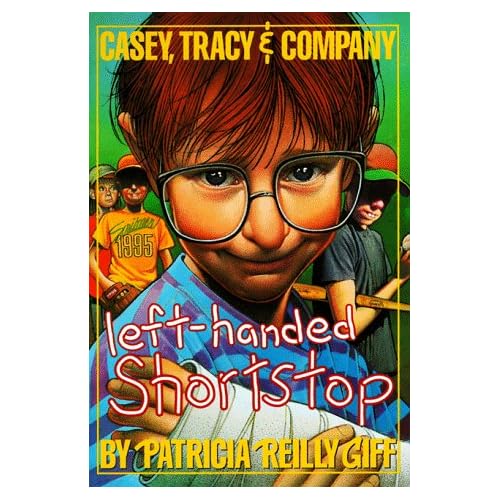
My internet investigation uncovered a few other interesting tidbits. First, there's a book called "Left-Handed Shortstop," apparently centered around a kid whose manager doesn't want to tell him that lefties can't play short. Also there was a college shortstop in softball a few years back who won the position in an open competition, despite being left-handed, and caused a sensation in the NAIA. Considering the shorter softball basepaths and quicker reaction times, I doubt that this player had the so-called problem of throwing to first-base quickly.

It's looking more and more that the bias against left-handed infielders is due to the vagaries of baseball tradition more than anything else. In addition, the notion in the article about left-handed catchers may be valid: if you're a kid and you're left-handed, chances are the manager is going to try you at pitcher. He might stick you in the outfield on non-pitching days, due to tradition, and the dearth of lefty infielders continues.

Monday, August 04, 2008

Matt's Yankee Stadium Memories: Part II

In Part I, I told the story of my first memories in Yankee Stadium, at the tender age of six. It would be more than a decade before I returned to the Bronx. I was not devoid of baseball in the meantime; in 1994, the St. Louis Cardinals moved their short-season single-A minor league team to Augusta, NJ. Over the next several years I attended more and more games, until eventually our family had season tickets. They were in the section behind home plate, in the last row of the top section of reserved seats. Behind us was a railing, and I brought the tradition of hanging K's to Skylands Park. A number of the pitchers told me they looked up to see how many they had, and I was even interviewed for local TV once. Not many players made it to the majors from those teams- Adam Kennedy, Matt Morris, Chris Richard, and Coco Crisp (who went by "Covelli" then) are the few I remember. But since these games were considerably cheaper and closer, my live baseball fix moved away from Yankee Stadium.

I returned to the Bronx in my senior year of high school after quite an ordeal. The tickets were organized through our school's chapter of the Future Business Leaders of America (FBLA). We had seats in the upper deck the previous season for a game against the Red Sox, but the game was rained out. The rescheduled game occured after 9/11/01, and our school forbid us from returning to NYC so soon afterwards. Instead the tickets were refunded and we used them the following year on a Yankees-Devil Rays game on May 14, 2002.

We sat in section 333, in fair territory over the right field fence. It was definitely the closest I've gotten to the field to watch a Yankees game, I could actually read the players' jerseys. During the first inning, we joined in the Bleacher Creatures during roll-call, from John Vander Wal to Bernie Williams all the way to Robin Ventura at third base. They then did their "Box Seats Suck" chant, which we found confusing. Still, Roger Clemens was on the mound and he started the game off in style, getting two strikeouts in the first inning and another two in the second. The Yankees were going down similarly in order, and we thought we were in for a pitchers duel, despite the fact that the Devil Rays had a pitcher I'd never heard of, Travis Harper.

Things started to fall apart for Harper in the third, as Vander Wal hit an 0-1 pitch deep to left, into the visiting bullpen. We all went crazy as the Yankees took a 2-0 lead. Though Clemens allowed a run in the top of the inning, Harper couldn't keep up the low scoring affair. In the fourth, Jason Giambi crushed a 2-0 pitch right at us! The ball didn't tail enough to make it to our section, but landed in our row in the next section over. I thought, well, that's the closest I'm going to come to catching a home run ball. It didn't take long to test that theory. Two pitches later, Jorge Posada ripped a ball that headed directly towards me! The only problem was, it was about sixty feet above my head, and landed in the mezzanine. As Yankees Radio man John Sterling must have said, "backa-to back, and belly-to belly!" Harper was quickly out of the game, and I'm not sure this actually happened, but in my mind I believe they played "Hats off to Harper" at the Stadium as he slowly walked for the showers.


The game calmed down for a bit after that, and Clemens was lifted in the sixth inning, but the Yankees' offense wasn't done. Up 4-1, they added another six runs in the eighth inning, all off of Jesus Colome. While exciting, I was a bit disappointed because I was looking forward to seeing Mariano Rivera pitch live for the first time. Instead, we got Ramiro Mendoza, who gave up a homer to seal the final score at 10-3.

Our group happily piled its way back onto the bus, where I believe a few friends and I recited the entire script of Monty Python and the Holy Grail from memory. Good times.

Sunday, August 03, 2008

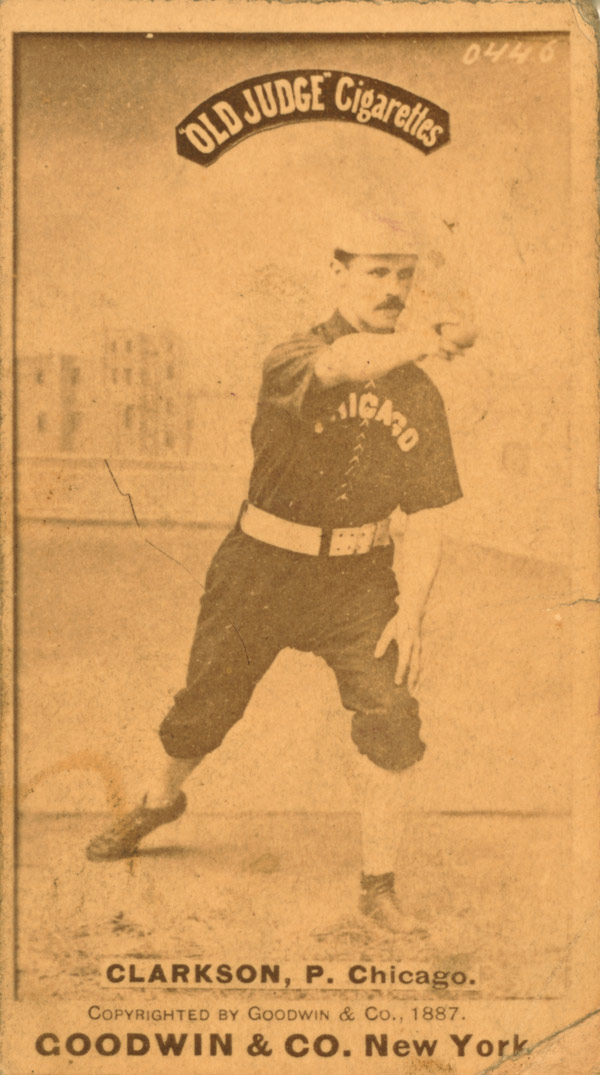
Immaculate Inning: John Clarkson

From the very beginning, this blog has been dedicated to the collection of knowledge associated with a very specific baseball feat. I'm speaking of course of the Immaculate Inning, that frame of domination achieved just 41 times in major league history. Since the inception of the blog, there have been three Immaculate Innings in the major leagues (and one chronicled in the minor leagues). It is also important to understand the achievement's history. With that in mind, I am starting a new series here at Immaculate Inning that chronicles the 38 men with this distinctive honor. First up: John Clarkson.


John Clarkson threw what is recorded as the first Immaculate Inning in major league history on June 4, 1889. Given the relative obscurity of nineteenth century baseball, it's amazing that we not only know it happened, but know a great deal about the man who twirled the historic inning for the Boston Beaneaters. On the other hand, it may be that the only reason we know about the immaculate inning is because John Clarkson tossed it. To many baseball historians, Clarkson was the first transcendent pitcher in baseball history, in a time when the position was still in its infancy.

Clarkson's wikipedia page is stocked with a ton of information about the man who retired with a record of 332-178, and was elected to the Hall of Fame in 1963. Clarkson was born in Cambridge, MA into a wealthy, educated, baseball family. Two of Clarkson's brothers, Arthur (who played as "Dad Clarkson") and Walter played in the National League; in addition, two cousins of Clarkson (brothers Mert and Walter Hackett) also spent time in the majors. But none was so accomplished as John.

John Clarkson started his career with the Worcester Ruby Legs in 1882 (at the age of 20), then spent a year in the minors before coming back with the Chicago Cubs. Clarkson pitched in Chicago for four years, tossing over 1700 innings. In the meantime, the rules for pitchers were in constant flux. As this profile of Clarkson notes, the number of balls that issued a walk changed four times during Clarkson's career- from seven in 1882 to six in 1884 to five in 1886 and four in 1889. In 1887, a strikeout took four strikes (the only season this rule was in effect). The pitching mound also evolved during this time, from a 4'x6' box 50 feet from home to a slightly raised 4'x7' box. Pitchers were required to pitch with one foot on the back line of the box from 1887-1893, when the rubber was finally introduced and the distance of 60 feet, 6 inches stayed put.

Most significantly, Clarkson was forbidden from throwing overhand until 1885; pitchers were required to throw underhand. Still, Clarkson adjusted well to the change, throwing 623 innings in 1885. In 1888, Clarkson was sold (for a then-outrageous sum of $10,000) to the Boston Beaneaters, and returned home to play for the next five and a half seasons. It was during Clarkson's most dominant season that his historic inning took place.

In 1889, Clarkson was the main pitcher for Boston, in a time where each team had a primary pitcher and a few backups. He would finish with 49 wins, a 2.73 ERA, and 284 strikeouts, winning the pitching Triple Crown- he also led the league in various other categories (including walks, as it was the first year of the four-balls-walk rule). On June 4, the Beaneaters took on the Philadelphia Quakers. The Baseball Almanac records that the immaculate inning occured in the fourth, but does not note which batters Clarkson faced that inning. One might imagine that Jim Fogarty was involved, as he finished tied for fourth in strikeouts in the National League that year.

UPDATE: A sudden obsession with peeling away the truth about immaculate innings led me to purchase this article from the June 5, 1889 edition of the Boston Globe. I was not disappointed. A few excerpts:

Clarkson and Sanders both did good work, the Boston boy getting most of the glory. He struck out Fogarty, Thompson, Mulvey, Farrarr, and Irwin in succession, and seemed to have little trouble in keeping the visitors from tracking the ball.... Clarkson was on to pitch in this [sixth] inning. Thompson and Fogarty struck out on six pitched balls, and Farrar followed them in fauning the atmosphere... Clarkson had a full head of steam. In the sixth inning he struck out the first two men on six balls. The third man in the same inning was also made to knock three big holes in the air.

The article has a substantial play-by play of the game, and a detailed box score. The men referenced in the article are Jim Fogarty (mentioned above), Sam Thompson, and Sid Farrar. The obsession with Immaculate Innings began when I found the Baseball Almanac page about it- notice that this site does not have available Clarkson's immaculate victims. Well, we present them to you for the first time!

The immaculate inning that Clarkson threw is perhaps the least-chronicled part of his life. We don't fault history for this, no one could have known in 1889 how rare the feat would be. The rest of the 1889 season was eventful for Clarkson and the Beaneaters, involved in one of the first great pennant races, which was chronicled in a recent book, Tale of Four Cities. The Beaneaters lost the championship by one game. The next season, Clarkson particpated in a player's rebellion that saw the formation of the Players League, but eventually relented and returned to Boston. Clarkson finished his career with the Cleveland Spiders before retiring to Michigan to open a cigar store, and developed mental problems. He died in a psychiatric ward, from pneumonia in 1909.

It is clear that John Clarkson is a worthy man to have acheived the first immaculate inning. One of the National League's first true greats, a pioneer on the mound during a turbulent time for the sport, and a handsome looking chap. A fitting way to begin the journey of the Immaculate Inning.

Photo: 19th Century Baseball

Saturday, August 02, 2008

Here Come the Marlins!

The Marlins lost last night along with the Phillies and the Mets which keeps the standings in place. As it is right now they're a game and a half behind the Phillies and a game behind the Mets.

Why will the Marlins win the NL East? The immediate reaction is to dismiss the question outright. They're the Marlins for crying out loud. Well, there's about 50 games left to go and they're absolutely in the thick of the race so dismissal isn't really valid. In a related note, saying that they don't have the "talent" to compete also doesn't apply at this point in the season. As of August 2nd, the Marlins are 6th in the league in Runs Scored and tied for first with the Phillies for home runs. They don't have the names, but they know how to hit. Uggla's recent slump is worrying though...

The pitching is whats been holding them back. Only the Rockies and the Pirates have given up more runs. The opening day starter this year was Mark Hendrickson with his career ERA+ of 88. Despite not making a huge move at the trade deadline the Marlins still drastically improved their bullpen, Marlin-style. Josh Johnson returned in early July from Tommy John surgery. In 2006, his last full season, he had an ERA+ of 139 in 157 innings pitched. Anibal Sanchez returned on July 31st. In his injury-shortened 2006 he had an ERA+ of 152 in 115 innings pitched. So, the Marlins get two theoretically above-average starters. This means they can move pitchers like Hendrickson to the bullpen, where they belong.

Next week is crucial as they have 3 games series against the Mets and the Phillies. At this point it's hard to see any team getting knocked out of it short of the Fish going 0-6, but it's hard to make up ground in the standings when you're behind two teams, so this is a golden opportunity to move up the board.

Friday, August 01, 2008

Randy Johnson Trades: Revisited

While future hall of famers were being whisked across the country in blockbuster trades yesterday, the Yankees made a minor move of minor leaguers that went largely unnoticed. In it, Brian Cashman sent AAA infielder Alberto Gonzalez (no, not that one) to the Washington Nationals organization in exchange for AA pitcher Jhonny Nunez. With this trade, three fourths of the haul from the 2006 Randy Johnson trade are now out of the organization. What follows is a look back at those deals and the impact on the players and the Yankees.

To begin, Randy Johnson was acquired in the fall of 2005 from the Arizona Diamondbacks. The Yankees were trying to recover from The Collapse of 2004, and it would be George Steinbrenner's final tyrranical off-season. In order to buy out Johnson's no-trade clause, the Yankees signed the 40-year old pitcher to a three year extension, which paid him $16 million. The money spent on RJ following this trade was later used by Cashman as a reason for not signing free agent Carlos Beltran, who went to the Mets for $13M/year. The trade losses:


Javier Vazquez: Aquired via trade in the previous offseason (for Nick Johnson and Juan Rivera), Vazquez pitched servicably for the Yankees during the regular season, leading the team in innings pitched and strikeouts. His ERA was below average (ERA+ of 92) but he was a workhorse in an otherwise aging rotation. It was the post-season that punched his ticket out of town, including this game, which I am pretty sure never happened or will be spoken of again. Since the trade, Vazquez has had a couple league average seasons- one with the Diamondbacks and one with the White Sox, in addition to a good 2007 season. It's possible that New York was just too much for Vazquez, but his loss isn't too great.

Dioneer Navarro
: It was his addition in the trade that most angered me at the time. While the Yankees' farm system has beefed up nicely in recent years, the prospects at catcher remain far away from the majors (especially when they get decked in spring training). In the meantime the Yankees played with fire, no one even approaching respectable to replace Jorge Posada in the event of injury. Well, this season the fire finally burnt, and the Yankees had to make a big trade to fill the void. If, instead, they'd held onto Navarro, they could be enjoying the kind of production he's currently giving the first place Rays: .313/.370/.421 and an All-Star appearance.

Brad Halsey:
For a while it looked as though Halsey might stick as a major leaguer- he was, after all, left-handed. But Halsey struggled for the Diamondbacks and A's, and his only claim to fame was giving up Barry Bonds' 714th home run.

Randy Johnson's two seasons in the Bronx were mixed; in 2005 he pitched well, 225 strong innings with an ERA+ of 112, and a solid strikeout ratio. But in 2006, RJ fell apart, ERA+ was 90, the strikeout rate dropped and so did his effectiveness. After a terrible ALDS against Detroit, Johnson was looking for a way out. Brian Cashman granted his wish on January 11, 2007, almost exactly two years from his previous trade. The haul:


Luis Vizcaino: The Viz would join the Yankees as his fourth team in as many years, but he had really kicked up his strikeouts (72 in 65 IP) as the Diamondbacks' set up man. The Yankees had him take charge of the seventh inning and he pitched okay- but with far too many walks. He had two of them, along with two hits, in just 2/3 of an inning in the 2007 ALDS, and his return was never likely. Vizcaino was offered arbitration following the 2007 seaosn but declined, netting a suppelementary round draft pick for the Yankees in the 2008 June Amateur Draft.

Alberto Gonzalez-
The impetus for this piece, the man the blogs nicknamed The Attorney General (although it may be spelled differently: baseball-reference has him one way, milb.com another). A slick fielding, average-hitting shortsop, Gonzalez looked to be the kind of player the Yankees were looking for to replace the Miguel Cairos of the world- someone who could actually field multiple positions and not look totally lost at the plate. Unfortuanately, Gonzalez never developed much, with an OPS below .700 in both seasons in baby pinstripes. He was also awful at the plate in two major league callups, but never had much of a shot, not with The Captain in front of him.

Ross Ohlendorf- The former Princeton student struggled as a starter in his first season in the Yankees' organization, and the team made the decision to convert him to a reliever. Initially it worked out well, and Ohlendorf finished the season with important innings in the big leagues. But despite picking up a few mph on his fastball, Ohlendorf could not consistently get men out in the majors, and had been demoted prior to the Nady/Marte trade. He was starting again in Scranton; one rumor had him being re-converted to a starter, while another rumor was he was trying to learn a splitter. Either way, he's out of the organization as well.

Steven Jackson- Coming off a great season in AA (in the Arizona organization), Jackson had high promise coming to the Yankees. However, he struggled at both AA Trenton and AAA Scranton, and has bounced between the levels again this year. As a 26 year old, he's not much of a prospect any longer. While he's the last remaining direct evidence of the trade, he will probably not amout to much at the big league level, if any.


Finally, we have the aftermath in 2008. First of all, the Yankees used their supplemental draft pick on Jeremy Bleich, of Stanford University. Despite some injuries and seemingly sub-par statistics, Yankees fans and blogs have grown on Bleich, especially after this vote of confidence from Baseball America's John Manuel (though I'm not really sure what "But he's a guy." means...) Next we have the big trade, Ohlendorf and others (frontlined by 19-year old prospect Jose Tabata) sent to the Pirates for Xavier Nady and Damaso Marte. From the reports of the trade, Ohlendorf was the other key guy, and the Pirates chose from a list of minor leaguers for the other two spots. Still, despite a mediocre performance in the big-league pen, Ohlendorf had enough value to improve the Yankees for 2008 and beyond.

This brings us back to the final trade: Gonzalez for Nunez. While I established above that Gonzalez didn't bring much to the table for the Yankees, he's still by far the most major-league ready infielder the Yankees have; in the event of an injury to Jeter or Cano, the Yankees will struggle to put someone who can at least field the position adequately. Nunez, meanwhile, is a bit of a mystery. He's 22 years old and doing well at AA, so he still has a prospect status, and is apparently a fastball-slider type pitcher. But no more is known about him.

So, what to make of the trades? I still think that the first RJ trade was one of the worst "Steinbrenner moves," and with Cashman in control the Yankees would have been a better team in 2005 and 2006. Still, the trade haul for him has given the Yankees useful players both this year and, as a result of subsequent trades, next year.