Tuesday, July 22, 2008

Ed Price: Wrong; Craig Breslow: awesome

I was reading through Emma Span's excellent blog, Eephus Pitch, when I came across this link. Ed Price of the Newark Star-Ledger notes that Twins pitcher Craig Breslow threw two wild pitches and also balked. Price cites the baseball-reference.com Play Index and declares that this is the first time any reliever has accomplished such a dubious feat.

Well, you know that I have an affinity for both the B-R.com play index and dubious random feats, so I decided to see what other balk-walk combos there have been. I started with Price's search, and here are the results. As you can see, Breslow is far from being the first ever reliever to have two wild pitches and a balk in a single game. It has been a while since someone has done it, but it's happened sixteen times since 1956. Some pitchers have even had two balks to go with their two wild pitches.

So I don't know what kind of search Mr. Price did, but Breslow is not remarkable for what he did last night. He is, however, a remarkable person. A journeyman left-handed pitcher, Breslow graduated from Yale in 2002 with degrees in both molecular biophysics and biochemistry. After his first season in pro-ball, he interned at a Yale lab studying stem-cell research. Since then he has started a cancer-reasearch charity, the Strike3Foundation, with his sister, a thyroid cancer survivor. Kudos to anyone else who combines my dual love for biology and baseball!

As for Ed Price, well....


Update: Ed Price has altered his post and apologizes for the misleading info. Hooray!

Thursday, July 17, 2008

Left-Handed Third Basemen

In the year-and-a-half since I've started the blog, there have been 109 posts. According to my Stat Counter statistics, the most popular post of all is this one, on the history of left-handed second basemen in the major leagues. Well, I've never been one above pandering to my audience, and plenty of people have come here in search of answers regarding other southpaw infielders. So let us take a look at the history of the even rarer Left-Handed Third Baseman.

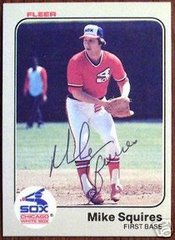
The play-index over at Baseball-reference.com allows one to search on a variety of parameters, and here is the result of searching for all hot-corner lefties since 1956 (the first year of full regular-season box score data). Indeed, there are just four players to have donned gloves on their right hands and played third base in the last fifty-four years. The earliest of these is Mike Squires, whose official position was third base in 13 games spread over two seasons.

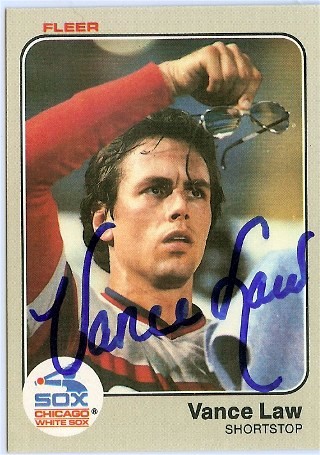
The first game was on August 23, 1983. Squires had played over five seasons in the majors at this point, primarily at first base, even earning a gold glove in 1981. But on this day Squire's White Sox were getting blown out by the Royals, and manager Tony LaRussa decided to clear his bench. Between the sixth and eighth innings, LaRussa replaced all but two fielders. Quizzically, he did not replace first baseman Greg Walker with Squires, instead having the latter replace Vance Law at third base. In doing so, Squires was noted at the time for becoming the first left-handed third baseman in over 50 years, which reaches back beyond the baseball-reference.com data.

That Time Magazine article notes that Washington Senators first baseman Joe Kuhel attempted one game at third base in 1936. BR.com does record Kuhel's fielding at first base but not third; however, retrosheet.org records Kubel as having two assists in a game in 1936. The box-score of this game has, presumably, been lost to the sands of time.

Mike Squires, meanwhile, did not record a putout or assist in his first action at third base; that would have to wait until 1984. On April 8, LaRussa pinch hit Squires for Law in the bottom of the seventh and then sent him to third for the eighth. Squires was immediately tested as Tigers' hitter Lance Parrish grounded one to third. Squires fielded and threw cleanly for the first assist by a left-handed third baseman in 48 years. In total Squires made 3 putouts and had 9 assists from third base in his 38 innings there, earning a perfect 1.000 fielding percentage. Notably, Squires played two innings at catcher in the major leagues, another position with very few southpaws.

Squires also managed to have an interesting three-position gambit in one game: first-base, third-base, pitcher. Yes, on April 22, 1984, Squires was asked to finish a game against the Detroit Tigers. He had started the game at first base; moved to third in the eighth, and then with two outs in the eighth LaRussa called on Squires with runners on first and second. Squires threw one pitch to Tom Brookens and induced a fly ball to centerfield to end the inning and Squires' pitching career. Surprisingly, this position combination has been tried four times since 1956; and two of them are by a friend from the last paragaph-- Vance Law.

The world would not have to wait another half-century for the next lefty third-baseman. Just over a year after Squires' final game at third base, Montreal Expos manager Buck Rodgers followed LaRussa's lead and inserted left-handed Terry Francona at third base. It was October 6, 1985, the last game in a third-place season for the Expos, and the starter at third base was-- Razor Shines. The 28-year old had a name much better than his ability (hit .185/.239/.198 in 81 career at bats). Wikipedia notes that he spent sixteen years in the minors, and is currently a manager for the Clearwater Threshers of the FSL. Anyway, Rogers must have seen enough (or there was an injury) and replaced Razor Shines with utility player (and current Red Sox manager) Terry Francona. It was the only appearance at third base in Francona's career, and he made good on all three of his assist chances. Francona was then replaced himself in the bottom of the eighth by.... Vance Law. Cue creepy music.

It would be a not quite a year after Francona's game at third, when the New York Yankees suffered an injury to regular third baseman Mike Pagliarulo on August 25. The Yankees then left for a west-coast trip, and in a game on August 29, suffered another injury, this time to shortstop Mike Fischlin. Mattingly himself vaguely recalled the circumstances in a November 2004 interview on his website. From the boxscore, it seems as though the players were shuffled around the field, with Mattingly moving from first to third. Mattingly started an around-the-horn double play to end his first inning of work at the hot corner. He would have five other assists and a putout in the rest of the game. The next day, Mattingly actually started the first game in a doubleheader at third base, though he moved to first in the sixth inning. Wayne Tolleson replaced him at third and started the second game. Pags did pinch hit in both games but did not return to regular action until September 4. Mattingly played one more game at third and that was it for his career.

Another decade passed before the next, and latest lefty third baseman. Mariners' utility man Mario Valdez pinch hit in the 8th and then played his only inning of third base in the ninth inning, but did not have a ball hit to him. And that's all for left-handed third basemen. The prospect of having to turn your back to the plate to throw across the diamond must not be appealing to most managers. One would think it would be an advantage on reaction plays down the line, while a disadvantage over a ball between third and short. Fielding bunts down the third base line would also be quite difficult for a lefty, I suppose.

Next time, we'll check out the even shorter list of left-handed shortstops. I find these investigations extremely interesting, because I get to pick out some of the rarer things in baseball history, and they always seem to coincide with other wacky events!

UPDATE: Be sure to check out the final installment, left-handed shortstops!

Tale of the Tape


Source: ESPN

Unless, of course, this unsubstantiated rumor were true. Which it isn't.

Dear Brian Cashman:

Wednesday, July 16, 2008

The Anti-Cookie


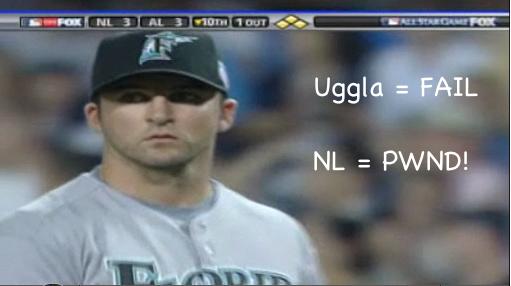
If there were such a thing as an anti-cookie, Dan Uggla has earned it. With a chance to highlight the Marlins' surprising season on national TV, Uggla entered the All-Star game in the bottom of the sixth as a defensive replacement. His night:

Bottom sixth: Caught pop-up off bat of Joe Crede for the second out.
Top eighth: Struck out swinging with go-ahead runner on first.
Top tenth: With two on and one out, grounded into a 4-6-3 double play
Bottom tenth: Botches an easy grounder to allow Michael Young to reach leading off
Bottom tenth: Next batter, Carlos Quentin, also hits one to Uggla, and it bounces off his chest for another error.
Bottom tenth: The very next batter hits another one to Uggla, and with the bases loaded Uggla takes his sweet time throwing home, allowing Sizemore to reach base, re-loading the bases.
Top twelfth: Uggla strikes out looking on three pitches, including getting frozen on a 67-mph curveball from Joakim Soria.
Bottom twelfth: Uggla manages to not screw up, getting Grady Sizemore on a ground out despite not catching the ball cleanly.
Bottom thirteenth: J.D. Drew reaches on Uggla's third fielding error, which sets an All-Star game record.
Top fifteenth: Uggla manages to get to four pitches this time but strikes out on a 93-mph fastball from Scott Kazmir.

So, Uggla had five ground balls hit to him, and he fielded none of them cleanly. He batted four times and failed miserably each time. Sure, none of the errors actually resulted in runs for the AL and the NL managed to score runs in two of the innings where Uggla batted. Still, for such an epic breakdown on a national stage, we shall reward him with the first ever Food Lion Anti-Cookie (Definitely Not Sponsored by Food Lion). If I could follow him around all day giving him the sarcastic slow-clap, I would.

Also, to the National League: thanks for playing. Your inferiority is unparalleled.

Monday, July 07, 2008

Shannon Rowbury-- Olympian

If there is one area of society through which most Americans live vicariously, it is the world of sport. Those of us blessed with only enough athletic talent which is useful for such feats as company softball and backyard beer pong have to gain their glory by raising athletes to hero status. Their success is ours; their rivals' defeats our schadenfraude. For me, I find this kind of self-worth especially gratifying when looking at people my own age, the success of others somehow justifying my mediocre existence; at least someone has done something with the same 24 years I've gotten.

So it was with great pride that I watched the women's 1500 m race at the US Olympic Trials in Eugene, Oregon last night. The favorite going into the race was fellow Duke graduate Shannon Rowbury, who previously had turned in the fastest US time in five years at an earlier meet. Rowbury was in my freshman dorm at Duke, and so somehow I feel that the vicariousness is closer. Also in the race was former UNC student Erin Donahue, who I met while attending a track camp back in high school. As they announced the contestants, there was another interesting side-story, a 16-year old girl, Jordan Hasay, had qualified for the final, shattering the high school record to do so.

Soon after the gun sounded, a slow pace was set by some of the underdogs in the race. This seemed to be counter-intuitive; in order to go to Bejing, a runner not only had to finish in the top 3 but also make the Olympic qualifying time of 4:07.00. Only five runners in the race (including Rowbury and Donahue) had such a mark, so it would have made sense for those who had not eclipsed that time to do so in this race. After running the first 1100 meters in about 2:50, Rowbury tired of staying with the pack and broke free. Her lead over the second group widened with 200 meters to go and Rowbury crossed the finish line with a solid 4:05.48. Said Rowbury after the race:

"I reacted well and was able to bring home the win. I'm so excited because we have a great contingent going to Beijing. Should be an exciting next couple of months and I can't wait till August."

Rowbury joins several former ACC track stars on the US team. Donahue qualified by finished second in the race, and Walter Dix of FSU filled the gap voided by injured superstar Tyson Gay by winning the 200 m final in 19.86 seconds. Fellow Duke grad Jillian Schwartz failed to qualify in a hotly contested pole vault field; a headwind complicated matters and even Sydney gold medalist Stacy Dragila failed to qualify.

Shannon Rowbury joins an illustrious cast of successful characters from my freshman dorm. There's Doug Kim, who finished at the final table in the 2006 World Series of Poker; Dan "DJ Sensei" Morris has also made a name for himself in the world of online poker. Yet another poker player, Dave Mosca, has his own start-up company. Someday, when this blog is the number one blog about a quirky baseball feat, I can join their lofty status. Someday.

Friday, July 04, 2008

Checking in on Da Bulls

It was more than a year ago when we awarded our very first Publix Cookie Lifetime Achievement Award to Chris Mason, then pitching for the Montgomery Biscuits. He threw an Immaculate Inning, and while this sort of thing may be more common than we realize in the minor leagues, it was the first we had heard about. The pitching coach that day actually said he was disappointed in Mason for not "working the count," but of course pitching an Immaculate Inning is way more impressive than throwing waste pitches so far out of the zone that it makes the hitter giggle. Mason finished last season very well, throwing 161.1 innings with 136 strikeouts, 44 walks, and a sparkling 2.57 ERA. The Gastonia, NC got to come home this season as he was assigned to the Durham Bulls.

Last night, I went to see the Bulls take on the Charlotte Knights, and Chris Mason was the starter. Mason has struggled this season, and holds a 6.38 ERA in 17 starts, though he's still striking out a lot of hitters- 77 in 86 innings, with a respectable number of walks (29). He's just giving up way too many home runs, 18 so far! He's currently the worst starter on a staff that is in the middle of the pack in the International League (4.51 runs/game). It's the excellent hitting that has propelled the Bulls to first place in their division. On July 3 they were taking on a Charlotte Knights team that was 10 games under .500, but this game was all Knights from the beginning.

In the first inning, Mason came out throwing his 92 mph fastball up in the zone, and paid for it. He gave up a leadoff double to Jason Bourgeois, a 26-year old minor league lifer. After inducing a groundout to first, up came David Cook, another 26-year old only recently promoted from AA. Cook jumped all over a 2-1 slider and hit a bullet to the centerfield lawn for a two-run homer. Mason later gave up a double in the inning, but stranded that runner. The second inning didn't start off well, allowing a bloop single to yet another 26-year old, Fernando Cortez. Backup catcher Hector Gimenez tried to pick off Cortez with a snap throw that ended up going down the right field line. Mason walked the next batter and then Knights manager Gary Allenson went small ball, calling for a sac bunt followed by a Sac Fly from Bourgeois.

Mason then calmed down for two innings, and had a nice play on a comebacker in the fourth inning, making a diving stop to his left. He would give up another run in the fifth on a double by Bourgeois and an RBI single by Danny Richar, but got a 6-4-3 double play to end the first half of the game with the Bulls trailing 4-0. Mason's night was done and the numbers weren't pretty: 5 IP 6 H 4 R (all earned) 1 BB 3 K, and just 49 of his 76 pitches were strikes. The Bulls would rally in the bottom of the fifth, including an impressive play by first baseman Chris Richard, who scored from second on an infield single. Fernando Perez would add a two-run double to make the score 4-3, but the Knights pulled away in the 7th inning due to innefective relief work from Kurt Birkins and Nick Debarr (whose first pitch was wild, allowing the fifth run to score from third).

The loss drops Mason's record to 3-9 on the season, but he gave up another home run, which is probably more damaging to his prospect chances. Mason recently turned 24, and with Tampa Bay's pitching staff beginning to come together, Mason needs to regain the control he had as a Montgomery Biscuit last year. As for the Bulls, their strengths continue to be hitting, though they are weaker on the prospect front than previous years. The top youngsters on the team are infielders: there's Reid Brignac, a 22 year old shortstop who didn't play last night. Eliot Johnson played short last night but normally plays second base; the 23 year old is infamous already for colliding with Yankees' catching prospect Fransisco Cervelli in a spring training game, breaking the catcher's wrist. Finally there's 23-year old 3B/OF Joel Guzman, who is playing in his third season with the Bulls. Guzman is famous locally for a tape-measure home run in 2007 that reached, in dead centerfield, the third floor of the then under-construction Diamond View office building. Guzman has the most cups of coffee of the three, with 56 days in the majors; still, his development is hampered by a puzzling inability to get on base- for both 2007 and 2008 his OBP is just .281.

Also of note in the game was an ejection for my least favorite Durham Bull- Justin Ruggiano, for arguing balls and strikes in the fourth inning. Ruggiano may be the Bulls' player closest to the majors, getting a chance to hold down right field for the Rays after they traded away Delmon Young. Ruggiano performed well in the majors but was demoted after the Rays traded for Gabe Gross. Still, the reason I despise Ruggiano is for two lazy incidents in the field during games I
attended. The first was opening day of 2007, when Bulls ace Mitch Talbot left after six innings, yet to give up a hit on a cold, breezy day. In the seventh, the first batter hit a looping ball towards right field. Ruggiano was slow to react and moved in the general direction of the ball, which fell about a foot in front of him for the first hit of the game. The crowd booed Ruggiano with great anger. Later that season, I attended another game in which the Bulls were leading after 8 innings; however, the Bulls closer imploded and the game was tied. There was a runner on first with two outs, and there was a solid hit down the right field line. Ruggiano took his sweet time
getting to the ball as the go-ahead run raced around the bases. Rather than try to get the runner at the plate, Ruggiano offered up a looping throw in the general direction of the first baseman, and the Bulls went on to lose the game. So, despite Ruggiano leading the Bulls in basically every offensive category, I will always hate him.

It is certainly encouraging to the Tampa Bay Rays and frightening to the rest of baseball that they not only have the best record in the majors, but their AAA team is also one of the best. To me, though, the prospect-status of the Bulls has waned from the years of Evan Longoria and BJ Upton; this team is full of 25/26 year old AAAA-type players. The true prospects are on the way- I plan on going to see as many of David Price's starts as I can, if he comes to Durham

Wednesday, July 02, 2008

Matt's Yankee Stadium Memories: Part I

As some folks may have heard, the Yankees will be playing their final games at E 161st and River Ave this season, as Yankee Stadium will be torn down and replaced by a newer, cleaner version across the street. Now, baseball fans are already pretty nostalgic, and Yankee fans especially so, given all the great teams of the past. Add to that the impending end of The House that Ruth Built, and you've got a perfect storm for the nostalgia. A number of Yankee fans over at Bronx Banter have been sharing all season how they've planned their last (and sometimes first!) trips to the Stadium. In a season where it looks as though the playoffs are but a dream, still fans are flocking to the park pilgrimage style. I am not immune to this behavior, and I will be making my last visit to the Stadium on July 8 to watch the Yankees take on the best team in baseball: the Tampa Bay Devil Rays.


This will be, I believe, my fifth game in Yankee stadium. I went to one game in high school, one while in college, and two when I was very young. My only memories of my first game in Yankee stadium was that the game was against the Oakland A's, was probably in the summer of 1989, and the Yankees lost. According to baseball-reference.com, the Yanks did host the A's for three games on Memorial Day weekend, and lost all three- this is a good indication I was there for one of those games.


I was a year older when we went to my second Yankees game, and I remember more about the game, but not the opponent. The first thing that jumped into my head was that Steve Balboni (pictured) pinch hit, got on base, and was immediately lifted for a pinch runner. For some reason I considered these moves odd, and they stuck with me. I also remembered that we went to the concession stand at some point during the game and missed a home run by Kevin Maas. These two memories were enough for me to pinpoint the game; it was against the White Sox on July 14, 1990.

It's too bad I don't remember all of the details about this game, because it looks like a good one. Sure enough, Steve Balboni hit a single to left field in the bottom of the seventh inning, while pinch hitting for catcher Matt Nokes. He was replaced by pinch runner Wayne Tolleson, who ended up scoring two batters later on an RBI single by Kevin Maas. The then 25-year old Maas was playing in just his twelfth career game that day, and already he was hitting .280/.400/.560. His 3-for-5 effort on July 14 raised his career OPS above 1.000, where it bounced around for the remainder of the season. He eventually played in 79 games with a .252/.367/.535 line and 21 home runs, including the one he hit during the fourth inning while I was off getting a hot dog with my dad. Maas would continue to play parts of three more seasons with the Yankees, never showing a glimpse of the "Home Run Kid" power he had in his first games in the Bronx. One of the top Yankees' blogs is dedicated to his brief moments of brilliance.


There were a number of famous players White Sox involved in the game: Hall of Famer Carlton Fisk had a pinch-hit groundout in the fifth; likely Hall of Famer Sammy Sosa was in his second big league season and went 0-for-5 hitting eighth. Current White Sox manager Ozzie Guillen was 3 for 5 while hitting 9th, and FOX announcer Steve Lyons was also in the game. Most historically, Bobby Thigpen set the single season record for saves in 1990, and picked up save number 29 of 57 in this one, though I probably missed it. Knowing my family we probably left with the game tied in the ninth.

This Yankees team is the first one I truly remember, and I knew all of the players. One of my first cherished baseball card sets was the 1991 Fleer Yankees set-- it was one of the very last true cardboard sets, before every company started going to glossy finishes on their cards. And what a way to go out, with quite possibly the ugliest baseball cards ever. Still, I can remember most of that team off the top of my head:

C: Matt Nokes, Bob Geren
1B: Don Mattingly, Kevin Maas
2B: Pat Kelly
SS: Alviro Espinoza, Randy Velarde
3B: Jim Leyritz
LF: Mel Hall, Oscar Azocar
CF: Roberto Kelly
RF: Jesse Barfield
DH: Steve Balboni

SP: Tim Leary CL: Dave Righetti
SP: Chuck Cary RP: Lee Gutterman
SP: Andy Hawkins RP: Greg Cadaret
SP: Mike Witt RP: Erick Plunk
SP: Dave La Point

I only had to look up third base (I'll always remember Leyritz as a catcher) and two of the starting pitchers. After Mattingly, Jesse Barfield was probably my favorite player on this team. I got to meet Barfield a few years later, while at a New Jersey Cardinals game, and told him as much. He thanked me as he signed one of the K's I brought to the games to hang up on the railing behind my seat.

Still, this team was terrible, they lost 95 games and were actually above their Pyhthagorean record. Two weeks earlier, the Yankees had lost despite Andy Hawkins allowing no hits through his 8 innings. Two weeks after this game, George Steinbrenner was banned from baseball for life because he'd hired a gambler to dig up "dirt" about Dave Winfield in order to get out of a $300,000 commitment to the Dave Winfield Foundation charity. Most folks believe that it was under the direction of Gene "Stick" Michael, without the meddling hands of Steinbrenner, that the Yankees dynasty of 1996-2001 was built. So the first game I can remember in the Bronx came at a pivotal time in my favorite team's history. But all I was concerned with was why a pinch hitter was lifted for a pinch runner immediately after getting on base, down by 3 runs in the seventh inning...

Next time, I'll review the next game I saw in Yankee Stadium, which was more than 10 years later.

Monday, June 30, 2008

Bonds: What are you waiting for?

Since the return of Alex Rodriguez to a struggling lineup on May 20, the New York Yankees are 24-14, scoring 5.36 runs/game (compared to 4.06 through the first 44 games of the season). The performance, combined with stellar pitching from Chien-Ming Wang (before he got hurt), Andy Pettitte (3 ER in his last 27 IP), Mike Mussina (2nd in the AL in wins), and Joba Chamberlain (1.84 ERA in 5 starts)... has propelled the Yankees to within five games of first place in the extremely competitive AL East.

On June 22, designated hitter Hideki Matsui limped off the field during a 4-1 win over Cincinnati and hasn't played since. It's another injury on his surgically-repaired left knee, which has landed him on the 15-day DL. Manager Joe Girardi acknowledged on Sunday that another (season-ending) surgery could be in order. If that's true, the Yankees' lineup will suffer much like it did without Alex Rodriguez. The Yankees' farm system is light on power-hitting bats in the high minors, and the trade market isn't strong yet. If only there were a slugger the Yankees could summon out of thin air. Wouldn't it be great if he were also free?

Oh wait, there is. Barry Bonds has been offered to each of the 30 major league teams to play at the league minimum of $390,000 (prorated for a shortened season). So, the arguably greatest hitter of all time is sitting on his ass while some teams like the Yankees struggle for offense. Let's go ahead and knock down some of the common reasons for not signing Bonds, from the Yankees' perspective:

1) He's too old. Last season, at the age of 42, Barry Bonds put up a line of .276/.480/.565 in 475 plate appearances. His home ball park had a park factor of 100- exactly neutral with respect to inflating/deflating hitting statistics. Where's the evidence that just one year later, all of a sudden Bonds would be able to hit home runs. Or at the very least take a walk- realize how absolutely insane a .480 on base percentage is... Barry Bonds reaches base a little less than half of the time. Plate discipline is not one of those things that suddenly drops off a cliff with age; so I fail to see the evidence that Bonds' age has anything to do with why he hasn't yet been signed.

2) He's a bad teammate. Most people would point to the altercations with Jeff Kent in the Giants' clubhouse, and Bonds' unwillingness to talk to reporters after games, as the main evidence for this claim. First of all, given the interactions with teammates after he left the Giants, that there's equal evidence it's Kent who's the bad teammate, not Bonds. Second of all, how do we have any idea that the way Bonds treats reporters corresponds to the way he treats his teammates? Bonds has no obligation to please these people, especially when they write scathing, inflammatory, borderline libelious things about him. As for the Yankees, they just signed and quickly promoted into the starting rotation, a man who was recently released from his previous team for "disrespecting teammates and club personnel." Doesn't that seem to suggest that Cashman is willing to give a little leeway on the whole "bad teammate" thing?

3) OMG STEROIDS!!!1!!!1!! Right, the 800 pound gorilla about Barry Bonds is the evidence that he took performance enhancing drugs prior to 2005. Some sub-points about this topic:

3A) Media circus Come on- it's the New York Yankees, who already have approximately 8,000 beat reporters and another 30,000 Japanese reporters in the clubhouse every day, and paparazzi who take pictures of Alex Rodriguez lounging in Central Park and going after the she-male muscular type. There's got to be some kind of saturation point for Media Circus-itude. Tied to this are the apparent concerns about Bonds' legal battles with perjury and so forth. Well, his court date is set for next January, four months after the season ends. Approximate effect on the Yankees' clubhouse: zero. Approximate effect on the Yankees on the field: also zero.

3B) He's a cheater! That's of course debatable, depending on your interpretation of the rules of MLB prior to 2005- the chemicals he allegedly took were not banned by MLB, but were illegal without a prescription. Either way, he's not taking them now- last season he had more "random" drug tests than any other player and not one came back positive. Okay, so he could be taking HGH, which does not show up in urine tests. But the evidence is mounting that HGH doesn't affect player performance anyway, and so by definition is not a PED. There is a general feeling around baseball that no one cares whether players are suspected of PED use- Astros' GM Ed Wade traded for Miguel Tejada knowing full well that his name would be in the Mitchell Report. In the Report itself, there's e-mails within the Boston front-office suggesting that Theo Epstein knew that Gagne's struggles could be lack-of-steroids related, and traded for him anyway.

More specific to the Yankees- Um... Jason Giambi? Andy Pettitte? These two players have admitted to taking some drug in an attempt to enhance their performance. I have watched about 75% of Yankees games this year, and I've not once heard Yankees fans boo either player. In fact, I've not once heard opposing fans boo either player, certainly not louder than they boo Jeter and Rodriguez. Conclusion: fans don't care about Giambi and Pettitte and their PED pasts; why should they care about Bonds'? (I have my theories, but Jason Whitlock is a much more credible source on that particular topic...)

3C) Yankee reputation! I'm not even sure what this objection really means, but I've heard it. Look, as anyone who's ever worn a Yankees shirt/jersey in public outside of New York/New Jersey can tell you, the Yankees are not exactly welcomed with cookies and milk across the country. At every ball park in the big leagues, you can hear fans making accusations about the Yankees' love for certain sexual acts. For millions of baseball fans, the only thing that will make them sympathetic to the Yankees, ever, is about 90 years without a title. Having a player who other fans despise is not something new to the Yankees. It's like anti-Bonds people aren't even trying. And if the Yankees sign Bonds and win the World Series, no one can claim it's because they "bought" Bonds; if he comes in at league minimum, your team could have had him too! And they passed on him! Because your GM is an idiot!

In closing, Brian Cashman:

Sign Barry Bonds.
Can't believe you haven't signed Barry Bonds yet.
What part of sign Barry Bonds do you not understand.
Meeeeeeeeeeh.

Saturday, June 28, 2008

Double Deuce!

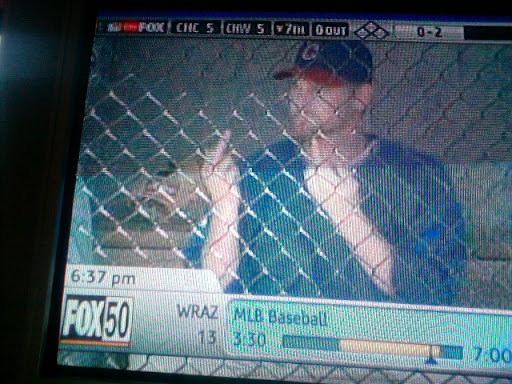
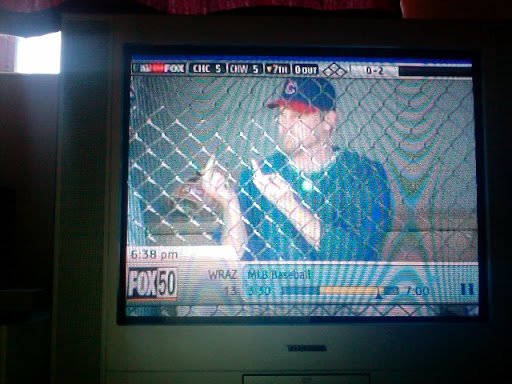
I was in the middle of watching the amazing pitching duel between Andy Pettitte and Johan Santana when Mother Nature decided to throw her own curveball. During the rain delay, Fox cut over to the equally close Cubs-White Sox game. It was the bottom of the seventh inning with nobody out, and an 0-2 count on Carlos Quentin. Thom Brennan was going over the strikeout numbers for Marmol as they panned to a shot of Kerry Wood. I had to rewind my DVR for a second look....


Kerry Wood is not at all pleased at something. He is clearly raising both middle fingers. Another look:


I guess not living up to your potential as one of the all time best starting pitchers is pretty anger inducing. But hey, you're the closer and your team has the best run differential in baseball to go with first place! What's there to be mad about?

Also, someone should definitely write an angry letter to Fox. Imagine all the children who have been corrupted by seeing two seconds Kerry Wood flipping off no one in particular during a baseball game? More than those who saw Janet Jackon's half-nipple, that's for sure!

Finally, just because: DOUBLEEE DEUUUUUUUUUUUUCE!

Thursday, June 26, 2008

Calendar Year All-Stars, Part II (AL)

Here is the continuation on the Calendar Year All-Stars, those players chosen for the All-Star game based not upon a small sample (the first few months) but on the larger sample of July 2007-present. Under discussion today: the outfielders and pitchers of the American League.

Outfield
Leading vote getters: Manny Ramirez (.291/.379/.516), Josh Hamilton (.310/.355/.572), Ichiro Suzuki (.285/.346/.365)
Runs Created Leaders: Grady Sizemore (59), Hamilton (59), Carlos Quentin (58)

Ichiro is clearly one of those Perennial All-Stars getting his votes bumped because of the rabid fan base in Japan, voting for him despite ranking 11th in the AL in Runs Created. Hamilton is an easy pick for most people because its the combination of MVP-type numbers and an amazing comeback story. Sizemore and Quentin are having good first halves, but how do they compare to the top outfielders since July 2007?

Manny Ramirez (.293/.380/.509, 568 PA)
Josh Hamilton (.315/.364/.584, 481 PA)
Ichiro Suzuki (.317/.365/.386, 758 PA)
Grady Sizemore (.269/.379/.483, 746 PA)
Carlos Quentin (.272/.376/.492, 372 PA)
Johnny Damon (.303/.374/.452, 663 PA)
Magglio Ordonez (.328/.397/.526, 683 PA)
Vladamir Guerrero (.307/.367/.517, 635 PA)
Nick Markakis (.304/.388/.502, 712 PA)

This is certainly one of the deepest positions. Despite the injury that cut short Hamilton's 2007, he still ranks up there among the best choices for the All-Star game. No one's slugging percentage is remotely close. Manny Being Manny is a solid choice as allways, but its tough to count out the performances of both Magglio Ordonez and Vladamir Guerrero. I think Mags has got to be in, and the tough decision between ManRam and Vlad will have to be left unto some sort of random number generator. Still, this is one of the votes that is closer to the Calendar Year All-Stars than the Small Sample All-Stars, although I'm certain both Sizemore and Quentin will be selected for the reserves.

All that said, let me throw out there one intriguing possibility:

Milton Bradley (.323/.437/.611) has the highest OPS of any American League regular over the past 365 days. He's currently the Rangers' DH and played in the NL last season, but he is listed on the roster as an outfielder. I think, despite the low number of plate appearances (442), he has to get some consideration over his teammate Hamilton. Just because one guy is a recovering coke addict who has found Jesus and the other one throws tantrums on the field shouldn't influence your vote (assuming your vote is based on statistics...).

Designated Hitter
Leading Vote Getter: David Ortiz (.252/.354/486, 37 RC)
Leading Runs Created: Milton Bradley (54), Hideki Matsui (47, .323/.404/.458)

We've dealt with Bradley already, and Matsui is leading DHs in 2008, with Ortiz having a down year and some inuries. Still, he has reached Derek Jeter territory in fan voting, and it would take a few seasons of absolute wretched hitting for the voters not to make him the starter. From the last year:

David Ortiz (.305/.414/.585, 609 PA)
Hideki Matsui (.302/.384/.486, 659 PA)
Aubrey Huff (.279/.352/.495, 633 PA)
Jim Thome (.257/.376/.536, 623 PA)

All right, it's not even close, it's Ortiz.

Pitchers
There is no vote for pitchers and I think its a shame. I don't think it would be too much to ask of MLB to come up with a list of their nine starting pitchers to be included on the roster, and then let the fans spend two weeks voting for the starter. It would be a large undertaking to try and fill the whole roster, so let's just try and figure out who should start the game based on the last years' statistics.

Strange times are afoot in the pitching ranks. With stalwarts like Roger Clemens, Randy Johnson, Curt Schilling, Johan Santana, and David Wells out of the league and even baseball, it's the young guns that have to fill the void. Of course, the two stats that carry the most weight for managers selecting the All-Star pitching staffs are ERA and Wins, and both statistics have their flaws. The Hardball Times tracks Pitching Runs Created, and here are the 2008 leaders:

Roy Halladay (57; 3.12 ERA)
Shaun Marcum (57; 2.65 ERA)
Cliff Lee (55; 2.45 ERA)
Felix Hernandez (53; 2.83 ERA)
Ervin Santana (51; 3.32 ERA)
Mariano Rivera (50; 0.76 ERA)
Zack Greinke (50; 3.40 ERA)

First of all, I want to note how incredible it is that a relief pitcher is in the top six pitchers in the AL; Rivera has been simply brilliant. That said, let's look at how some top pitchers have performed over the last 365 days. I'm going to have to use ERA because that's what's available, but walks and strikeouts also give a clue to dominance.

Halladay (33 starts, 249.1 IP, 3.21 ERA, 177 K, 49 BB)
Marcum (32 starts, 193.2 IP, 3.62 ERA, 146 K, 52 BB)
Lee (20 starts, 135.1 IP, 3.92 ERA, 108 K, 30 BB)
Hernandez (35 starts, 235.1 IP, 3.40 ERA, 190 K, 72 BB)
Santana (27 starts, 167.2 IP, 4.56 ERA, 155 K, 54 BB)
Greinke (23 starts, 166.2 IP, 3.03 ERA, 139 K, 51 BB)

And add in some of last year's best pitchers:

Sabathia (33 starts, 225 IP, 3.60 ERA, 208 K, 50 BB)
Beckett (30 starts, 203.2 IP, 3.58 ERA, 212 K, 39 BB)
Lackey (25 starts, 178.2 IP, 2.57 ERA, 142K, 34 BB)
Matsuzaka (29 starts, 171 IP, 4.26 ERA, 155 K, 86 BB)

And the pitchers who will get consideration to start the game because of their win totals:
Mussina (31 starts, 176.1 IP, 4.59 ERA, 100 K, 32 BB) 10 wins
Saunders (28 starts, 178 IP, 3.89 ERA, 104 K, 47 BB) 11 wins
Padilla (24 starts, 138.1 IP, 3.77 ERA, 92 K, 52 BB) 10 wins

That's a lot of different stat lines to consider. But let me ask: with the game on the line, would you rather have a pitcher from group A, group B, or group C? The choices have to be down to Halladay and Sabathia, with the Doc getting the nod based on his superior control.

Relief Pitcher

I've already made my choice quite clear. Over the past 365 days, here's a stat line for you:
73 games, 79 IP, 1.71 ERA, 87 K, 10 BB (and 42 saves)

Here's another to consider... Joba Chamberlain, who probably won't get any mention for the game due to his hybrid role the past calendar year, but:

44 games, 72.2 IP, 1.49 ERA, 90 K, 30 BB

I'd take both of those lines over any of the following:

Putz: 56 games, 57 IP, 2.84 ERA, 69 K, 24 BB
Papelbon: 67 games, 65.2 IP, 2.06 ERA, 92 K, 11 BB
Nathan: 69 games, 72 IP, 1.38 ERA, 77 K, 16 BB
Street: 62 games, 66.1 IP, 3.66 ERA, 80 K, 15 BB

Sure, Papelbon has more strikeouts and Nathan has a lower ERA. But neither of them is the Sandman.

Matt's AL All-Stars:
C Joe Mauer
1B Kevin Youkilis
2B Ian Kinsler
3B Alex Rodriguez
SS Derek Jeter
OF Milton Bradley
OF Josh Hamilton
OF Magglio Ordonez
SP Roy Halladay
CL Mariano Rivera

Friday, June 20, 2008

Calendar Year All-Stars, AL (Part 1)

Every year, the Mid-Summer classic rolls along and writers/bloggers everywhere try to convince the world that the game is irrelevant. Still, the event gets decent ratings for a week-night exhibition game, and the voting methods are arbitrary enough that they always cause debate. This is particularly true in an age where online voting exists, as fans from extremely popular teams don't need to pick up ballots at the ballpark. The result, most recently, is that the starting players are usually dominated by Yankees, Red Sox, Dodgers, and Mets; additionally the occasional popular foreign import, such as Ichiro, galvanizes support from his home country.

While it is definitely true that the All-Star game needs to be mid-season in order to avoid irrelevance (i.e. The Pro Bowl), this has some unfortunate disadvantages. One of these problems is that players are typically judged on two criteria:

(1) Perrenial All-Stars, who continue make the team long after they are truly the best at their position, or;
(2) Small Sample All-Stars, who have an amazing first half of the season only to return to average.

So while there is some prestige behind post-season awards such as the Silver Slugger and Rolaids Relief-Man, far more performance bonuses are tied to having hot starts and making the All-Star team. Still, I wonder what we would find if we searched the past year's worth of stats (spanning the second half of 2007 and the first half of 2008) for each player. Who would be the most deserving all-stars then? I will be consulting the current votes leaders from this article, as well as the leaders in THT's Runs Created statistics. Baseball-reference.com will be the source of stats from the last 365 days for each player.

Catcher
Current Vote Leader- Jason Varitek (2008- .240/.320/.408, 7 HR in 196 AB; 20 RC)
Base Runs Leader- Joe Mauer (42; 2008- .335/.420/.441, 2 HR in 236 AB)

Varitek is obviously a Perennial All-Star choice, spurred on by the rabid Boston fanbase intent on having as many Red Sox as possible start the game in Yankee Stadium. Being the tenth best catcher in Runs Created, in the AL, is tantamount to saying he's the least productive regular player in baseball. The past 365 days he's had a .244/.353/.408 line, just as bad as his season to date. Mauer, unsurprisingly, leads AL catchers in runs created, but his full 365-day line is (.307/.394/.429). Still good, but I think we may be able to find some better catchers.

Mauer (.307/.394/.429, 580 PA)
J. Posada (.329/.435/.521, 444 PA)
A.J. Pierzynski (.288/.332/.417)
G. Laird (.247/.297/.381)
V. Martinez (.283/.357/.426)

Martinez and Posada were 1 and 2 in Runs Created among catchers last year. Posada has missed a bunch of games this season, which explains his lagging in the voting, but he has hit like a monster since his return on June 5. Martinez, meanwhile, has struggled this season, with an OPS+ of 79. Posada's numbers are clearly better than Mauer's, but Mauer has had 136 more plate appearances. It's a tossup here, but I'll have to give it to Mauer since his contribution is likely more valuable.

First Base
Current Vote Leader: Kevin Youkilis (2008: .305/.376/.530; RC 49)
Runs Created Leader: Justin Morneau (54; 2008: .306/.366/.489)

This is a deep position full of solid hitters. Youkilis and Morneau are certainly deserving candidates, but let's take a look at the past 365 days:

K. Youkilis: .273/.371/.461, 606 PA
J. Morneau: .284/.349/.461, 680 PA
J. Giambi: .238/.370/.523, 370 PA
P. Konerko: .248/.345/.471, 629 PA
C. Pena: .251/.384/.538, 646 PA

Here's a great example of why the 365-day approach awards players who would not normally be recognized. Sure, Carlos Pena isn't having a good season this year, made worse by his broken index finger that will keep him on the DL for a while. However, he was not selected to the 2007 All-Star game despite a .287/.395/.609 line at the break. He was even better in the second half of 2007. His OBP and SLG are better than both Youkilis and Morneau over a similar number of at bats. He also has more HR and RBI than either of them over that stretch. Voting an injured player into the All-Star game already happens regularly, so this would be no different.

Second Base:
Current Vote Leader: Dusty Pedroia (.274/.322/.398; 34 RC)
Runs Created Leader: Ian Kinsler (58; .308/.361/.490)

Another Red Sox player leading the popular vote, another terrible choice. Just going on this years' stats, Pedroia is seventh among AL second basemen. There are actually a lot of good choices, and so voting in Pedroia is going to mean a snub for one of the actually productive AL keystoners. The last 365 days:

D. Pedroia: .296/.347/.420 (705 PA)
I. Kinsler: .298/.373/.465 (634 PA)
B. Roberts: .280/.364/.458 (718 PA)
P. Polanco: .332/.385/.455 (623 PA)
R. Cano: .288/.337/.451 (677 PA)

As you can see, it's not hard to find an AL second baseman more valuable than Pedroia. Roberts has been either the first or second man in Runs Created at 2B for several years now. If Robinson Cano played for any other team, his Perennial All-Star possibility would be nil, and if he continued his terrible first half/amazing second half routine, he might never play in another All-Star game. Obviously at Immaculate Inning we have sort of a soft spot for Ian Kinsler. I mentioned last year in a similar post that if I were voting in May the clear choice would have been Kinsler, so I pick Kinsler in the toss-up this time around.

Third Base:
Vote Leader: Alex Rodriguez (.335/.414/.629; 42 RC)
Runs Created Leader: Casey Blake (44; .263/.339/.433)

I have no idea how Blake leads the AL third baseman, but A-Rod is not far behind despite missing a month with a quad strain. That demonstrates how feeble the position is after A-Rod, and so this is really an easy exercise. Miguel Cabrera makes things interesting with his .297/.380/.503 line the past 365 days, but A-Rod blows it away with .321/.423/.616. Cabrera would be more competitive among first basemen (the position he's been playing this year), but he's listed at third on the ballot.

Shortstop

Vote Leader: Derek Jeter (.276/.333/.381, 37 RC)
Runs Created Leader: Jeter and Michael Young (.281/.337/.407)

The vote has Perennial All-Star written all over it, especially for someone who's been watching Jeter ground out feebly all season. Still, this is a contest where you perform well by out-doing your peers, and Jeter and Young are neck and neck in terms of offensive production this season. Orlando Caberera is on their heels with 36 RC, followed by Bobby Crosby at 32. Using the past 365 days:

D. Jeter (.295/.353/.412, 697 PA)
M. Young (.314/.369/.418, 708 PA)
O. Cabera (.271/.321/.364, 715 PA)
B. Crosby (.242/.294/.358, 415 PA)

Remember when the decision was three, four, or sometimes five players deep all with great stats? Well now it's down to Jeter and Young, who both have slightly-above-average stats. Young is the better defender, Jeter is the better baserunner. They've both hit 11 homers over the past 365 days. Well, since I went with Mauer over Posada, I have some homer-karma available, so I'll go with Jeter over Young.

Next time, I'll go through the outfielders and the surprising pitching staff. Until then, go to mlb.com to cast your ballot, but please... only one Red Sox infielder (Youk). Please.

Wednesday, June 18, 2008

Immaculate, Twice in a Month!

The chisel marks have barely cooled on the Immaculte Inning rock when suddenly, Felix Hernandez etches his name into baseball immortality. Last night, the Seattle Mariners pitcher struck out the side in the fourth inning against the Florida Marlins, becoming the 13th American League pitcher to throw an Immaculate Inning. The feat came in a particular string of dominance for Hernandez, who ended up striking out six straight from the third to the fifth inning. The victims:

Jeremy Hermida
Pitch 1: Fastball (89 mph) down and inside corner, called strike
Pitch 2: Splitter (88 mph) down and inside corner, called strike
Pitch 3: Curveball (85 mph) outside corner, swinging strike

Jorge Cantu
Pitch 4: Fastball (97 mph) belt high over the plate, called strike
Pitch 5: Fastball (97 mph) belt high over the plate, swinging strike
Pitch 6: Fastball (96 mph) chest high and inside, foul tip caught by catcher

Mike Jacobs
Pitch 7: Curveball (84 mph) belt high, outside corner, called strike
Pitch 8: Fastball (96 mph) thigh high, way outside, swinging strike
Pitch 9: Slider (88 mph) thigh high, inside corner, called strike

Hernandez is just the third pitcher to throw an immaculate inning during interleague play, matching the Padres' Brian Lawrence who threw one against the Orioles in 2002 and Rick Helling's effort for the Brewers against the Tigers in 2006. The Florida-Sun Sentinel has the story, including this quote fom Jacobs:

"After facing him, it's not surprising he can do that. He did a good job filling the strike zone up with everything he had. He pitched everybody different every at-bat. He's pretty nasty. He's one of the better [ones] I've ever seen."
This AP story has more:


Portraying his youth, Hernandez was ambivalent to his accomplishments.


"I was just trying to throw strikes. That's all,'' Hernandez said. "I didn't know it was a nine (pitches), but it felt good.''


Despite the dominant start to the game, striking out nine and at one point retiring 11 straight hitters, Hernandez struggled to keep the Mariners in the lead. In the sixth inning he gave up three runs (two earned) and left the game in the eighth inning with a respectable pitching line, but nothing like it was shaping up to be in the fateful fourth. So in this one game we have a microcosm of Hernandez's career: at times, absolutely brilliant, and worthy of a "King." At other times, he flounders and winds up with a performance that's simply above average.

After a rookie season that stunned the American league, Hernandez struggled in 2006, putting up an ERA+ of just 98. A simply above average season followed in 2007, an ERA+ of 110 and only 165 strikeouts in 190 innings, a career low for him. This season is off to a great start, however. Amid talks of a long-term contract from the Mariners, he's got an ERA of 2.87 (139 ERA+) in 103 innings, striking out 91. He's got his coaches finally calling him an "ace" again. Whatever his title, today, he is Immaculate.

Sunday, June 08, 2008

Rich Harden: Immaculate!

The Immacualte Inning Blog rises from its ashes to celebrate Rich Harden's Immaculate Inning, thrown today in a game against the Anaheim Angels. The oft-injured Oakland starter gunned down the first three hitters of the game in the following fashion:

Maicer Izturis
Pitch 1: Fastball away (91 mph)- called strike
Pitch 2: Changeup away (86 mph)- foul
Pitch 3: Fastball away (96 mph)- foul tip caught

Howie Kendrick
Pitch 4: Slider low and away (85 mph)- swinging strike
Pitch 5: Fastball away (93 mph)- foul
Pitch 6: Slider in the dirt (87 mph)- swinging strike

Garret Anderson
Pitch 7: Fastball away (93 mph)- called strike
Pitch 8: Fastball away (95 mph)- called strike
Pitch 9: Slider down and in (88 mph)- swinging strike


Our records indicate that this is the 41st Immaculate Inning in baseball history, and Harden is the 39th pitcher to accomplish the feat, and the first since Buddy Carlyle last year. He joins Sandy Koufax, Pedro Martinez, and Rick Helling as the only pitchers to throw immaculate innings to start the game. Harden would go on to finish with nine strikeouts in six innings, but would have to watch from the clubhouse as his teammates took 12 innings to beat the Angels today. Harden now has an astounding 58 strikeouts, good for 15th in the AL despite missing a month with an injury. He's done it in just 47.1 innings, good for a ratio of 11.02 K/9 IP, which ranks first in the majors among pitchers with at least 40 IP.

Jane Lee of mlb.com describes the situation:

Before that frame, Harden had kept things quiet on the mound -- except for a first-inning performance that had everyone in the Coliseum talking.

The 26-year-old pitcher began the game striking out the side on nine pitches, becoming the first A's player to do so since Lefty Grove did it in 1928.

"I don't think I had ever seen that before," Geren said.

But for Harden, it was "just three outs."


Apparently Harden was more concerned with getting yet another no-decision on the season (his fifth in eight starts). Still, congratulations to Rich Harden, we at Immaculate Inning couldn't help but mark your achievement, even if we're slightly mad at you that you don't go with the nickname "Dick." Your continued health could turn the A's into a juggernaut in the AL West, provided Billy Beane doesn't trade you for ten prospects this July.

In closing, we of course have to give you one of these. Savor it, let it melt in your mouth. You deserve it.

Tuesday, October 02, 2007

Former Marlin-based Playoff Predictions

The concept of Former Marlin Power was born after the 1997 post-World Series fire sale that was instigated by Wayne Huizenga for the purpose of slashing payroll and making the team easier to eventually sell. Several good players were on this team and in the following seasons many of them went on to put up impressive numbers. As a fan it was sickening to watch players such as Moises Alou and Gary Sheffield go on to have great success elsewhere while we were stuck holding the fractured pieces of a once great team. Players such as Craig Counsell later went on to help other teams win World Series. Former Marlins became a stable fixture on any successful team.
In last night's one game playoff, it only appeared that putting in Julio Jorge, Former Marlin, was a terrible idea. In reality, the Rockies were pressing their Former Marlin(FM) advantage. The only FM the Padres had was Trevor Hoffman, while the Rockies had already played FM Matt Herges. Trevor Hoffman's Former Marlins Power wasn't enough to overcome the FM power of Herges and Julio, so the Padres fell to the Rockies.
Before I break down the week 1 games, lets go through some scientifically calculated measurements.

Any player who has been on the field as a Marlin for a single play has at least a FM power of 1. This covers everyone from Mike Piazza to Kevin Millar.

Any FM who played in the post-season for a World Series winning team gets a 50% bonus to their FM power, 75% if they were the World Series MVP.

Players who have been former Marlins twice also get a 50% bonus.

Players who were Original Marlins get a 50% bonus. I believe that's just Conine and Hoffman at this point.

Angels versus the Red Sox

Angels FM Power: 1
Darren Oliver 1 (2004 2-3 6.44 ERA)

Red Sox FM Power: 3.25
Josh Beckett 1.75 (2003 WS MVP)
Mike Lowell 1.5 (2003 WS)


As you can see, the Angels don't have much of a chance. Note that although the Sox only have 2 Former Marlins, they get the most out of what they have. If things look dicey though, they're going to really miss Alex Gonzales.


Yankees versus Indians

Yankee FM Power: 1
Ron Villone 1 (2005 3-2 6.85 ERA)

Indians FM Power: 1
Joe Borowski 1 (2006 36 Saves)

This should be a very good series with the FM Power tied. I'm calling the Yankees due to unofficial extra Marlin power from having Carl Pavano on their DL as well as having Al Leiter on the payroll as a broadcaster on YES. Neither go toward the official count, but Pavano gets the WS bonus from 2003 and Leiter is both a 2-time FM and gets the WS bonus from 1997. With FM power this tight, any advantage can tip it. Also of note, this is the We Hate the Marlins Series. The Indians lost to the Marlins in the 1997 World Series and the Yankees were the victims in 2003.

Rockies versus Phillies

Rockies FM power: 2
Matt Herges 1 (2006 2-3 4.31 ERA)
Jorge Julio 1 (2007 0-2 12.54 ERA) (the fact that he has a job is proof that I'm not the only one who believes in FM power)

Phillies FM power: 3.25
Antonio Alfonseca 2.25 (1997 WS, 2-time Marlin)
Wes Helms 1 (2006)

Cubs versus Diamondbacks

Cubs FM Power: 4
Ryan Dempster 1
Derrek Lee 1.5 (2003 WS)
Cliff Floyd 1.5 (1997 WS)

Diamondbacks FM Power: 1.75
Livan Hernandez 1.75 (1997 WS MVP)


Cubs take this one in a sweep.

Monday, August 27, 2007

Cookie of the Indeterminate Time Period


Last Saturday, 44-year-old Randy Couture absolutely dominated the bigger 28-year-old Gabriel Gonzaga in a fight that ended in the third round with a TKO. In doing so, he kept his UFC Heavyweight belt. Here's a man who has always been the underdog since he made his comeback, and yet still manages to out train, out maneuver, and out fight Tim Sylvia and Gonzaga.
Gonzaga was supposed to be a terrible match up for Couture. Couture is a very good wrestler who fights well in the clinch. Gonzaga is both a good striker and a good wrestler, as well as being 16 years younger. Despite this, Couture made Gonzaga fight his fight and controlled the pace from the very first second.
Now, this is all pretty badass, and this alone would certainly be worth a cookie, but there's more. What could possibly make him more awesome? How about winning the fight with a broken left arm.
Enjoy your victory while your arm heals Randy. We here at the Immaculate Inning look forward to watching you fight again, and Dana White willing, perhaps even some day fighting the consensus Baddest Man on the Planet, Fedor Emelianenko.

Tuesday, August 21, 2007

Jeff Conine, Met for now, Marlin forever

Jeff Conine was traded to the Marlins' NL-East rival the Mets the other day. With all the former Marlins there it is in Conine's own words, "the Marlins North." Fish Chunks spells the situation out pretty well. I've always been a big believer in Former Marlin Power, and apparently the Mets are too.

It is always sad to see Conine go to a non-Marlin team, because he is the closest thing the Marlins have to an iconic player. He started in the Marlins very first game against the Dodgers and went 4-4 in the win, earning the title Mr. Marlin. (also note that future Former Marlin Mike Piazza was playing for the Dodgers).

He played Left Field when Al Leiter threw the first No Hitter in Marlins' history.

He played First Base when Kevin Brown threw his No Hitter.

He was a member of the 1997 Florida Marlins, the first Wild Card team to ever win the World Series.

During the Marlins 2003 season, they randomly had Jeff Conine bobblehead night...even though he wasn't actually on the team yet. When Mike Lowell got hurt though during the playoff chase, the Marlins ownership manned up and got Conine to help the team out (also, they called up a couple guys named Dontrelle Willis and Miguel Cabrera).

Although his regular season numbers with the Marlins that season aren't particularly great, he had some huge hits against the Phillies which helped the Fish beat them out for the Wild Card spot. At the time, it seemed like he was single-handedly taking a bat to their playoff hopes. In the playoffs he hit .267 in the NLDS, .458 in the NLCS, and .333 in the World Series.

In the Marlins untarnished playoff series record, he's appeared in all but one game(Game 4 of the 1997 WS). For a team like the Marlins where you're forced to watch your team get taken apart over and over again, he is the closest thing to consistency.

Wednesday, August 08, 2007

Glavine: Not Shot After All

In the summer of 2003, I had my experience in an Office Space type job, making copies and filing mail 8 hours a day and a 1 hour commute each way. Not knowing anyone else in the company, I usually ate lunch in my car, listening to Mike and the Mad Dog on WFAN. In the days before the explosion of blogs and other internet commentary, this was the pinnacle of interactive New York sports. Their call-in show was one of the firsts of its kind, and balanced the calm bass voice of Mike Francessa with the crazy, octave-too-high hot-head of Chris "Mad Dog" Russo. This was not always the case, particularly during the summer when one or the other would go on vacation, leaving his partner with four hours a day to fill.

July 20, 2003 was one of those days. The previous day, Mets' starter Tom Glavine threw a stinker against the division leading Braves- he went just 4.1 innings, giving up 7 earned runs on 9 hits. The loss dropped the Mets to fifth place, 24 games behind the Braves. Russo, on his own with Francessa on vacation, decided to make it the "Bash Tom Glavine Show."

"Glavine is shot! He's 37, he's 6 and 10, he's got a 5.10 ERA-- he's just shot! The Mets are going nowhere until they get rid of him! He's shot!"


It went on and on like that until the end of my lunch break. Three hours later, as I drove home, Russo was still going strong with the Glavine bashing.

Tom, however, was not fazed. He went 3-1 with a 1.95 ERA in August of 2003, and finished the season having dropped his ERA to 4.52. He followed this with the following seasons:

2004: 119 ERA+
2005: 118 ERA+
2006: 113 ERA+

While Glavine has been pretty average (96 ERA+) in 2007, he's now 41 years old and certainly nearing the end of his career. And on Sunday, Glavine joined a pretty exclusive group and won his 300th career game. While we at Immaculate Inning realize the relative unimportance of wins as a measurement of a pitchers' worth, we also realize that this is a milestone to be proud of, especially when blowhards like Russo are proved wrong. So have a cookie, Tom, a Publix cookie.

One final note, about 300 wins- lots of announcers have been pontificating again, much as with the "cheapened" 500 HR plateau. They say that 300 wins will never be touched again, as Randy Johnson (284 wins) is old and Mike Mussina (246 wins) is just too far away. They say that with the rise of relief specialists and the five-man rotation, that no one will make it again. Yet Glavine (and Johnson, and Roger Clemens, and Greg Maddux) pitched their entire careers in an era where the 5-man rotation was dominant. Glavine and Maddux may have been aided by a few years with the braves when they, John Smoltz, and Denny Neagle had a de facto 4-man rotation. However, with the many young pitchers entering the game in their early 20s, is it so hard to imagine that someone could put up 15 wins for 20 seasons? Or even 18 wins for 17 seasons?

So it's interesting to me that, for some reason, the mainstream media sees five 500 HR hitters in four years and calls the plateau "cheapened." But three hurlers passing 300 wins in the same period means that it will never happen again? God forbid we use the passing of milestones to celebrate the careers of those who pass them. No, we should discuss existential properties of the milestones, instead. In other news, I am proud to have not listened to Mike and the Mad Dog since I left the NYC area.


Powered by ScribeFire.

Tuesday, August 07, 2007

756, meh

It shouldn't be like this, not for the most important record in all of sports. I shouldn't be watching Bonds hit his 756th career homerun with my eyes half-rolled. The record is too important to be shadowed by suspicion. I remember watching Cal Ripken Jr. play his 2,131st game with my father. My dad is a huge Lou Gehrig fan but he was happy to see someone break a record that seemed unbreakable. I remember getting goosebumps when they changed the giant sign they had mounted on the brick wall from 2,130 to 2,131. It was a record that every baseball fan could celebrate.

The same thing happened when McGwire broke Roger Maris's record of 61 HR in a season. Yes, it turned out we were all naive about the whole steroid thing, but it was a great moment at the time. Supposedly, it was this homerun chase which pushed Bonds into steroids. You can argue the chemistry, philosophy, whatever, but he basically changed his body type chemically. Scroll down to the picture at the bottom of this article, it's such an unnatural change that it's grotesque.

I really don't see what he gained and I don't think he's fully grasped, or cared about what he lost. Nobody would argue that Bonds isn't a great hitter, regardless of chemicals. It's possible he would've hit in the mid to late 600's through natural ability. Even if he only hit in the mid-500's he'd still be considered one of the greatest hitters ever. He was never a particularly loved athlete, but he could've been like Rogers Hornsby or Ty Cobb. A complete asshole, but respected as a baseball player.

I wouldn't wish harm on anyone, but it would've been interesting if the luck of Ken Griffey Jr. and Barry Bonds were swapped, and that in a couple years all of baseball would stand up and cheer as Griffey hit 756. I hope Bonds decides to quit while he's ahead after this season, and that in 7 or 8 years from now we can watch A-Rod seize the career homerun record from controversy and return it to its proper place in baseball lore.

Saturday, August 04, 2007

It begins again

The intensity of the NFL season builds throughout the regular season, becomes white hot in the playoffs, and peaks with the Super Bowl. However, the Monday after Super Bowl Sunday begins a period of emptiness.

In most sports the season ends at different times for different people. Typically in baseball, Kansas City's fans stop caring about the season well before the season ends for Yankee fans. In football, everyone watches the championship game, as opposed to sports such as baseball and basketball where only the fans of the teams involved and a percentage of casual fans watch. Columnists talk about certain World Series match-ups being good for ratings. Nobody worries about the Super Bowl ratings being low because it involves small market teams.

In football, the season ends the same day for everyone. Once the playoffs are over, the long drought begins. Sure, there's the Pro Bowl, but nobody cares about that. Within a few months though, signs of the dawn of the new season begin to appear. Teams start talking to free agents. Players are drafted. Draft picks start signing(or don't). Mini-camps begin. Training camp begins. All these events happen at the back of the collective sports consciousness, but one event is the trumpet call that signals the football drought is almost over, today's Hall of Fame Induction.

Tomorrow is the Hall of Fame Game. The New Orleans Saints play the Pittsburgh Steelers on a high school field in Canton Ohio. Sure, the starters might only play a quarter, but this signals the beginning of preseason, and therefore the beginning of Football Season. Sundays begin their transition from the least important day of the week to Gameday.

Next week, all the other teams(including the Unstoppable Miami Dolphins) play their first preseason game. Early favorite teams and players will emerge. Starters will start to play more and more of the games, and soon enough it'll be September 6th and the regular season will begin once more.

Football season is here.

Wednesday, August 01, 2007

Waiting to Bash

"They were taking pictures of the wrong guy," said Alex Rodriguez, when asked about all the flashbulbs in Yankee Stadium on July 31, 2007. A-Rod's light sense of humor about the issue suggested he wasn't "pressing," while waiting for his 500th career home run. This even in the light of how seven of his teammates tied a franchise record, hitting 8 homers in one game against the White Sox. So, using the immutable power of the Baseball-reference.com play index, let's find out how long sluggers have "pressed" to get from #499 to #500 (since 1958, anyway). From the top:

Henry Aaron: 4 games, between 7/7 and 7/14/68 (there was an All-Star Break in there)
Barry Bonds: 1 game, between 4/17 and 4/18/01 (on his way to 70)
Babe Ruth: unknown via b-r.com, I'll try to look it up elsewhere. Suffice to say there was no pressure, as no one had even hit 200 before Ruth.
Willie Mays: 1 game, between 9/12 and 9/13/65
Sammy Sosa: 4 games, between 9/29/02 and 4/4/03
Ken Griffey, Jr: 7 games, between 6/13/04 and 6/20/04 (he would get injured two weeks later and not have another homer for almost a year... what might have been...)
Frank Robinson: 0 games, hit two on 9/13/71
Mark McGwire: 1 game, 8/4 to 8/5/99 (but we're not here to talk about the past)
Harmon Killebrew: 26 games between 7/25 and 8/10/71
Rafael Palmeiro: 3 games between 5/8 and 5/11/03 (The only member of the 500 club proven to have used PEDs).
Reggie Jackson: 2 games between 9/15 and 9/17/84 (The first 500th home run of my lifetime. I remember it well.)
Mike Schmidt: 1 game, between 4/17 and 4/18/87 (BOOOOOOOOO!)
Mickey Mantle: 9 games, between 5/3 and 5/14/67
Jimmy Foxx: unknown
Willie McCovey: 3 games between 6/27 and 6/30/78
Ted Williams: 1 game between 6/16 and 6/17/60
Ernie Banks: 3 games between 5/9 and 5/12/70
Eddie Mathews: 3 games between 7/8 and 7/14/67
Mel Ott: unknown, all homers before 1958
Eddie Murray: 6 games between 8/30 and 9/6/96
Frank Thomas: 4 games between 6/24 and 6/28/07

It would be fair to say that Killebrew didn't have to face 24 hour sports coverage and live look-ins, and perhaps the "pressure" of hitting #500 would not be as grand as those that came in the last 15 years or so. That would mean that in the ESPN era, only Junior Griffey has gone more games than A-Rod between #499 and #500. This makes a bit of sense, as A-Rod seems to hit homers best when he's not "trying" to- like #499, which came on an opposite-field shot in a situation when A-Rod was clearly just trying to poke a single for a game-tying hit. Hopefully A-Rod hits the big one soon, because the Yankees will need a comfortable, non-pressing cleanup hitter as they move closer to the post-season.

The other interesting thing I noticed in doing this was the frequency of players joining the 500 Homer Club. Mantle and Matthews hit their 500th in the same season, and Aaron's was a year later. In the next three years, three other players joined- Banks, Robinson, and Killebrew. I find this interesting in light of all the articles calling 500 homers "not all that impressive" anymore. After A-Rod's 500th, the four year period beginning with Sosa in 2003 will include the same number of club inductees as the 1967-71 period.

I wonder if, as Killebrew neared the mark, sportswriters noted the sudden surge in the number of players with 500 hits and thought that it "cheapened" the milestone. Then again, in a world without specially marked baseballs, live look-ins, and announcers completely overdoing their calls of deep fly balls (see: Kay, Michael and Sterling, John), how would fans even know that homer #500 is momentous?

Meanwhile, as I write this, Robinson Cano and Shelley Duncan both homered for the Yankees. Maybe they'll reach #500 first...


Powered by ScribeFire.